
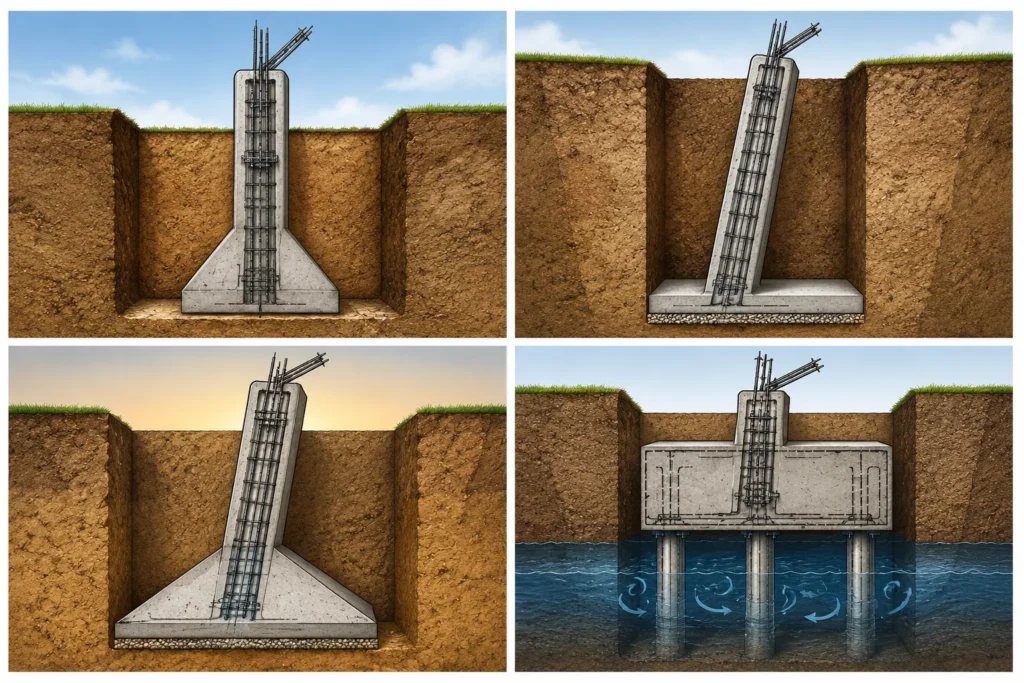
Type of foundations for transmission line tower widely varies in practice, depending upon the soil parameters, structural elements of the transmission tower that transfers the tower loading to the ground to ensure the stability of the structure. The foundation of transmission tower is specially designed to resist the compression, uplift in transmission tower, overturning and lateral forces caused by the tension in the conductors, wind load and ice loads, broken wire conditions etc. No single type of foundation works best for all transmission tower because of varied soil parameter, site condition and loading requirements.
Table of Contents
Type of foundations
Based on the structural arrangement of the foundation, various type of foundations are possible. The necessity of erecting the transmission towers on variety of soil has made possible the adoption of new design and innovations. This resulted in the devising of new type of foundation for transmission towers and are discussed below:
PCC type of foundation
It is a type of foundation (gravity) constructed using plain cement concrete with no reinforcement. This type of foundation resists the tower loading primarily through it’s self weight and weight of surrounding soil. It is among the most simplest type of foundation used for suspension and small angle transmission towers. It consists of a PCC pad and chimney with or without reinforcement.
The stub is taken inside the bottom pad and effectively anchored to it by cleat angles or keying rods. The chimney with the stub inside works as a composite member. The pad of the foundation can be of pyramid shape, requiring more form work or stepped, requiring less shuttering material but more attention to avoid cold joints between steps.
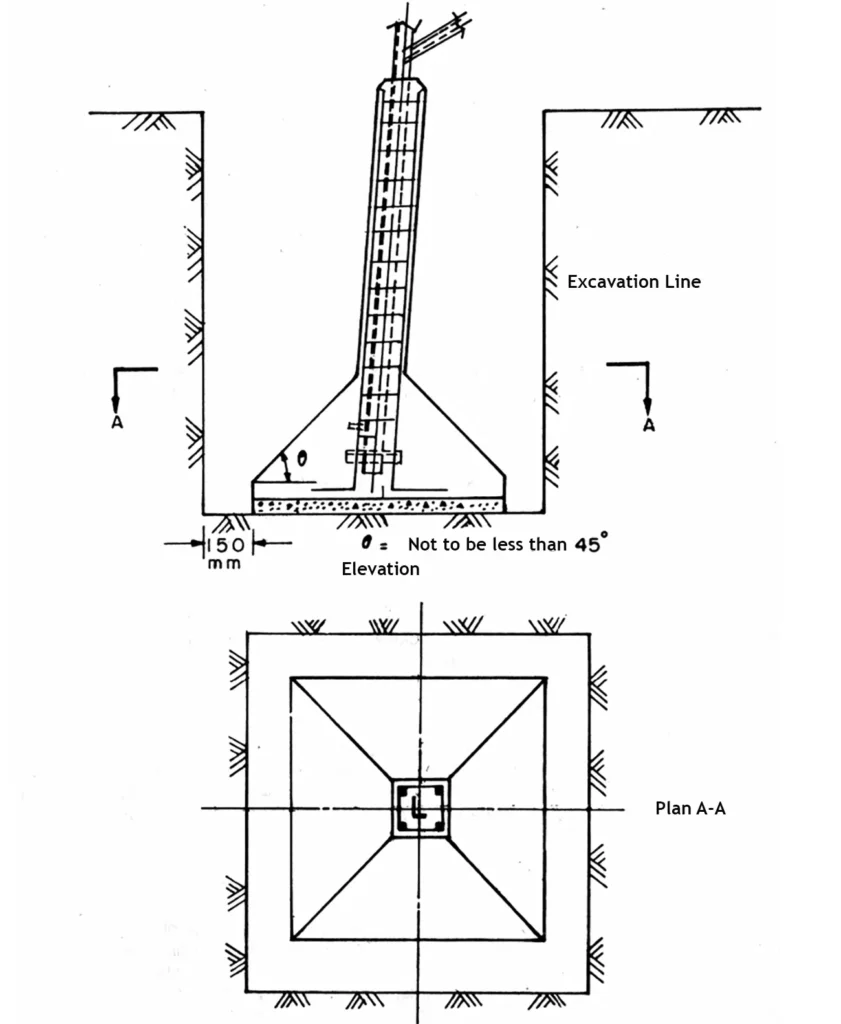
This type of foundation is used where the soil condition is good with excellent bearing capacity, level terrain, low ground water level and low to moderate voltage level. This type of foundation requires more concrete volume than RCC type and is not suitable where uplift force is high.
RCC spread type of foundation
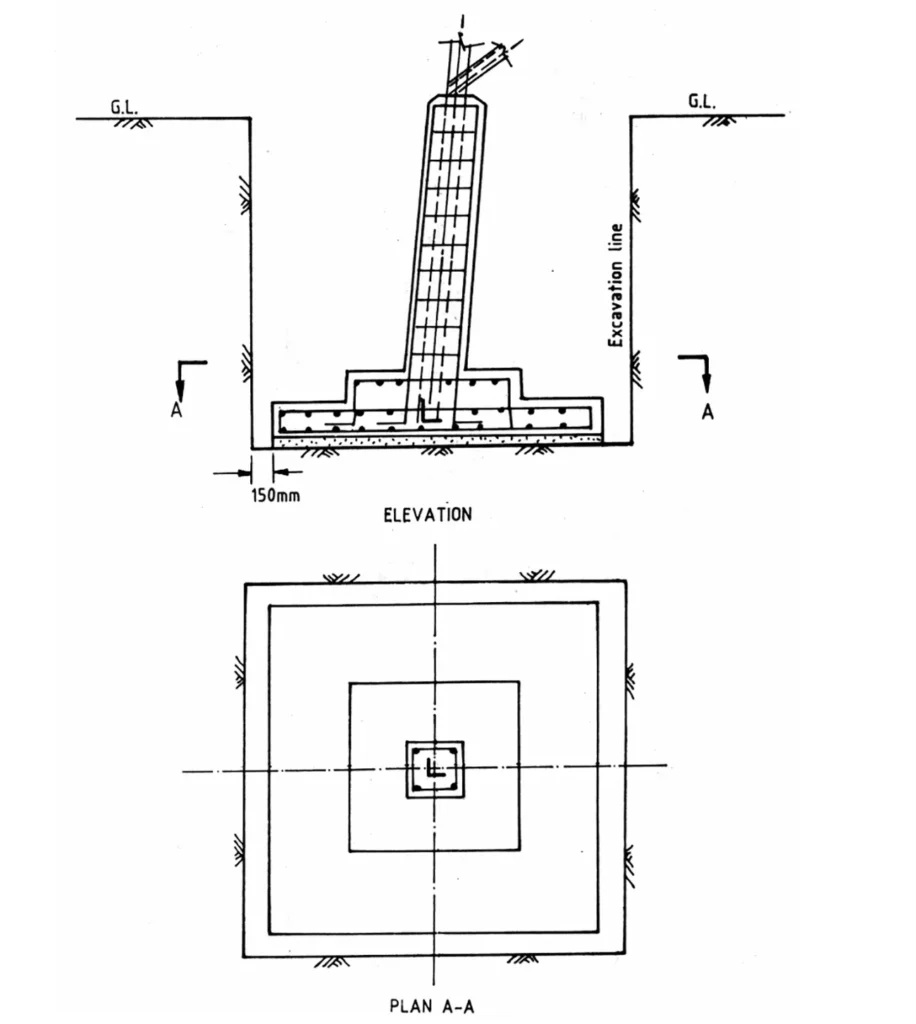
It uses reinforced concrete footing designed to distribute the tower load over a larger soil area. This type of foundations are widely in application for moderate to high voltages angle, dead end towers, where uplift and overturning forces are high. The RCC spread foundation are preferred where soil condition are moderate with high loads on the foundation, where pyramid shaped footing is not feasible from techno-economical consideration. In some cases, the RCC type foundations can be high in cost but it is structurally more stable and safer compared to PCC.
Block type of foundation
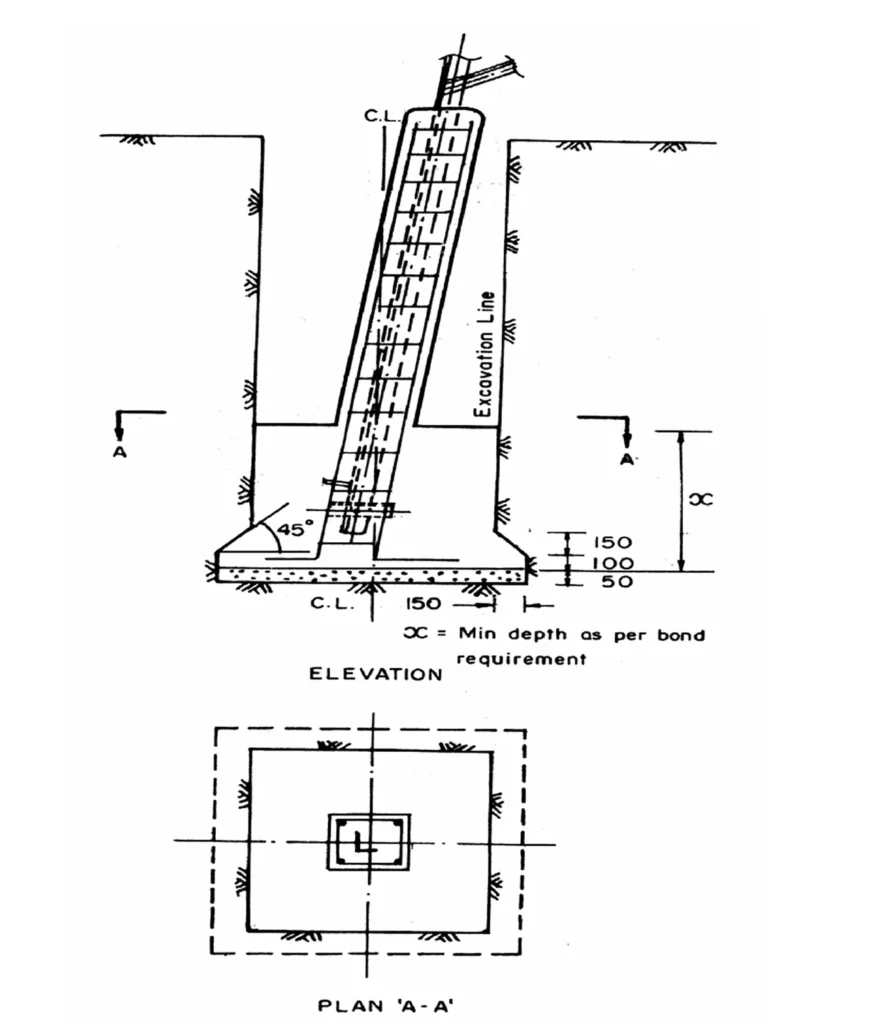
It is commonly used where soft rock or hard rock strata is found near the ground surface. This type of foundation consists of a block and a chimney cast directly in the excavated rock. The uplift resistance is developed through the bond between the concrete and the rock and the size of the footing is determined by the uplift force and the bearing area requirement for the downward thrust. The minimum depth of the foundation is advised to be 1.5 m below the ground level.
Under cut foundation
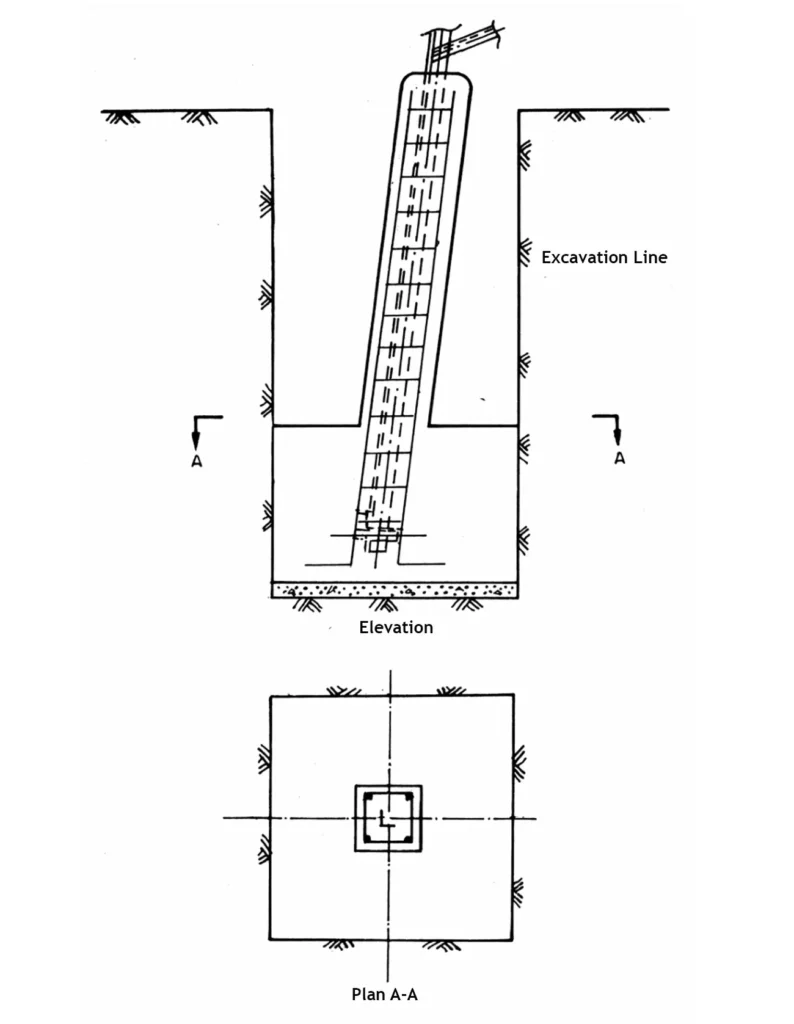
This type of foundation is used for normal dry cohesive soil, hard murrum, fissured or soft rock and clinker mixed soil, which is not collapsible. An undercut is formed below the footing which anchors it in the undistributed soil, providing higher uplift resistance compared to conventional foundation and thus improving the stability.
Grouted rock and rock anchor foundation
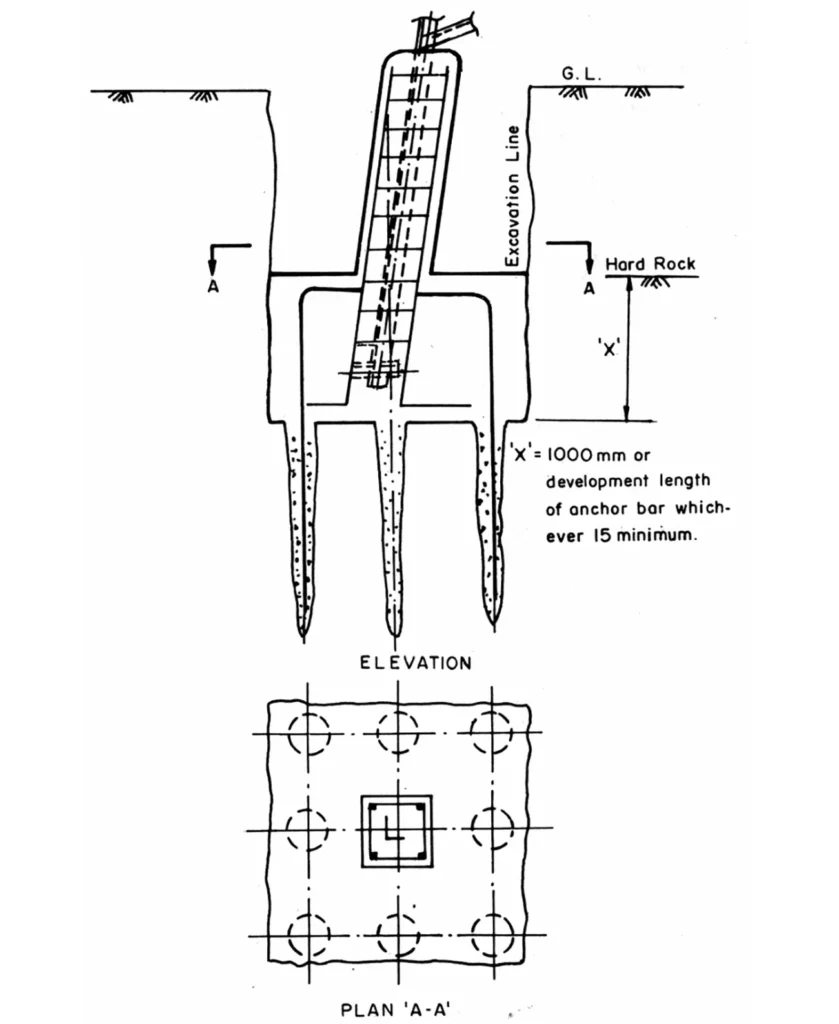
This is used in very hard rock formations where conventional foundation are impractical. It consists of a shallow concrete block which is connected to steel anchor bars, grouted into drilled rock holes. The depth of the block, diameter and number of anchor bars depends upon the uplift force on the footing. The diameters of the anchor bars are usually not less than 12 mm and the grouting holes are usually 20 mm more than the diameter of the anchor bars.
Since the bearing capacity of such rocks is usually higher, uplift resistance must be carefully designed. The surface of the rock may be roughened, grooved or shaped to increase the uplift capacity. The anchor strength can be substantially increased by provision of mechanical anchorage such as eye bolt, fox bolt, threaded rods or used of keying rods in case of stub anchoring.
Augur type foundation
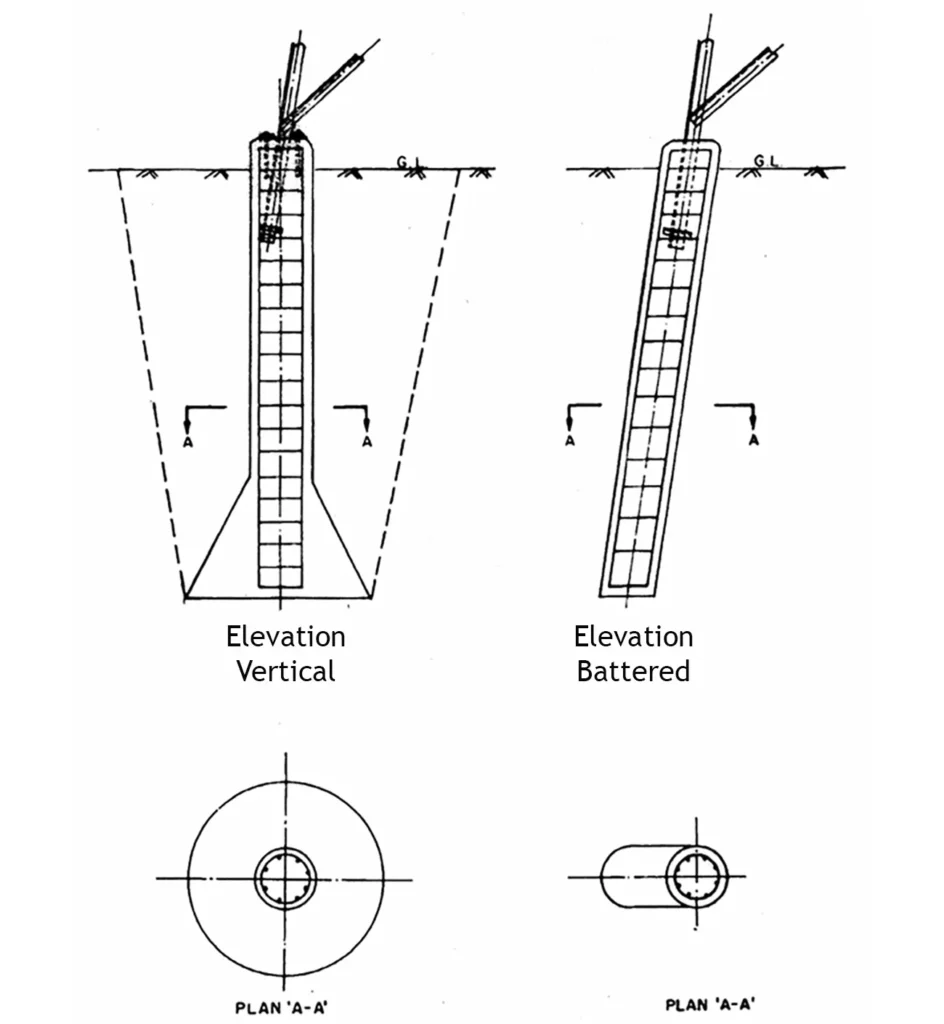
This type of foundation is a cast in situ reinforced concrete foundation which is constructed by drilling a circular hole using a power augur. It is commonly used in stiff clays and dense sands, where excavated holes remain stable during the construction. Bentonite slurry or similar material is sometimes used to stabilize the drilled hole for long concreting works, stub installations and installation of anchor bolts. The footing can have a belled base of increased diameter to improve the uplift resistance. Usually, Holes are drilled up to 1 m diameter and 6 m deep. This type of foundation offers significant reduction in time of construction and labour.
Augured footings without bell shaped base has a limited uplift resistance because the resistance is provided only by the friction along the surface of the shaft.
Under reamed pile foundation
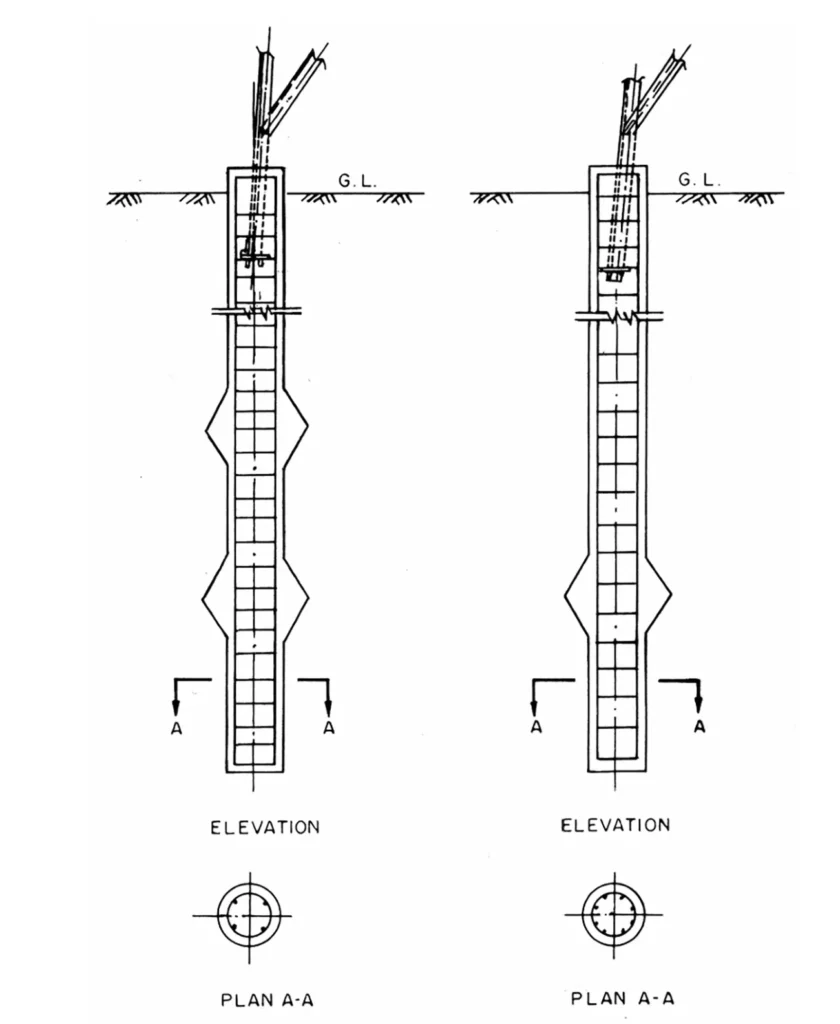
This type of foundation is similar to augured footings with an exception of having under-reaming above the bottom of the shaft. It is constructed by hand augur, where the bore is drilled vertically with arrangement of cutting flange, which can be opened by a lever. This arrangement makes under-ream at various level of bore. It is used commonly in black cotton soil and medium dense soil conditions.
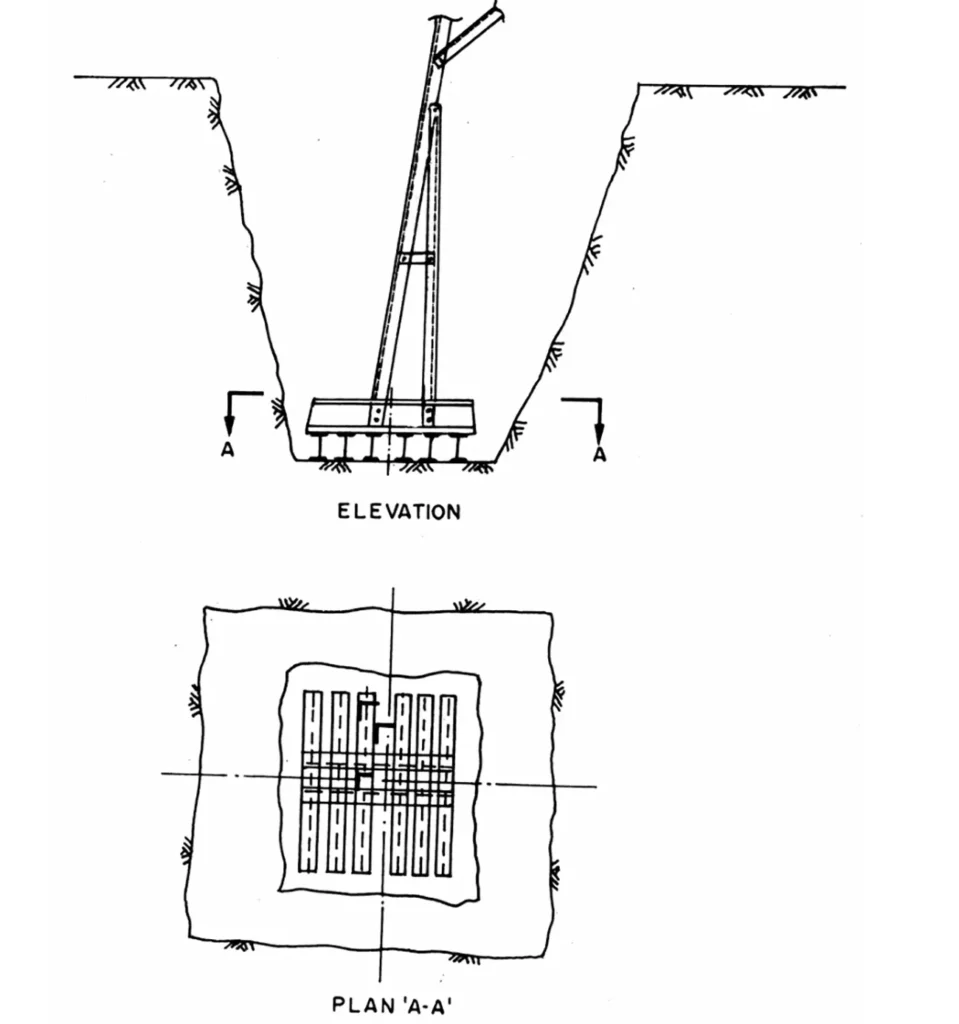
Steel grillage type foundation
This type of foundations are made up of structural steel section. It consists of a layer of steel beam as pad for the bearing area. The footing reaction is transmitted to the pad by means of heavier joists or channels resting crossway on the bearing beams. The grillage is designed to resist the downward thrust and uplift.
This foundation has no solid slabs compared to concrete foundations. If the distance between the grillage members is not greater than the width of the members, the gross area of the grillage is utilized in calculating the bearing pressure. If the distance is large, the net area is taken for calculating the bearing pressure. The compaction of the backfill and corrosion resistance is very critical to the actual load carrying of this foundation.
This foundation provides quick construction and easy installation making it useful for line restoration. It is usually practiced in areas where transporting concreting materials to the site via head loading is difficult. This type of foundation is not so popular these days in the transmission line sector.
Steel plated foundation
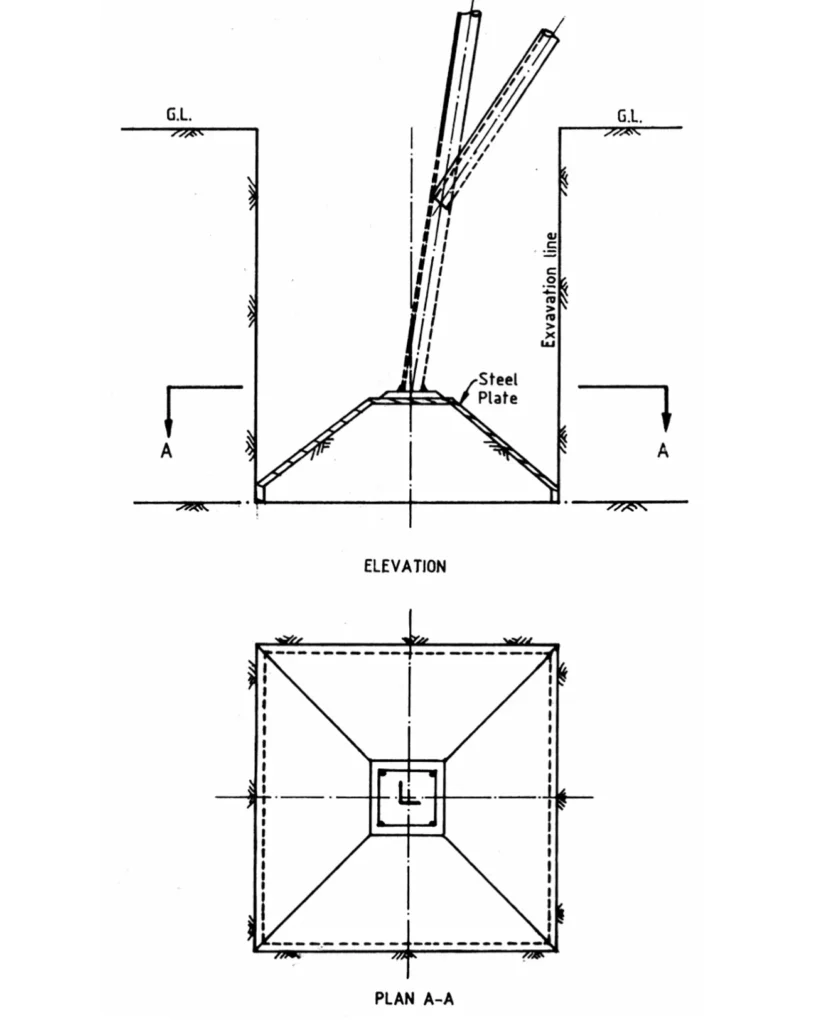
This type of foundation uses pressed steel in place of grillage beams found in steel grillage foundations. This foundation type is adopted where concreting is impractical and transportation of material to the site is difficult. It is suitable for firm, good and cohesive soils. The size of the steel plate is dependent on the uplift resistance and bearing capacity required, while the lateral forces are countered by the passive pressure of the surrounding soil. It is a old practice and is now almost obsolete.
Pile type foundation
A pile type foundation is usually adopted when the soil is very weak and has a very poor bearing capacity. For transmission lines, where foundations has to be located in filled up soil, sea mud of large depth, river beds, creek bed which are likely to get scoured during flood. These foundations are generally designed with the data of soil exploration at the tower location with the most important parameters being the unit weight of the soil, angle of internal friction and cohesion. Also maximum flood level, velocity of water, scour depth are also considered.
In this foundation, the downward force is carried by the skin friction of the pile shaft and the point bearing or both. The uplift of the tower is resisted by the concrete in the piles and pile caps and frictional resistance between the piles and surrounding areas. Two types of piles are normally used viz driven piles and bored piles. The driven piles are of two types viz pre cast piles and cast in-situ driven piles.
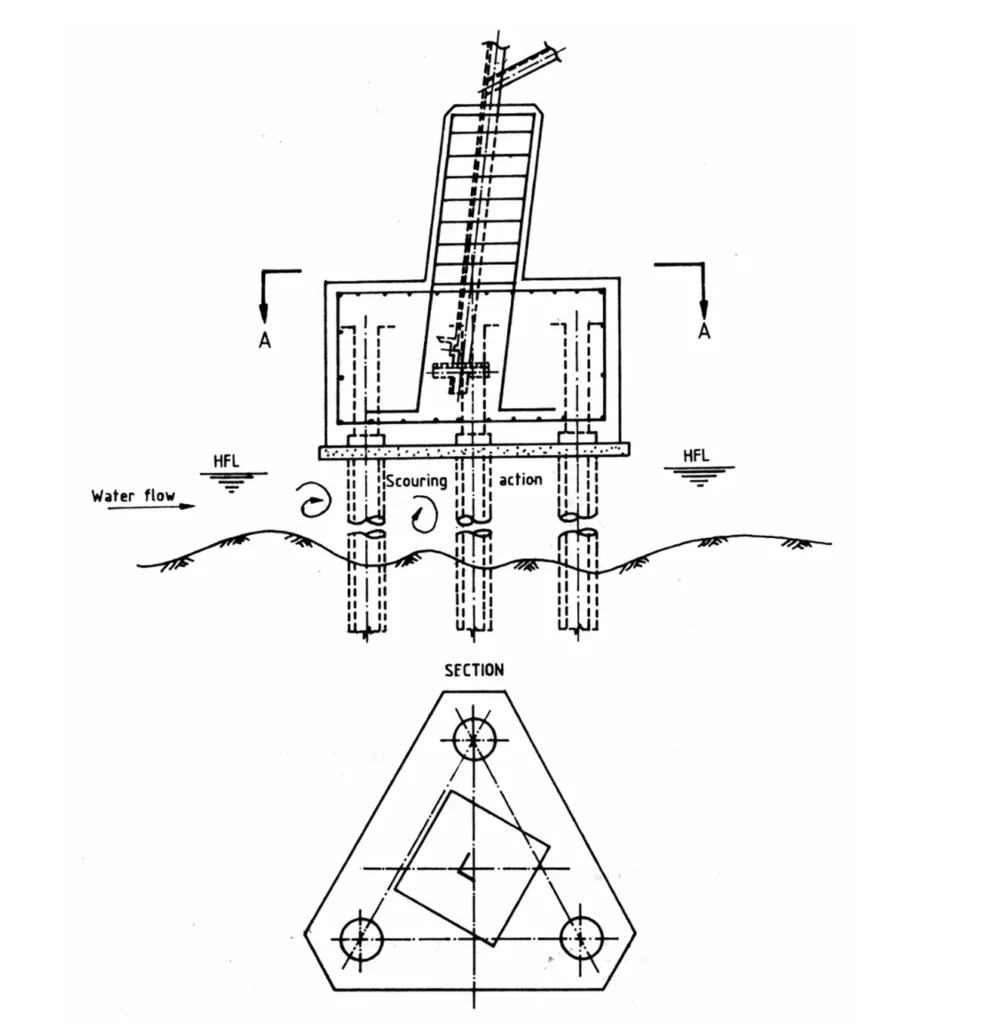
Since the cost involved in the pile foundation is very high, it is only considered when other type of foundations are not techno-economically viable. Mostly cast in-situ concrete bored piles are used in the transmission line project as they require medium sized machinery for the construction unlike the heavy ones used in driven piles.
Well type foundation
This foundation type is usually provided only for tower location that falls within the course of major river with large discharge, heavy flood during monsoon and large scouring of river bed during floods. The cast-in-situ wells of RCC or brick masonry are sunk by continuous excavation from within the wells. The parameters on which this foundation type is designed are angle of internal friction, cohesion and soil density at various levels along the depth of the well, maximum flood discharge, velocity of water, scour depth, etc.
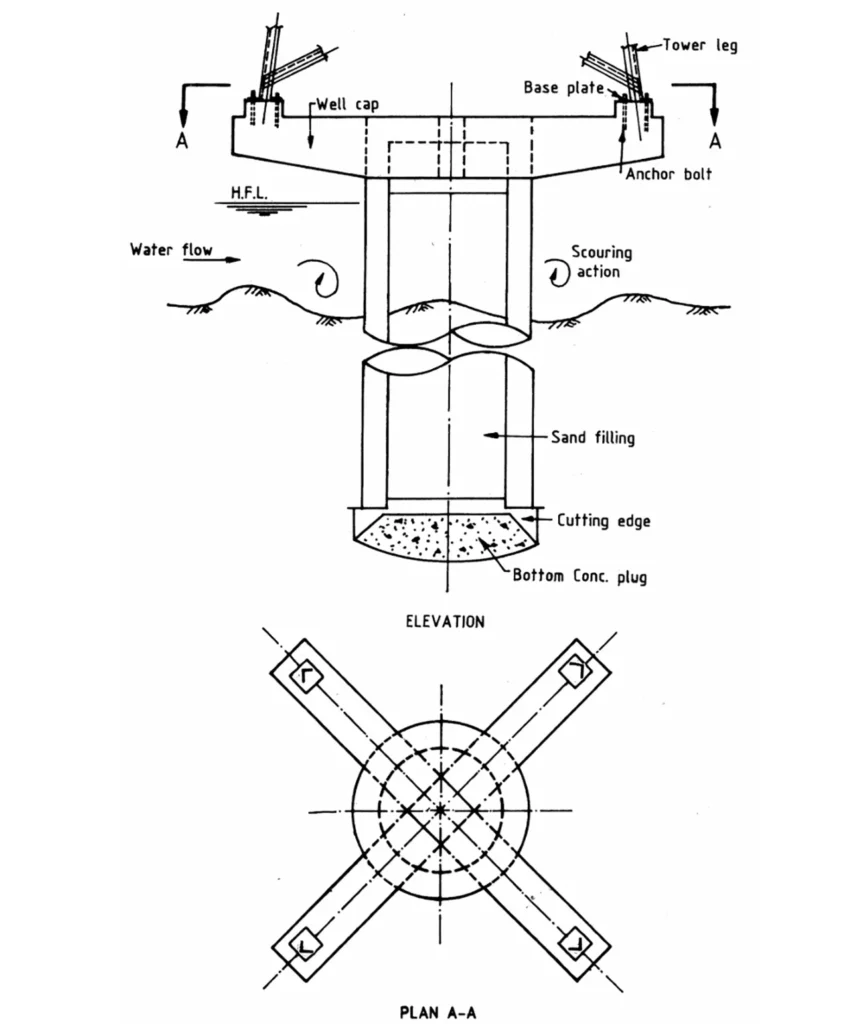
The well has to be below the estimated scour level to a depth which is sufficient for obtaining desired grip length and load carrying capacity of the well. Kentledge has to be used during the sinking of the well for penetrating the hard strata of soil and also prevent tilting. After the well has been sunk to desired design depth, it is filled with sand and a well cap is constructed on the top of the well which accommodates the tower with stub or anchor bolts.
Raft foundation
This type of foundation involves a single concrete block which supports all four legs of the tower instead of having individual separate footings for each leg. The raft foundation is adopted for soil having poor bearing capacity and towers where the individual footings overlaps each other or for narrow base tower, where leg to leg distance is too small for individual footings.
Classification of types of foundation based on water table
| Foundation Category | Soil / Water Table Condition | Key Characteristics |
| Normal Dry Soil Foundation | Water table is below foundation level. Soil is cohesive and homogeneous throughout the foundation depth with clay content of 10–15%. | Most common foundation condition; provides good bearing capacity and uplift resistance. |
| Wet Soil Foundation | Water table is above foundation level and up to 1.5 m below ground level. Also includes areas with standing surface water such as paddy fields where water penetration does not exceed 1.0 m below ground level. | Requires consideration of reduced soil strength and construction difficulties due to water presence. |
| Partially Submerged Foundation | Water table lies between 1.5 m and 0.75 m below ground level. Soil remains normal and cohesive. | Foundation is partially affected by groundwater and requires suitable design modifications. |
| Fully Submerged Foundation | Water table is within 0.75 m below ground level. Soil is normal and cohesive. | Foundation excavation and construction are significantly influenced by groundwater conditions. |
| Black Cotton Soil Foundation | Soil contains more than 15% inorganic clay and exhibits high shrinkage and swelling characteristics. Soil need not necessarily be black in colour. | Special foundation design is required to accommodate volume changes caused by moisture variations. |
| Partial Black Cotton Soil Foundation | Top 1.5 m layer consists of black cotton soil, while the underlying soil is normal dry cohesive soil. | Foundation design must address both expansive upper soil and stable lower soil strata. |
| Soft Rock / Fissured Rock Foundation | Decomposed rock, fissured rock, hard gravel, or similar material that can be excavated without blasting. | Undercut foundations are generally recommended to develop adequate uplift resistance. |
| Hard Rock Foundation | Excavation requires chiselling, drilling, or blasting operations. | Rock anchor or grouted rock foundations are commonly adopted. |
| Sandy Soil Foundation | Soil contains very low clay content (0–10%) and has negligible cohesion. | Design relies primarily on soil friction rather than cohesion; uplift resistance is generally lower than cohesive soils. |
This article is a part of the Transmission line page, where other articles related to topic are discussed in details.

Engineering is always about solving for the environment. At Telkom University, we learn that systems whether they are digital networks or physical power grids must be designed to withstand the ‘noise’ and ‘stress’ of their operational environment. From Undercut foundations for cohesive soil to Grouted Rock anchors for hard strata, these designs are the ‘physical-layer’ solutions that ensure system uptime. Great technical summary