
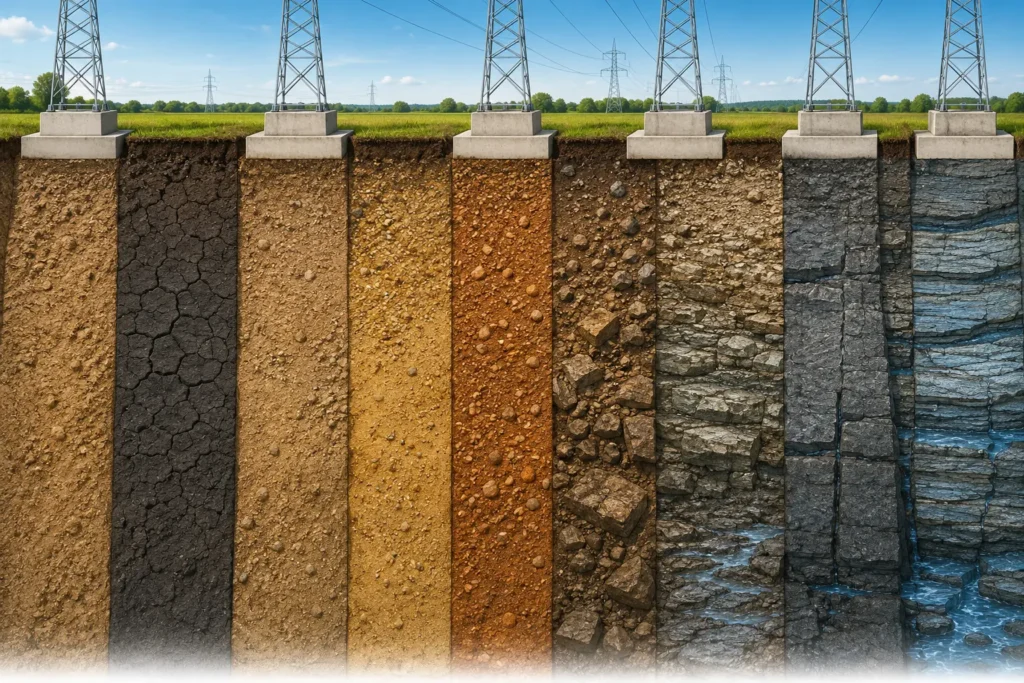
Soil parameters are the key factors in designing the foundation of a transmission line tower. Since the foundation of the tower has to transmit the downward thrust, uplift and side thrust as well from transverse and longitudinal tower loading, efficiently to the soil, the soil parameters as revealed in the geo technical investigation helps the engineers to design detailed foundation for the transmission line, which remains reliable throughout its service life.
Table of Contents
Soil parameters
Unit weight
Unit weight of soil is basically the weight of the soil per unit volume. It is one of the most important soil parameters in the design of foundation. Depending on the moisture condition, it is often classified as dry unit weight, bulk unit weight and saturated unit weight. The unit weight directly affects the self weight of the soil above the foundation, contributing to the uplift resistance against overturning forces. The unit weight is also used in calculating the earth pressure acting on the foundation and the dead weight of soil mass.
Cohesion
This soil parameter is the component of the soil shear strength that exists because of the bonding and attraction between soil particles. This soil parameter is particularly significant in the clay soils, where the intermolecular forces provide resistance even in the absence of normal pressure. It contributes to the bearing capacity of the foundation and enhances the resistance to uplift force acting on the foundation. Higher value increases resistance to shear and pull-out loads.
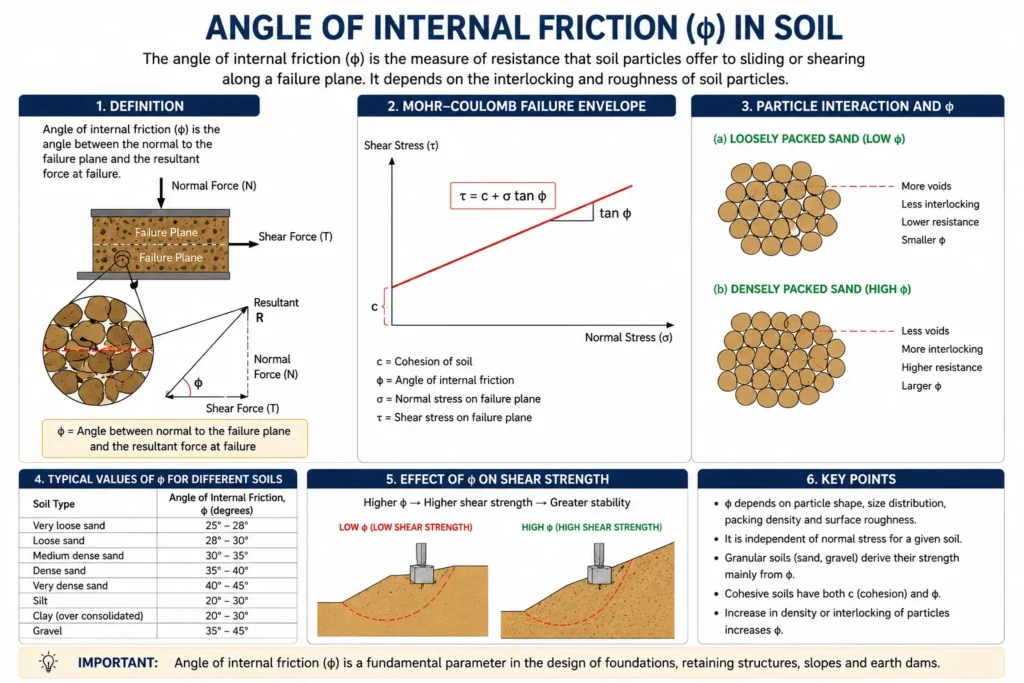
Angle of internal friction
This soil parameter represents the resistance offered by the soil particles against sliding due to interparticle friction. It is the key soil parameter for shear strength in sandy and granular soil, where friction rather than the cohesion governs the soil behaviour. Higher value of angle of internal friction improves bearing capacity of soil, improves uplift resistance and also enhances lateral resistance against horizontal loads acting on the foundation.
Limit bearing capacity
This soil parameter, also known as ultimate bearing capacity, is the maximum pressure that the soil can withstand before the shear failure or excessive settlement. It basically represents the soil’s load carrying capacity under foundation load. In the design of the foundation, limit bearing capacity is arrived at by multiplying a factor of safety to the safe bearing capacity.
Soil density
It is the mass of soil per unit volume. It is an important soil parameter in geotechnical and foundation engineering. The soil density indicates the degree of soil compaction and influences the strength, stiffness and load carrying capacity of the soil.
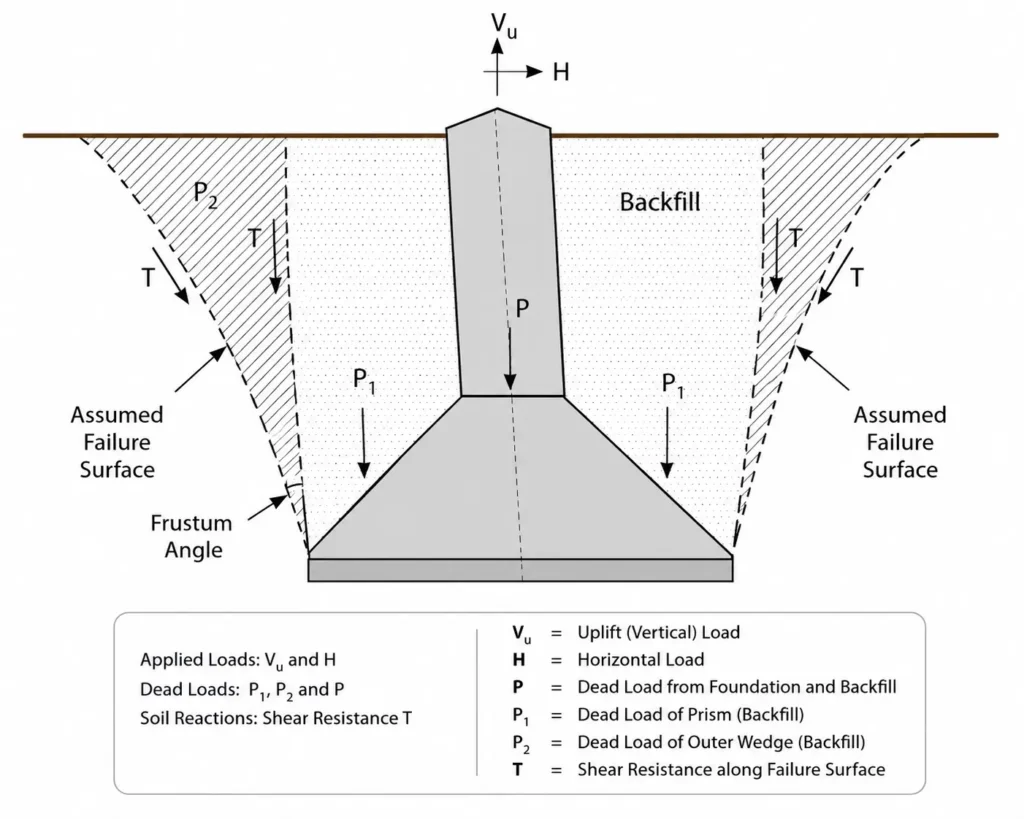
Angle of earth frustum
This soil parameter, the angle of earth frustum, is the angle formed between the vertical axis of the transmission tower foundation and the assumed failure surface. During the uplift, a cone or frustum shaped mass of soil is considered to move along the foundation block. This angle is used to determine the weight of soil mass and volume, which resists the uplift. For cohesionless soil, the angle of earth frustum is assumed to be
or
Larger the angle of earth frustum is, more is the volume of resisting soil and higher is the uplift resistance of the foundation.
Soil parameters to be considered while designing tower foundations
| Sl. No. | Type of Soil | Angle of Earth Frustum (°) | Unit Weight of Soil (kg/m³) | Limit Bearing Capacity (kg/m²) |
| 1(a) | Normal Dry Soil (Without Undercut) | 30 | 1440 | 25,000 |
| 1(b) | Normal Dry Soil (With Undercut) | 30 | 1600 | 25,000 |
| 2 | Wet Soil due to Presence of Sub-soil Water / Surface Water | 15 | 940 | 12,500 |
| 3(a) | Black Cotton Soil (Dry Portion) | 0 | 1440 | 12,500 |
| 3(b) | Black Cotton Soil (Wet Portion) | 0 | 940 | 12,500 |
| 4(a) | Sandy Soil with Clay Content 0–5% | 10 | 1440 | 25,000 |
| 4(b) | Sandy Soil with Clay Content 5–10% | 20 | 1440 | 25,000 |
| 5(A)(a) | Fissured Rock / Soft Rock (With Undercut) – Dry Portion | 20 | 1700 | 62,500 |
| 5(A)(b) | Fissured Rock / Soft Rock (With Undercut) – Wet Portion | 10 | 940 | 62,500 |
| 5(B)(a) | Fissured Rock / Soft Rock (Without Undercut / Block Type) – Dry Portion | 0 | 1440 | 62,500 |
| 5(B)(b) | Fissured Rock / Soft Rock (Without Undercut / Block Type) – Wet Portion | 0 | 940 | 62,500 |
| 6 | Hard Rock | — | — | 1,25,000 |
| 7 | Normal Hard Dry Soil (Murrum) with Undercut | 30 | 1600 | 40,000 |
- Limit bearing capacity is arrived at by using a factor of safety of 2.5
- In soil, where clay content is more than 10% but less than 15%, that type of soil is classified as normal dry soil.
- Angle of earth frustum is taken with respect to the vertical.
Guidelines for classification of foundation in different soils
| Sl. No. | Soil Encountered | Foundation to be Adopted |
| 1 | Good soil (silty sand mixed with clay) | Normal Dry |
| 2 | Top layer of Black Cotton Soil extends up to 50% of foundation depth, followed by good soil | Partial Black Cotton |
| 3 | Black Cotton Soil exceeds 50% of depth and extends to full depth or is followed by good soil | Black Cotton |
| 4 | Top layer is good soil up to 50% of depth, but lower layer is Black Cotton Soil | Black Cotton |
| 5 | Subsoil water encountered at 1.5 m or more below ground level in good soil | Wet |
| 6 | Good soil locations submerged in surface water for long periods with water penetration not exceeding 1.0 m below ground level (e.g., paddy fields) | Wet |
| 7 | Good soil with subsoil water encountered between 0.75 m and 1.5 m below ground level | Partially Submerged |
| 8 | Good soil with subsoil water encountered within 0.75 m below ground level | Fully Submerged |
| 9 | Normal dry soil extends up to 85% of foundation depth followed by fissured rock without water | Dry Fissured Rock |
| 10 | Top layer is fissured rock followed by good soil/sandy soil with or without water | Special Foundation |
| 11 | Normal soil/fissured rock extends up to 85% of depth followed by hard rock | Dry Fissured Rock with Undercut in Fissured Rock combined with Anchor Bar for Hard Rock Design |
| 12 | Fissured rock encountered with subsoil water within or below 0.75 m from ground level (top layer may be good soil or Black Cotton Soil) | Submerged Fissured Rock |
| 12(a) | Fissured rock encountered with subsoil water 1.5 m below ground level (top layer may be good soil or Black Cotton Soil) | Wet Fissured Rock |
| 13 | Hard rock encountered at 1.5 m or less below ground level | Hard Rock |
| 14 | Hard rock encountered from 1.5 m to 2.5 m below ground level, top layer being good soil | Hard Rock Foundation with Chimney for Normal Soil |
| 15 | Hard rock encountered from 1.5 m to 2.5 m below ground level, top layer being Black Cotton Soil or Fissured Rock | Hard Rock Foundation with Chimneys Designed for Wet Black Cotton Soil |
| 16 | Fissured rock encountered at bottom of pit with Black Cotton Soil at top | Composite Foundation |
| 17 | Hard rock encountered at bottom with water and Black Cotton Soil at top, hard rock depth less than 1.5 m | Hard Rock |
| 18 | Sandy soil with clay content not exceeding 10% | Dry Sandy Soil Foundation |
| 19 | Sandy soil with water table in foundation pits | Wet Sandy Soil Foundation (to be developed considering water depth) |
| 20 | Normal dry soil up to 1.5 m below ground level followed by hard soil/murrum | Normal Dry with Undercut |
| 21 | Marshy soil at bottom with top layer of good soil, fissured rock, or Black Cotton Soil | Special Foundation Design after Soil Investigation |
| 22 | Top layers consist of clinker mixed with firm soil, gravel, and stone chips up to 60% of foundation depth, followed by hard murrum | Normal Dry with Undercut |
| 23 | Top layers consist of hard murrum, soft rock, etc., followed by yellow/black clayey soil | Special Foundation Design after Soil Investigation |
Murrum is a reddish to yellowish residual soil formed by weathering of rocks, specially laterite and basalt
This article is a part of the Transmission line page, where other articles related to topic are discussed in details.