
Otto cycle VS Atkinson cycle at Glance
| Parameter | Otto Cycle | Atkinson Cycle |
| Basic principle | Conventional Spark Ignition cycle | Extended expansion |
| Compression/expansion ratio | Usually same | Effective expansion ratio is greater than compression ratio |
| Heat addition | Constant volume | Constant Volume |
| Heat Rejection | Constant Volume | Constant Pressure |
| Expansion | Ends at a relatively higher volume or pressure | Longer expansion (older approach) or shorter compression (Modern approach) |
| Efficiency | Lower | Higher (5-10% higher than Otto cycle) |
| Specific power | Higher (Usually 8-10% higher than Atkinson cycle) | Lower |
| Fuel economy | Lower | Better compared to Otto cycle (10-13% more than Otto cycle) |
| Typical application | Conventional gasoline engines | Hybrid vehicles, efficiency-focused engines |
Table of Contents
How the Atkinson Cycle Differs from the Otto Cycle
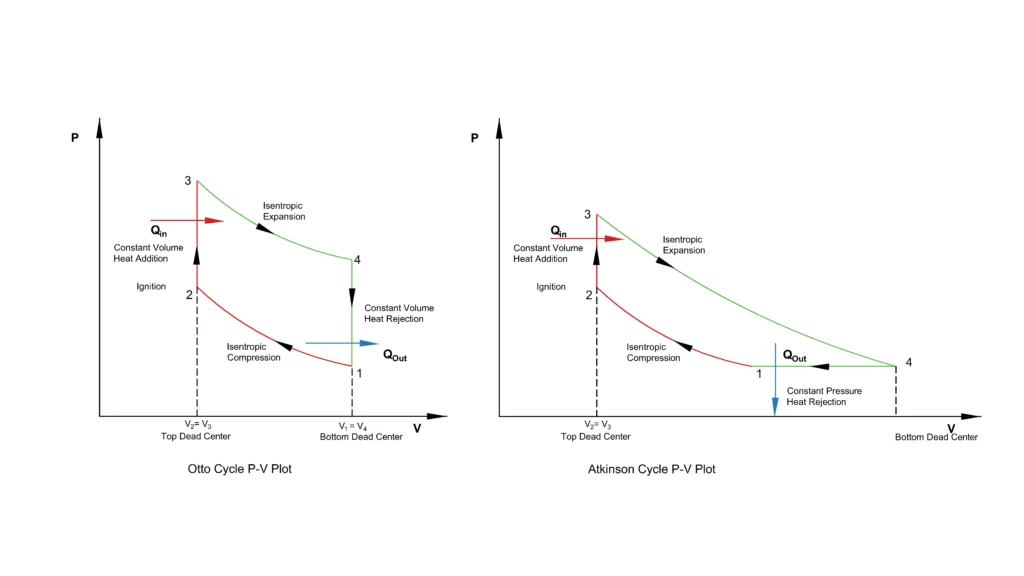
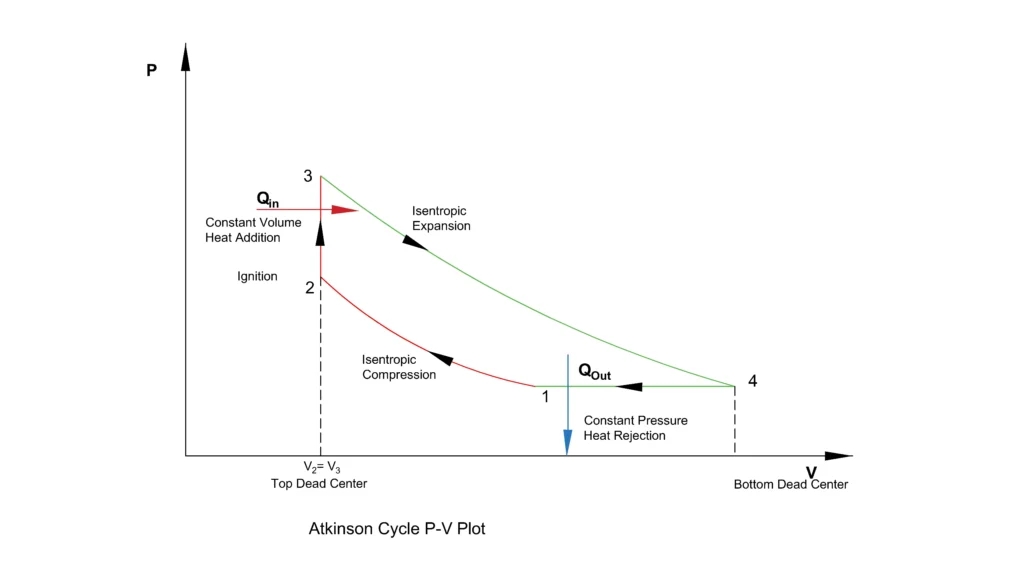
The defining difference between Atkinson cycle and Otto cycle is the relationship between the compression and expansion ratios. In the Atkinson cycle, the expansion ratio is usually greater than the effective compression ratio. This makes the extraction of more work from the combustion of the gases and also reduces the energy lost through the exhaust.
In modern Atkinson cycle engines, the expansion ratio is made greater than the compression ratio by closing of the intake valve late after bottom dead center in the compression stroke. The intake valve is made to remain open during the initial part of compression stroke, allowing some of the intake charge to flow back into the intake manifold. This results in lower effective compression ratio while retaining the geometric expansion ratio, expanding more before the exhaust valve opens.
The shorter compression ratio and longer expansion ratio, although provides with less work but increases the thermal efficiency compared to Otto cycle and in some cases can reduce the pumping losses associated.
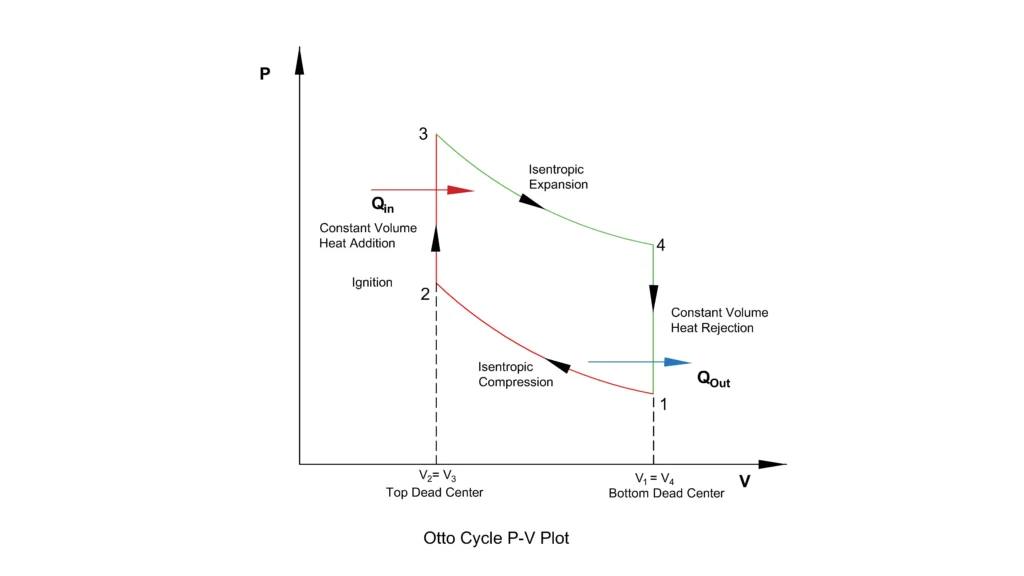
The Otto cycle has a constant volume heat rejection process but the heat rejection in the Atkinson cycle is constant pressure. At the end of the power or expansion stroke, the pressure in the cylinder is almost constant and is made to be equal to the atmospheric.
PV diagram difference
This article is a part of thermal system, where other related articles are discussed.