
PV and TS diagram difference
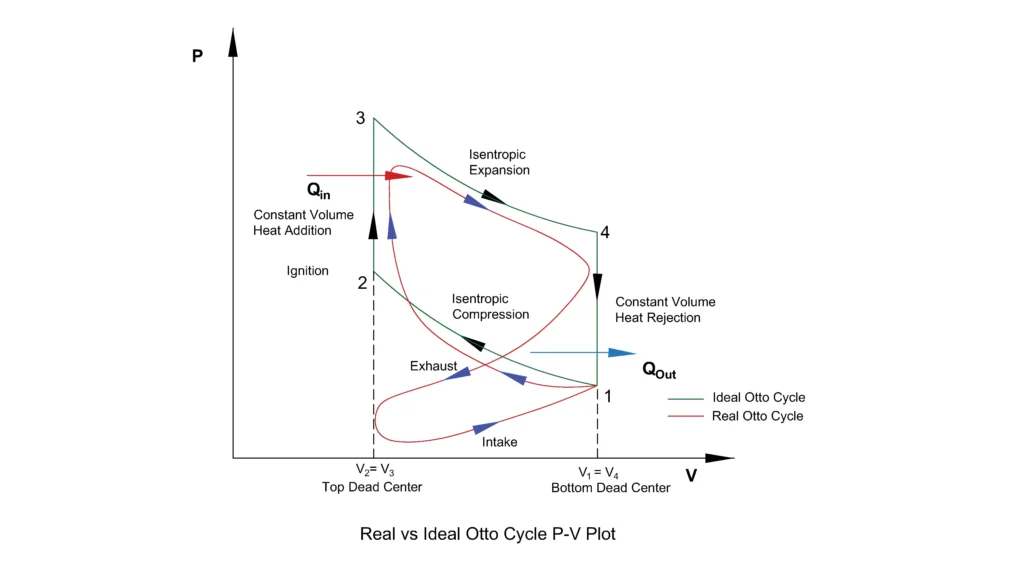
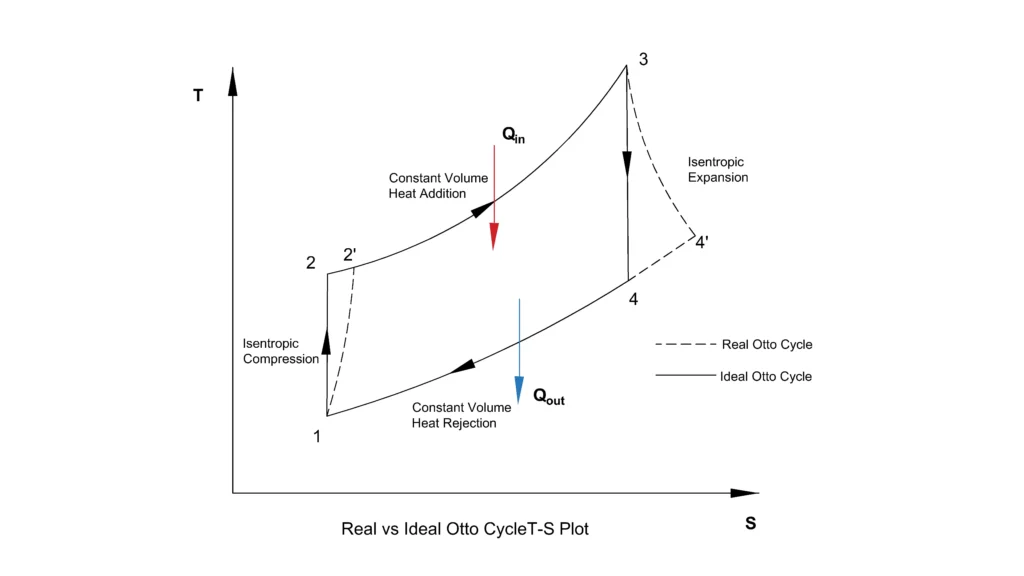
Table of Contents
Main Comparisions of Real vs Ideal Otto Cycle
| Parameter | Ideal Otto Cycle | Real Otto Cycle |
| Compression | Isentropic or Reversible adiabatic | Irreversible |
| Expansion | Isentropic or Reversible adiabatic | Irreversible |
| Heat addition | Constant volume | Finite-rate of combustion with varied volume |
| Heat rejection | Constant volume | Occurs through exhaust |
| Combustion | Instantaneous, idealized and complete | Takes finite time and can be incomplete |
| Heat transfer | Neglected | Heat lost to cylinder walls |
| Friction | Neglected | Present |
| Pumping losses | Neglected | Present |
| Specific heats | Usually, constant | Vary with temperature |
| Pressure losses | Neglected | Present |
| Efficiency | Higher | Lower |
| Net work | Higher | Lower |
Compression and Expansion
In ideal Otto cycle, the compression is assumed to be reversible adiabatic, which keeps the entropy constant through out the process and gives maximum compression efficiency. But in case of the real Otto cycle, piston ring friction, heat transfer to the cylinder walls, viscous effects and turbulent fluid motion inside the cylinder contributes to the irreversibility of the process diverging away from isentropic.
The expansion process of the real Otto cycle diverges away from isentropic because of the same reasons. The combustion gases are highly turbulent, heat from the combustion gases gets transferred to the cylinder walls, viscous dissipation of the gases contributes to the entropy generation and thus reducing the work extracted during the process.
Heat Addition
In the ideal Otto cycle, heat is added at constant volume instantaneously in ideal combustion process. But in the real cycle, this is not the case. Combustion takes 1-2 milli seconds and occurs while piston is moving, changing the volume. Heat release, therefore occurs over a range of crank angles rather than the constant volume.
Heat Rejection
In the ideal cycle, the heat rejection occurs instantaneously at constant volume, returning the working fluid to its initial condition.
But in the actual cycle, heat is rejected through the exhaust gases and engine cooling system.
Combustion
In the ideal cycle, the combustion of fuel is assumed to be instantaneous and complete, allowing all the chemical energy to be converted into thermal energy.
But in real Otto cycle, combustion takes finite amount of time and can still be incomplete. The chemical energy release depends on the flame propagation, air fuel mixture quality and combustion timing.
Heat Transfer
In ideal Otto cycle, the heat transfer between the working fluid and the cylinder walls is neglected and hence all the heat supplied remains available for conversion to work.
But in the real cycle, 20-30% of the converted thermal energy is lost as a result of heat transfer to the cylinder walls, reducing the availability of useful energy.
Friction
Friction between the piston rings and cylinder, bearings, valve mechanism and other moving parts is completely neglected in the ideal Otto cycle. Hence, the indicated work of the ideal cycle is a function of pressure and change in volume.
However, in the real Otto cycle, mechanical friction can consume anywhere between 8-10% of the indicated work, lowering the brake work available at the crank shaft.
Pumping loss
The ideal Otto cycle does not account for the pumping losses as the intake and exhaust processes are not represented.
However, for the real Otto cycle, the engine must draw in fresh air fuel mixture and expel the exhaust gases. Pressure difference between the cylinder and intake and exhaust manifold during these processes creates the pumping losses. It shall be noted that the pressure difference is not the pumping loss but the engine has to extend more work to overcome these pressure differences, which reduces the net engine work.
Specific Heat
In the ideal Otto cycle, the specific heat CP and CV are treated as constant, which simplifies the thermodynamic analysis.
But in the real Otto cycle, the temperature of the gas changes significantly during the cycle causing the specific heats to vary with temperature because of additional molecular energy modes and vibration. This reduces the γ, ratio of specific heat with increasing temperature.
Thermal Efficiency
In the ideal Otto cycle, the thermal efficiency is usually higher because it excludes the heat losses, friction, incomplete combustion and other irreversibilities.
However, in real Otto cycle, heat losses, combustion inefficiency, compression and expansion irreversibility, pumping losses are present, which reduces the thermal efficiency.
It shall be noted that mechanical friction reduces the brake thermal efficiency, where as the thermal efficiency of the cycle depends upon the indicated work which is affected by combustion, heat transfer, pumping and gas exchange process and variable properties.
This article is a part of thermal system, where other related articles are discussed.