

Wind load refers to the force exerted by the moving air on the transmission line structure (conductor, insulator and tower) which produces conductor to swing at a swing angle, increases the tension of the conductor or ground wire and also generates bending moment in the tower members. Wind load mainly depends upon the wind speed and exposed area.
Table of Contents
Wind speed map of India
Wind load is based on basic wind speed, which is peak gust velocity averaged over a time duration of 3-seconds corresponding to 10 m height above mean ground level. Based on this basic wind speed, the map of India is divided into 6 wind zones with a minimum wind speed of 33 m/s to maximum of 55 m/s.
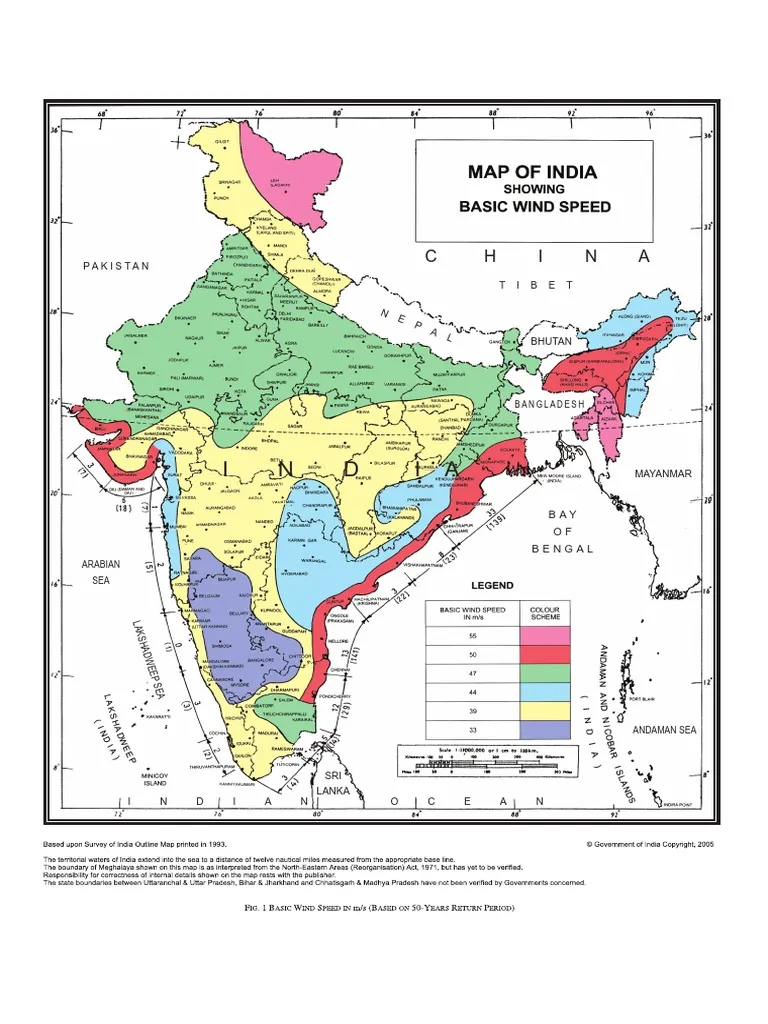
| Wind Zone | Basic Wind Speed, (V_b) (m/s) |
| 1 | 33 |
| 2 | 39 |
| 3 | 44 |
| 4 | 47 |
| 5 | 50 |
| 6 | 55 |
In case the transmission line goes via the border of two wind zones, for calculation of wind load, the maximum of the two basic wind speeds is to be considered.
Reference wind speed
It is the value of wind speed over an average period of 10 minutes and is calculated form the basic wind speed Vb via the formula
VR = Vb / K0
K0 is the factor which is equal to 1.375, it converts the 3 second peak gust to average wind speed of 10 minutes period.
Designed wind speed
The reference wind speed obtained by the above equation is to be modified to account for risk coefficient K1 and Terrian Roughness K2.
Vd = VR. K1. K2
Risk coefficient accounts for the probability that the design wind speed may exceed during the life of the structure. The value of K1 largely depends upon the return period and reliability requirement of the structure. For a higher reliability, K1 is higher.
Risk Coefficient for Different Reliability Levels and Wind Zones
| Reliability Level | Return Period (Years) | Wind Zone 1 | Wind Zone 2 | Wind Zone 3 | Wind Zone 4 | Wind Zone 5 | Wind Zone 6 |
| 1 | 50 | 1.00 | 1.00 | 1.00 | 1.00 | 1.00 | 1.00 |
| 2 | 150 | 1.08 | 1.10 | 1.11 | 1.12 | 1.13 | 1.14 |
| 3 | 500 | 1.17 | 1.22 | 1.25 | 1.27 | 1.28 | 1.30 |
The terrain roughness factor K2 accounts for the effect of ground surface and obstacles on the wind speed.
Terrain Roughness Coefficient K2
| Terrain Category | 1 | 2 | 3 |
| Coefficient K2 | 1.08 | 1.00 | 0.85 |
Category-1: Coastal area, deserts and large stretch of water.
Category-2: Normal cross-country lines with very few obstacles.
Category-3: Urban built-up areas or forest covers.
Design Wind pressure Pd
The wind pressure acting on conductors and insulators shall be obtained by
Pd = 0.6 Vd2
Where Pd is the design wind pressure in N/m2 and Vd is the design wind speed in m/s.
Design wind pressure for all three reliability levels corresponding to six wind zones and three terrain categories at 10 m height are given below:
| Reliability Level | Terrain Category | Zone 1 | Zone 2 | Zone 3 | Zone 4 | Zone 5 | Zone 6 |
| 1 | 403 | 563 | 717 | 818 | 925 | 1120 | |
| 1 | 2 | 346 | 483 | 614 | 701 | 793 | 960 |
| 3 | 250 | 349 | 444 | 507 | 573 | 694 | |
| 1 | 470 | 681 | 838 | 960 | 1083 | 1319 | |
| 2 | 2 | 403 | 584 | 719 | 879 | 1013 | 1131 |
| 3 | 291 | 422 | 519 | 635 | 732 | 817 | |
| 1 | 552 | 838 | 1026 | 1182 | 1455 | 1892 | |
| 3 | 2 | 473 | 719 | 879 | 1013 | 1248 | 1622 |
| 3 | 342 | 519 | 635 | 732 | 901 | 1172 |
Wind load on Tower
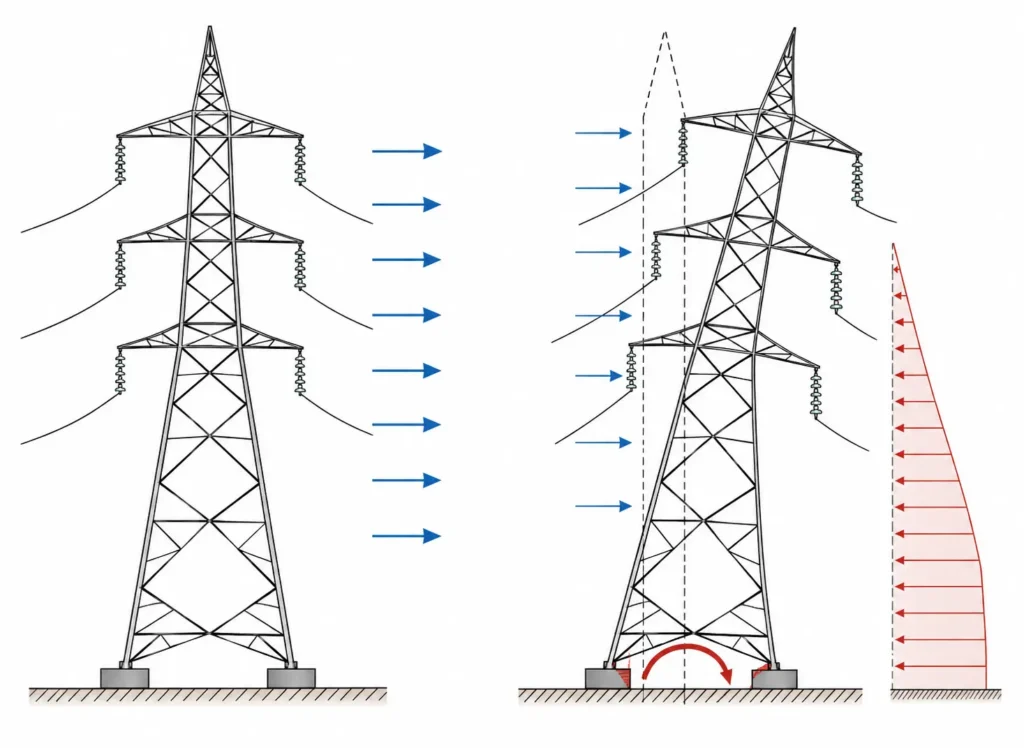
For determining the wind load on tower, the tower is divided into different panels with a height of h. These panels are usually taken between the intersection joints of legs and bracings. For a lattice tower, the wind load Fwt in newtons, for wind normal to the face of the tower on a panel height h applied at its center of gravity is
Fwt = Pd. Cdt. Ae. GT
Where Pd is the design wind pressure in N/m2
Cdt is the frag coefficient pertaining to the wind blowing against the face of the tower.
Ae is the total net surface area of the legs and bracing of the panel projected normally on the face in m2. The projection of the bracing elements of the adjacent faces, plan and hip bracing can be neglected while determining the projected surface of a face.
GT is the gust response factor, peculiar to the ground roughness and depends on the height above the ground.
Drag coefficient for tower
| Solidity Ratio* | Angles | Circular Sections | Single Frame (Ladders, Railings, etc.) |
| Up to 0.05 | 3.6 | 2.1 | 1.9 |
| 0.10 | 3.4 | 1.9 | 1.9 |
| 0.20 | 2.9 | 1.7 | 1.8 |
| 0.30 | 2.5 | 1.5 | 1.7 |
| 0.40 | 2.2 | 1.4 | 1.7 |
| 0.50 and above | 2.0 | 1.35 | 1.6 |
Solidity ratio is the ratio of the projected solid area normal to wind direction to the gross area enclosed by the frame. Higher solidity ratio results in lower drag coefficient because of the shielding effects between the members.
Gust Response Factor for Towers ( ) and Insulators ( )
| Height Above Ground (m) | Terrain Category 1 | Terrain Category 2 | Terrain Category 3 |
| Up to 10 | 1.70 | 1.92 | 2.55 |
| 20 | 1.85 | 2.20 | 2.82 |
| 30 | 1.96 | 2.30 | 2.98 |
| 40 | 2.07 | 2.40 | 3.12 |
| 50 | 2.13 | 2.48 | 3.24 |
| 60 | 2.20 | 2.55 | 3.34 |
| 70 | 2.26 | 2.63 | 3.46 |
| 80 | 2.31 | 2.69 | 3.58 |
The gust response factor accounts for the amplification of the wind load due to the gust which increases with the height above the ground and turbulence which increases terrain roughness.
Wind load on conductor and ground wire/OPGW
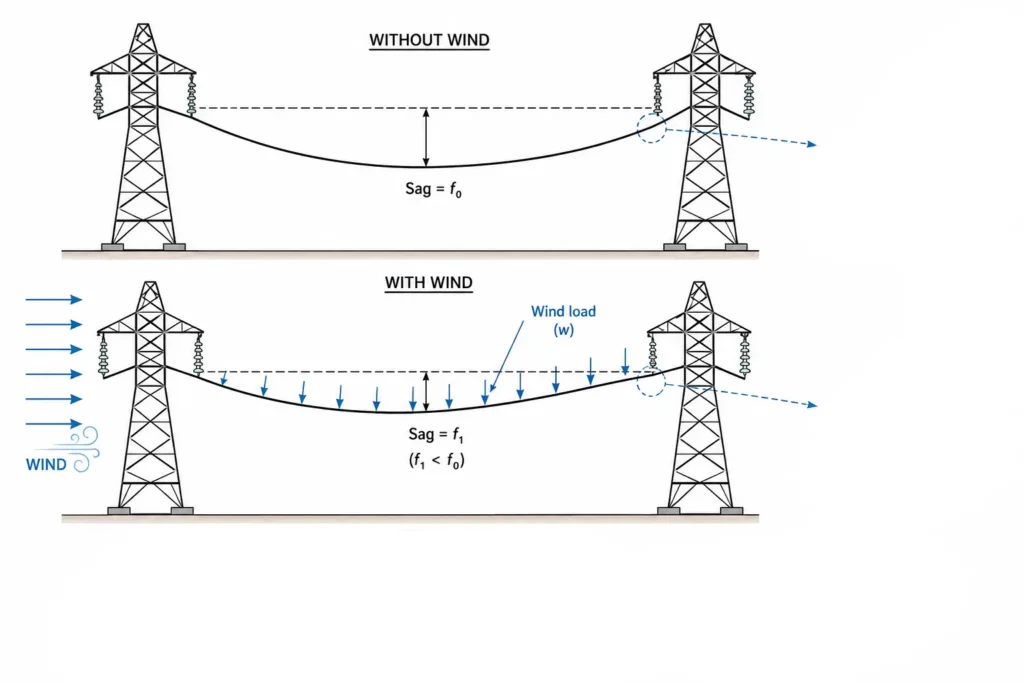
The wind load that acts on each conductor and ground wire, Fwc in newtons, applied at the supporting point normal to the line is determined by the formula
Fwc = Pd. L. d. Gc. Cdc
Where, Pd is the design wind pressure in N/m2,
L is the wind span, sum of the half span on either side of the supporting point in meters.
D is the diameter of the conductor, ground wire / OPGW
Gc is the gust response factor that accounts for the turbulence of the wind and dynamic response of the conductor.
Cdc is the drag coefficient given below
| Dia of conductor, ground wire/OPGW | Drag Coefficient Cdc |
| Up to 12.5 mm | 1.2 |
| 12.5 to 15.8 mm | 1.1 |
| Above 15.8 mm | 1.0 |
Gust Response Factor for Conductors / Ground Wires
| Terrain Category | Height (m) | Up to 200 m | 300 m | 400 m | 500 m | 600 m | 700 m | 800 m & Above |
| Up to 10 | 1.70 | 1.65 | 1.60 | 1.56 | 1.53 | 1.50 | 1.47 | |
| 20 | 1.90 | 1.87 | 1.83 | 1.79 | 1.75 | 1.70 | 1.66 | |
| 1 | 40 | 2.10 | 2.04 | 2.00 | 1.95 | 1.90 | 1.85 | 1.80 |
| 60 | 2.24 | 2.18 | 2.12 | 2.07 | 2.02 | 1.96 | 1.88 | |
| 80 | 2.35 | 2.25 | 2.18 | 2.13 | 2.10 | 2.05 | 1.98 | |
| Up to 10 | 1.83 | 1.78 | 1.73 | 1.69 | 1.65 | 1.60 | 1.55 | |
| 20 | 2.12 | 2.04 | 1.95 | 1.88 | 1.84 | 1.80 | 1.73 | |
| 2 | 40 | 2.34 | 2.27 | 2.20 | 2.13 | 2.08 | 2.05 | 2.03 |
| 60 | 2.55 | 2.46 | 2.37 | 2.28 | 2.23 | 2.20 | 2.17 | |
| 80 | 2.69 | 2.56 | 2.48 | 2.41 | 2.36 | 2.32 | 2.28 | |
| Up to 10 | 2.20 | 2.05 | 1.90 | 1.83 | 1.77 | 1.73 | 1.73 | |
| 20 | 2.44 | 2.37 | 2.13 | 2.10 | 2.06 | 2.03 | 2.03 | |
| 3 | 40 | 2.76 | 2.67 | 2.49 | 2.42 | 2.38 | 2.34 | 2.34 |
| 60 | 2.97 | 2.87 | 2.67 | 2.60 | 2.56 | 2.52 | 2.52 | |
| 80 | 3.19 | 3.04 | 2.85 | 2.78 | 2.73 | 2.69 | 2.69 |
Wind load on the insulators
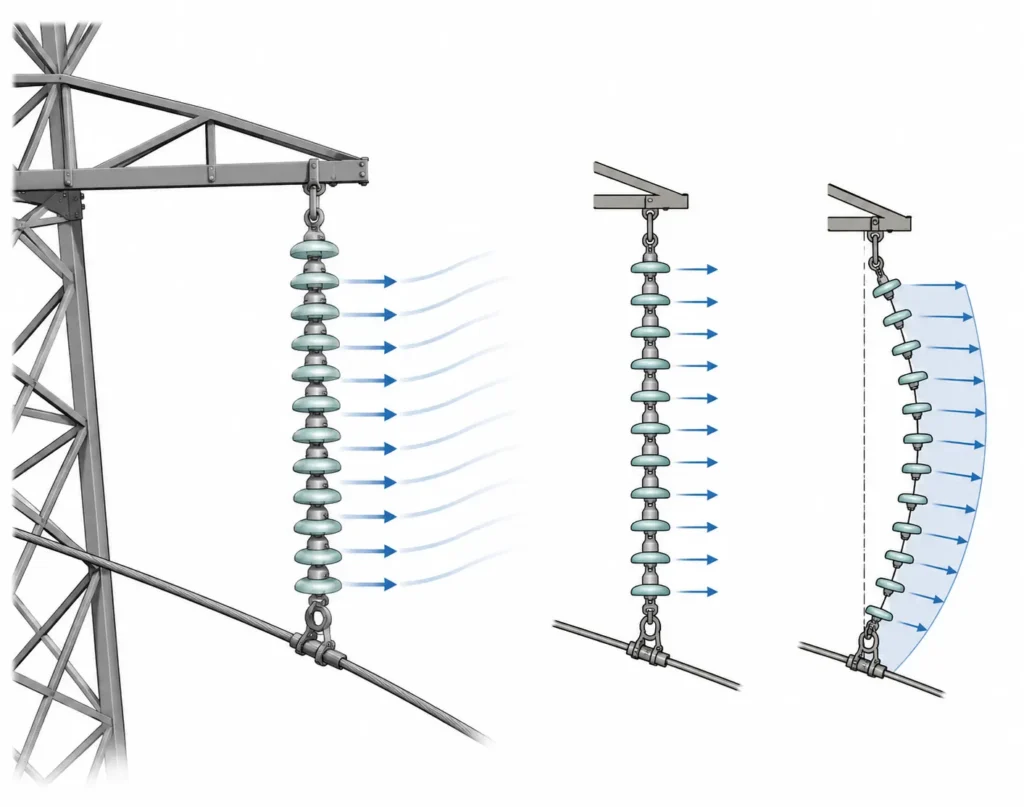
The wind load on the insulator strings Fwi is determined from the attachment point to the center line of the conductor in case of suspension strings and upto end of clamp in case of strain insulators in the direction of the wind. The wind load on insulators is given by the formula
Fwi =1.2 Pd. Ai. Gi
Where Pd is the design wind pressure in N/m2
Ai is the 50% area of the insulator string projected on the plane parallel to the longitudinal axis of the string (0.5 x diameter x length).
Length for suspension insulator is from the center point of the insulator to the connection point in the tower and in tension insulator, the length is from end of tension clamp to the connection point of insulator in the tower.
This article is a part of the Transmission line page, where other articles related to topic are discussed in details.