
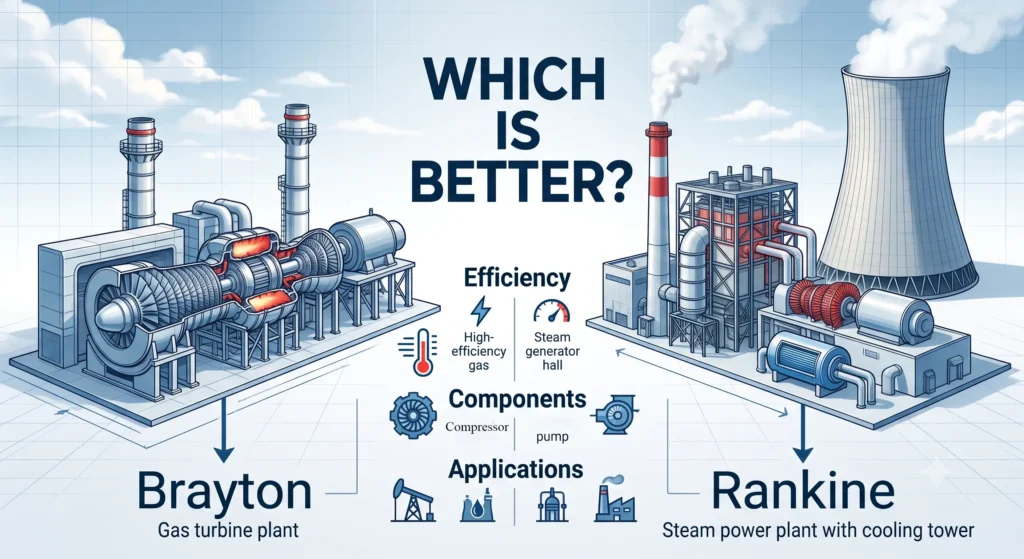
Brayton cycle and Rankine cycle are among the two most important thermodynamic power cycles used for large scale electricity generation and propulsion. Both these cycles convert thermal energy into mechanical work, which is then be used to drive generators or mechanical equipment. However, these cycles operates under varied principles and also uses different working fluids.
The Brayton cycle uses gas as the working fluid and it is the fundamental cycle behind operation of gas turbine, jet engines and combined cycle power plants. In contrast, the Rankine cycle uses mostly water as the working fluid with phase changes and forms the basis of thermal power plants, nuclear power plants and other renewable energy systems.
It is therefore important to understand the difference between Brayton cycle and Rankine cycle to select more suitable technology for a given application.
Table of Contents
What is a Brayton cycle?
The Brayton cycle is a gas power cycle that converts heat energy to mechanical work through isentropic compression, constant pressure heating and isentropic expansion of a gaseous working fluid. In open cycle system, air is taken as the working fluid, is compressed and then mixed with fuel in the combustion chamber and expanded in a gas turbine with the exhaust gas releasing to the atmosphere.
However, in the closed cycle system, inert gas such as helium or nitrogen circulates in a closed loop, receiving the heat after compression from external source. The heat addition is done at nearly constant pressure.
The main components of Brayton cycle are Compressor, Combustor and Gas turbine. Brayton cycle is extensively used in the aircraft engines, industrial gas turbines and combined cycle power plants specially as through this cycle a high power to weight ratio is achievable with continuous operation.
Related article: Brayton Cycle: Working Principle, Processes, T-s Diagram, Efficiency, Advantages and Applications
What is Rankine cycle?
The Rankine cycle is a vapour power cycle that converts the heat energy into mechanical work by using water as the working fluid with phase transformation. Unlike the Brayton cycle, the working fluid undergoes a phase transformation as water evaporates into steam in the boiler and condensing back to water in the condenser. The main components of the Rankine cycle are Boiler or Evaporator, Steam turbine, Condenser and Feed water pump.
In the boiler, water is heated at constant pressure to produce steam, which then expands in the steam turbine generating shaft power. The exhaust steam is then condensed back to water in the condenser before it is pumped back to the boiler, thus completing the cycle.
The Rankine cycle is widely used in coal fired, biomass, concentrated solar thermal, geothermal and nuclear power plants because of its high efficiency of converting the heat from external sources into electricity.
Related article: Rankine Cycle: Working Principle, Processes, T-s Diagram, Efficiency, Advantages and Applications
Working principle comparison
Although both Brayton cycle and Rankine cycle converts heat into mechanical work, they differ significantly in the way the working fluid flows through the system. In Brayton cycle, ambient air is first compressed in a compressor, increasing its pressure and temperature. Fuel is then injected into the combustion chamber, where it burns at approximately constant pressure, producing high temperature combustion gas. This gas then expands through the Gas turbine, generating mechanical work. Part of this generated work, drives the compressor, while the remaining power is used to produce electricity or provide propulsion. In open Brayton cycle, the exhaust gas is discharged to the atmosphere, while in closed Brayton cycle, the working fluid is cooled and recirculated.
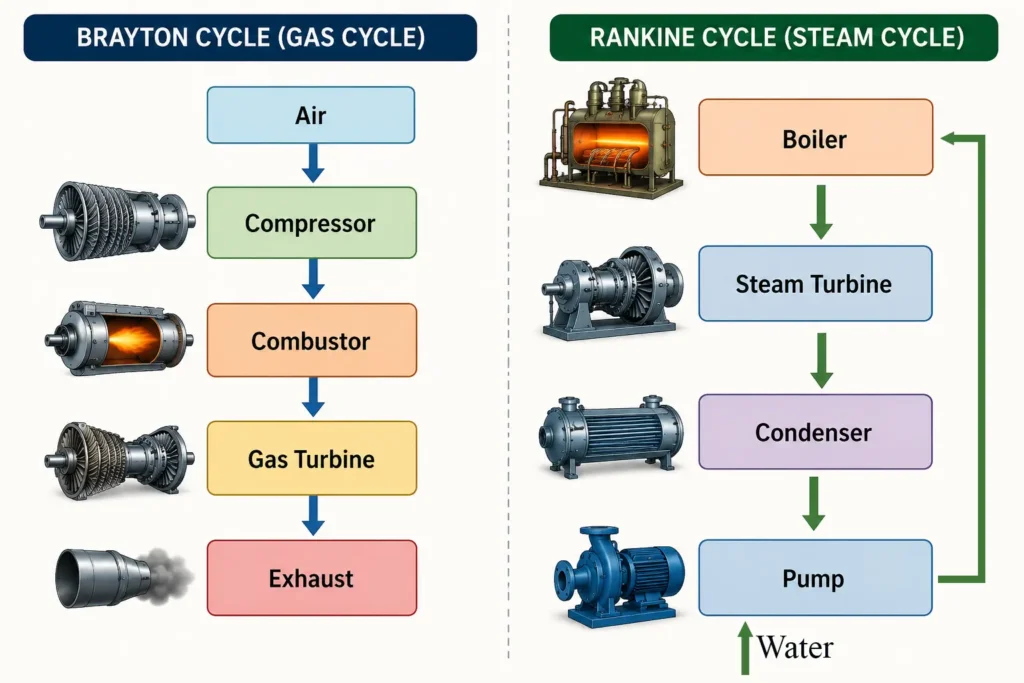
In the Rankine cycle, the liquid water is first pressurized by the feed water pump and is then heated in the boiler to produce high pressure steam. This steam is then expanded in a steam turbine for generating the shaft power before entering the condenser, where the steam releases the heat and condenses back to liquid water. The condensate is then pumped back to the boiler, completing the cycle.
The fundamental difference between the two cycle is that Brayton cycle operates entirely with gases with no phase change of the working fluid occurring at any part of the cycle, whereas in the Rankine cycle, there is continuous phase change between liquid and vapour enabling efficient heat transfer and power generation in the steam power plants.
Thermodynamic Processes
Thermodynamically both ideal Brayton cycle and Rankine cycle have same sequence of the basic four processes.
- Isentropic compression
- Constant pressure heat addition
- Isentropic expansion
- Constant pressure heat rejection
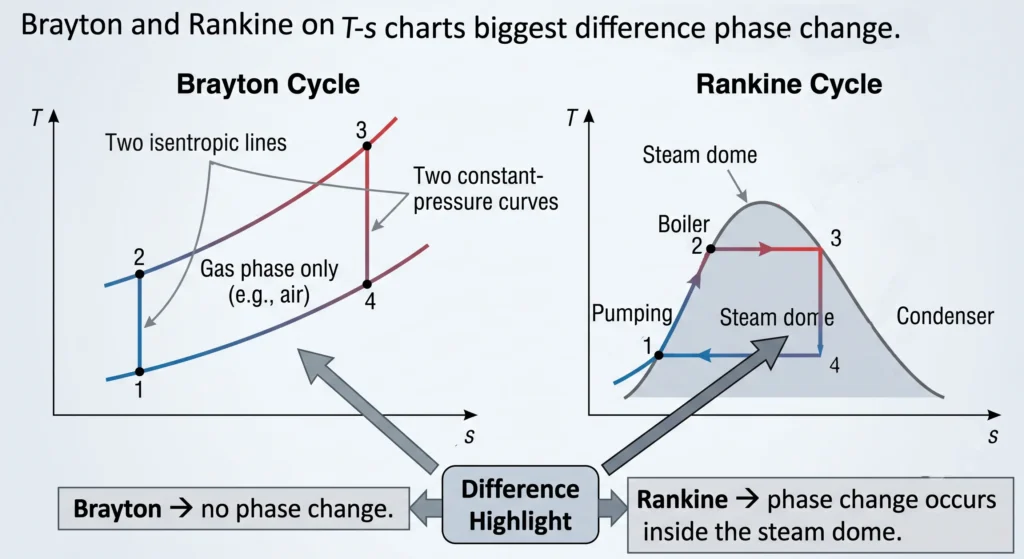
The difference is however not in the thermodynamic process but in how they are carried out.
| Process | Brayton Cycle | Rankine Cycle |
| 1–2 | Isentropic compression of a gas in a compressor | Isentropic compression of liquid water in a pump |
| 2–3 | Constant-pressure heat addition in a combustor | Constant-pressure heat addition in a boiler, causing water to evaporate into steam |
| 3–4 | Isentropic expansion of hot gases in a gas turbine | Isentropic expansion of steam in a steam turbine |
| 4–1 | Constant-pressure heat rejection to the surroundings (or cooler in a closed cycle) | Constant-pressure heat rejection in a condenser, where steam condenses into liquid water |
The Brayton cycle uses a compressor to compress the working fluid. While, Rankine cycle uses a pump to compress the liquid, requiring much less work compared to the compressor.
Brayton cycle vs Rankine cycle Comparison Table
| Parameter | Brayton Cycle | Rankine Cycle |
| Working fluid | Air | Water/Steam |
| Phase change | No | Yes |
| Main components | Compressor, combustor, turbine | Pump, boiler, turbine, condenser |
| Heat addition | Constant pressure | Constant pressure |
| Compression Device | Gas compressor | Liquid pump |
| Turbine exhaust | Gas | Wet or superheated steam |
| Cooling system | Often not required (open cycle) | Condenser required |
| Typical efficiency | 30–40% (simple) | 35–45% (modern plants) |
| Start-up time | Fast | Slow |
| Power-to-weight ratio | High | Lower |
| Common applications | Aircraft, gas turbines | Thermal & nuclear power plants |
Thermal efficiency comparison
The thermal efficiency of the Brayton cycle primarily depends upon the pressure ratio of the compressor. For an ideal Brayton cycle with constant specific heats, thermal efficiency is given by
Where, rp = P2/P1 is the compressor pressure ratio and γ = CP/CV is the ratio of the specific heat. When the pressure ratio is increased, the thermal efficiency increases by raising the average temperature of heat addition. However, the efficiency of practical Brayton cycle can be increased by using regenerative Brayton cycle, where waste heat is recovered from turbine’s exhaust, intercooling, which reduces the compressor work and reheating, which increases the gas turbine’s specific work output.
Unlike the Brayton cycle, the thermal efficiency of the Rankine cycle cannot be expressed in a single equation because it involves several operating parameters. Among them, the most important factors are the boiler pressure, turbine inlet temperature and condenser pressure. Increasing the turbine inlet temperature and boiler pressure raises the average temperature of heat addition, while lowering the condenser pressure increase the expansion ratio at the steam turbine and results in improved thermal efficiency. Additional modifications like regeneration with feed water heaters, and reheating further improves the thermal efficiency of the Rankine cycle by reducing the fuel consumption and minimizing the moisture at the steam turbine’s exhaust and increasing the average temperature of heat addition.
When should you chose Brayton cycle?
Chose Brayton cycle when:
- Fast response to changing power demand is the priority. E.g., peak load power plants.
- When high power to weight ratio is priority, as in aircraft propulsion.
- When compact light weight equipment is preferred over large systems.
- When rapid startup and shutdown is essential. Gas turbines typically reaches full load in 5-20 minutes time.
- When the primary heat source is direct combustion of natural gas or liquid fuel.
When should you chose Rankine cycle?
Chose Rankine cycle when:
- Large scale, continuous generation of electricity is the priority.
- The primary heat source is coal.
- When the application is a nuclear power plant, heat from the reactor generates the steam.
- When the heat source is biomass, geothermal energy or concentrated solar thermal energy.
- When waste heat recovery is desired, Organic Rankine cycle can be used.
This article is a part of thermal system, where other related articles are discussed.