
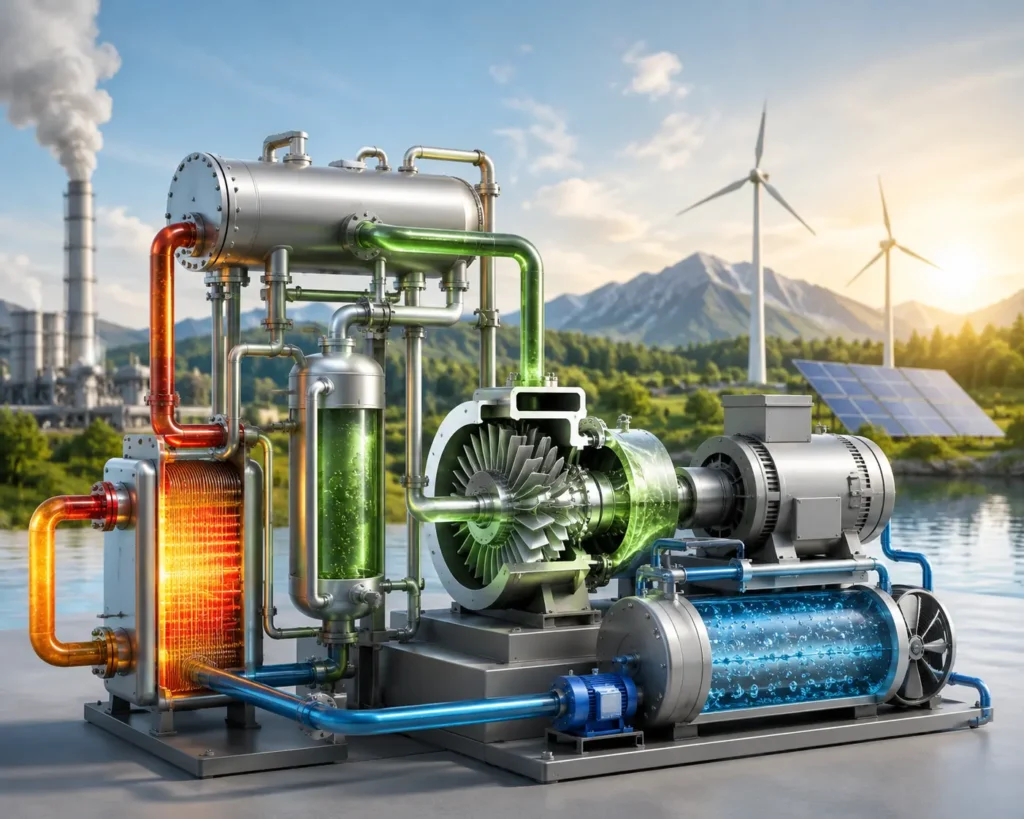
The organic Rankine cycle is a thermodynamic cycle that is commonly used to generate power from low grade, low temperature heat source by using organic fluid with low boiling point instead of water. The conventional Rankine cycle becomes inefficient for heat source below 350°C but the organic Rankine cycle can effectively utilize the low grade thermal energy which otherwise is wasted in the atmosphere through exhaust, cooling system or process steam. The organic Rankine cycle is widely used to recover industrial waste heat, harness the geothermal, biomass and solar thermal energy.
Table of Contents
Because the otherwise wasted heat is converted into work, the organic Rankine cycle thus improves the overall energy efficiency, reduces fuel consumption and supports cleaner and sustainable power generation.
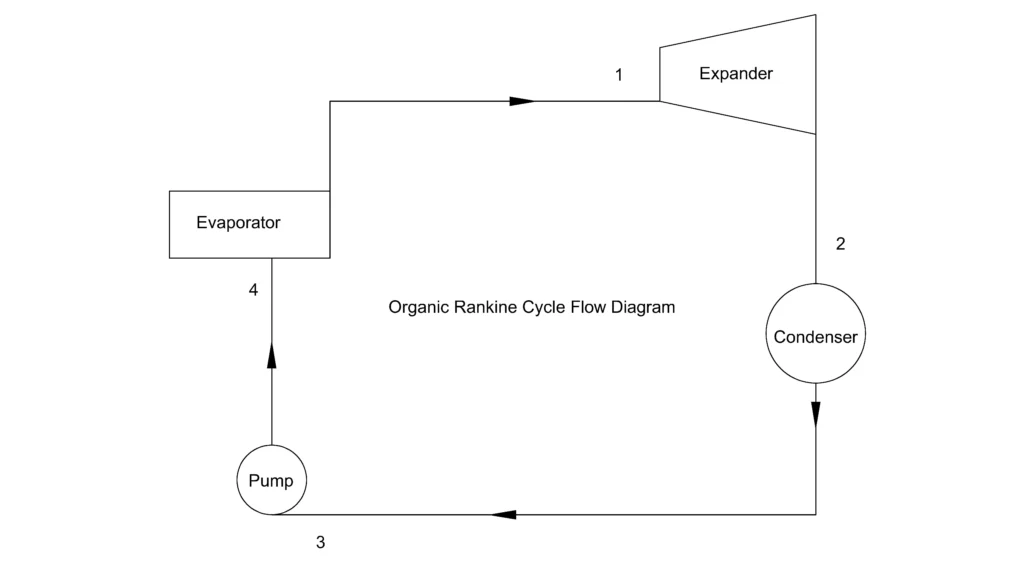
Major components of the organic Rankine cycle
Evaporator
The evaporator is the primary heat exchanger, where the heat energy from the low temperature source is transferred to the organic fluid. As the fluid absorbs the heat, it vapourizes and in some cases becomes slightly superheated before entering the expander.
Expander or Turbine
The high pressure organic vapour enters the turbine and expands converting the thermal and pressure energy into mechanical work. Depending on the type of applications and power output, the organic Rankine cycle can use radial turbine, axial turbines, screw or scroll expander.
Condenser
After leaving the expander, the low pressure vapour enters the condenser, where it rejects the heat to cooling medium like air or water. The vapour condenses into saturated or subcooled liquid thus completing the condensation process.
Feed Pump
The feed pump is responsible for raising the pressure of the condensed organic fluid into evaporator pressure. As the working fluid is in the liquid state, the pump requires less work relatively.
How Organic Rankine Cycle Works
Step 1: Pressurization
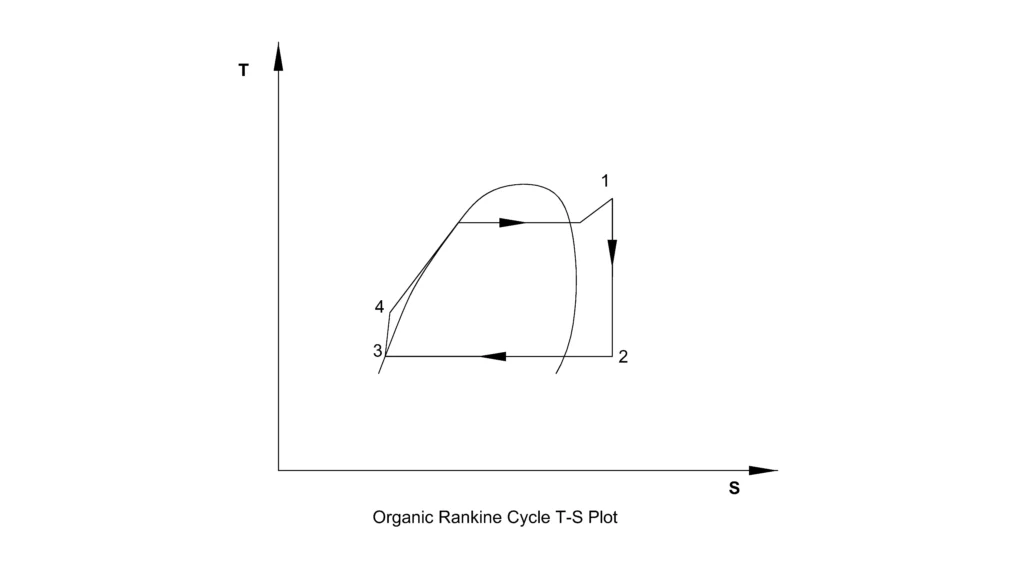
The cycle begins with the feed pump increasing the pressure of the organic fluid. As the fluid is incompressible in the liquid state, only a small amount of pumping work is needed.
Step 2: Heat absorption
The pressurized fluid enters the evaporator and absorbs heat from the low temperature source like industrial waste heat, geothermal fluid, biomass combustion or solar thermal energy. The fluid vaporizes and becomes superheated absorbing the heat and then is expanded.
Step 3: Expansion
The high pressure vapour expands in the turbine or expander, converting the energy of the vapour in to mechanical work. The turbine is coupled to a generator which converts the mechanical energy into electricity.
Step 4: Condensation
The low pressure vapour leaving the turbine enters the condenser and rejects the heat to a cooling medium and condenses back to liquid state. The condensed fluid is then pumped back to the evaporator, completing the cycle.
Why Organic fluids are used instead of water
Organic fluid is used in the organic Rankine cycle because of the following reason:
Lower boiling point
Water boils at 100°C (1 atm), but organic Rankine cycle needs a fluid with much lower boiling point temperature such as R245fa with 15.1°C, R1233zd(E) with 18.3°C, isobutane with -11.7°C, pentane with 36.1°C all at 1atm pressure. This allows these fluids to vapourise using low temperature heat sources.
Higher vapour pressure at moderate temperature
At 100°C, water has a saturation pressure of 1.01 bar, whereas the organic Rankine cycle requires fluid to exhibits much higher pressure at low temperatures. For example
| Working Fluid | Saturation Pressure | Saturation Temperature |
| R245fa | ≈ 9 bar | 100°C |
| R1233zd(E) | ≈ 4.5 bar | 100°C |
| Isobutane | ≈ 15.5 bar | 100°C |
| n-Pentane | ≈ 3.4 bar | 100°C |
Better utilization of low grade heat
Organic fluids essentially has to recover energy from low heat source in the range of 80-350 °C, where conventional Rankine cycle with steam is uneconomical.
Reduced moisture during expansion
The organic fluids are often classified as dry or isentropic fluids. They mostly remain superheated at the turbine exit, nullifying the liquid droplet formation and blade erosion problem.
Advantages vs Limitations of Organic Rankine Cycle
| Advantages | Limitations |
| Utilizes low-temperature heat sources: Efficiently generates power from heat sources as low as 80–350°C, whereas conventional steam Rankine cycles are generally uneconomical below ≈350°C. | Lower thermal efficiency: Organic Rankine Cycle typically achieve 8–25% thermal efficiency, compared to 35–45% for conventional Rankine power plants operating at high temperatures. |
| Waste heat recovery: Can recover 5–20% of the waste heat available in industrial exhaust streams, depending on the heat source and cycle configuration. | Lower power output: This cycle produces typically 50 kW to 20 MW, while steam Rankine plants commonly generate 100 MW to over 1,000 MW. |
| Low pump work: Pump work is typically less than 1–3% of the turbine output as the working fluid is compressed in the liquid phase. | High working fluid cost: Organic refrigerants such as R1233zd(E) or specialty fluids for the cycle are significantly more costly than water and require periodic replacement due to leakage or degradation. |
| Reduced turbine moisture: Dry organic fluids maintain turbine exhaust quality close to 100%, virtually eliminating liquid droplet erosion. | Environmental concerns: Some fluids, such as R245fa, have a high Global Warming Potential (GWP ≈ 858–1,030), although newer fluids such as R1233zd(E) have a GWP < 1. |
| Lower turbine speed: Turbine rotational speeds are typically 3,000–15,000 rpm, compared with 10,000–30,000 rpm for many small steam turbines. | Large heat exchangers: The evaporators and condensers of organic Rankine cycle often requires 20–50% more heat transfer area than steam systems because of lower temperature gradient between organic fluid and exhaust gas. |
| High availability: Commercial organic Rankine cycle plants typically achieve 95–98% annual availability with relatively low maintenance requirements. | Higher capital cost: Installed costs generally range from US$2,000–5,000 per kW, depending on plant size and application. |
| Lower emissions: Waste heat recovery systems can reduce fuel consumption and CO₂ emissions by 5–15% in many industrial applications. | Fluid selection is critical: No single working fluid performs optimally across the entire 80–350°C operating range, requiring careful thermodynamic and environmental evaluation |
Sources
- U.S. Department of Energy / Idaho National Laboratory (INL)
- MDPI – A Comprehensive Review of Organic Rankine Cycles (2023)
This article is a part of thermal system, where other related articles are discussed.