
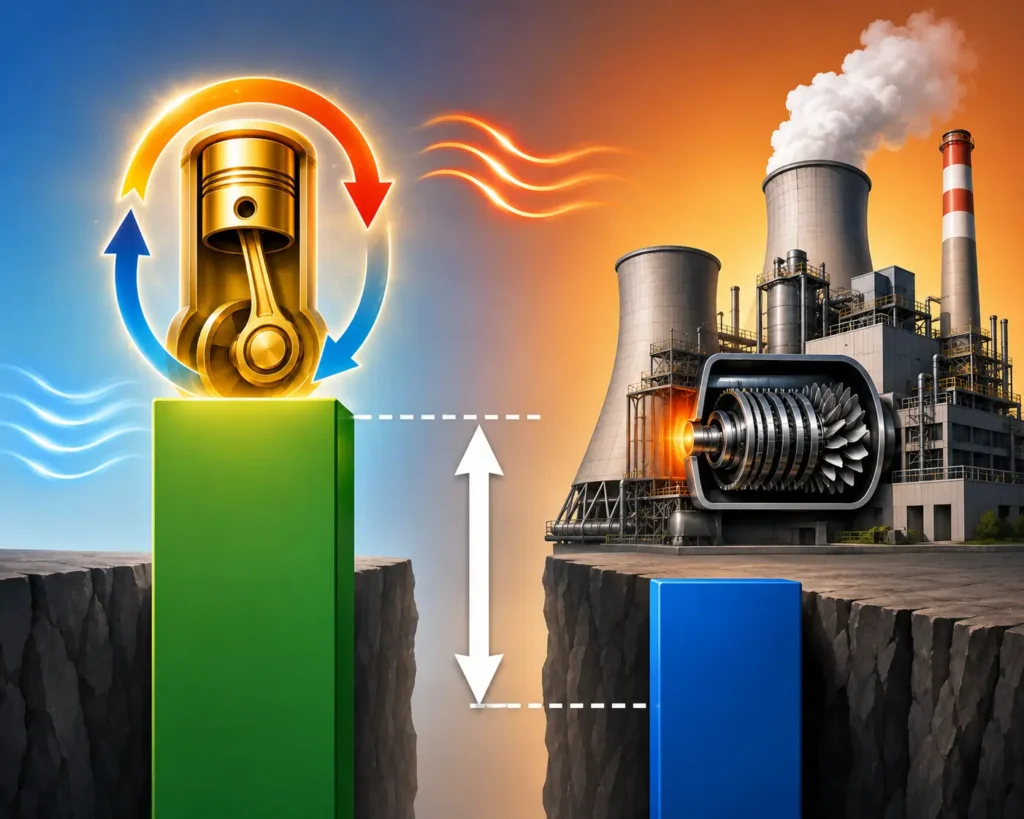
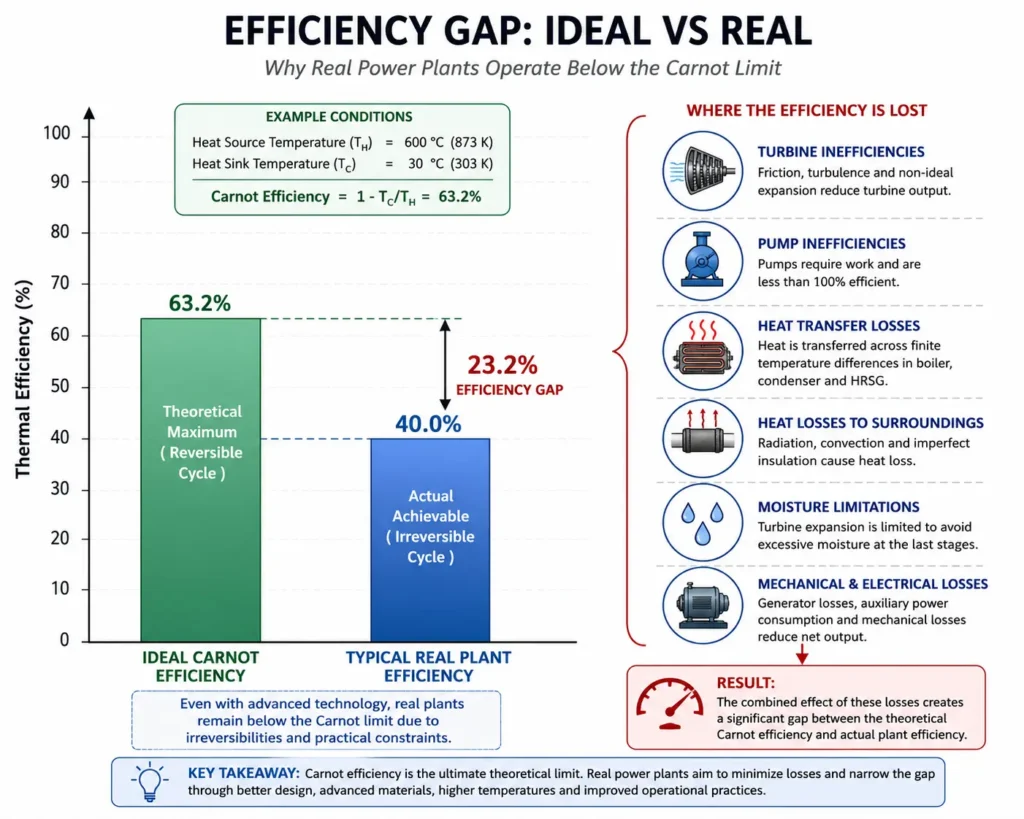
Carnot efficiency is one of the most important indicators of a power plant’s performance as it is the theoretical maximum efficiency that any heat engine can achieve while operating between two temperature limits. While, in practice, the power plants work on Rankine Cycle, Brayton cycle, Regenerative Rankine cycle or combined cycle, the plant always operates below the Carnot efficiency because of irreversibilities, heat loss and other engineering constraints. Hence, the Carnot efficiency serves as a benchmark for evaluating the performance of all thermal power plants. Therefore, understanding the gap between the Carnot efficiency and actual plant efficiency is essential for improving the power generating units.
What is Carnot Efficiency?
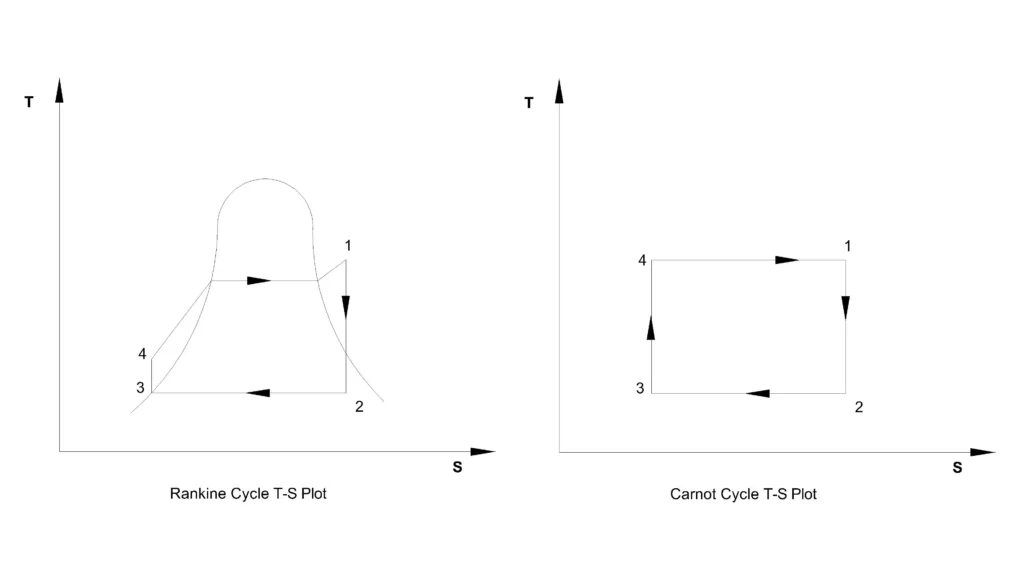
Carnot efficiency is the maximum theoretical efficiency that any heat engine can achieve, working between a high temperature heat source and low temperature heat sink. The Carnot efficiency is based on Carnot cycle, which consists of entirely reversible process and assumes no friction or heat loss or other irreversibility. Hence, no real heat engine can be more efficient than a Carnot engine operating between same temperature limits.
The Carnot efficiency is given by
Where, TH is the absolute temperature of heat source (K)
TC is the absolute temperature of heat sink (K)
Since, the equation of Carnot efficiency depends only on the absolute temperatures of the heat source and heat sink, the Carnot efficiency is independent of working fluid used in the cycle.
The Real plant efficiency
The real plant efficiency, also known as the actual thermal efficiency is the ratio of the net useful work produced by the power plant at the turbine shaft to the heat energy supplied by the fuel. Unlike the Carnot efficiency, it accounts for all practical losses such as friction, heat transfer irreversibility, pressure drops and equipment inefficiencies. It is given by
Typical real plant efficiency or thermal efficiency of modern power plants are
- Subcritical Rankine Cycle: 35-40%
- Supercritical Rankine Cycle: 42-45%
- Brayton Cycle: 30- 45%
- Combined cycle power plant: 55-65%
These values are always lower than the corresponding Carnot efficiency because of no real power plant operates under perfectly reversible conditions.
Why Real power plants cannot reach the Carnot efficiency
Although the Carnot efficiency is the maximum theoretical efficiency of the heat engine, real power plants operates below this limits because of the unavoidable thermodynamics and engineering constraints. These are:
Irreversible processes
The real power plant contains numerous irreversible processes that generates entropy and reduces the amount of useful work obtained from heat supplied. Friction in turbines, pumps and bearings, converts the mechanical energy into low grade heat, while the fluid turbulence and pressure loss in pipes and heat exchangers increases the energy dissipation. These irreversibilities prevent the cycle from achieving the reversible processes which is assumed in the Carnot cycle.
Heat transfer across finite temperature difference
In practical systems, heat cannot be transferred unless there is a temperature gradient between the hot and cold fluid. Boilers, Condensers, Heat Recovery Steam Generators therefore, works within a finite temperature gradient to maintain continuous heat transfer. This makes the heat transfer process irreversible and the greater is the difference, higher is the irreversibility and entropy generation. This lowers the maximum achievable thermal efficiency.
Component inefficiencies
There is no power plant equipment that operates with 100% efficiecncy. Steam turbine, gas turbine works with an isentropic efficiency of 85-95%, requiring more energy to produce the same work output. Pumps and compressors on the other hand consumes more power than the ideal value. Together these inefficiencies reduces the plant’s overall thermal efficiency.
Heat loss to the surrounding
A portion of heat supplied is inevitably lost to the environment through radiation, convection and conduction from boilers, steam pipes, turbines and other high temperature equipment. Although thermal insulation reduces the surface heat loss by 55-65%, while insulation of the distributing steam lines reduces the heat loss by 90% compared to uninsulated lines. The heat loss cannot be eliminated completely resulting in lower thermal efficiency.
Moisture limitation of steam turbines
In ideal carnot cycle, steam can continue to expand to maximize the work output. However, in practice, excessive expansion of the steam produces high moisture content in the later stages of the turbine. The water droplets at high velocity can erode the turbine blades, reducing the component life. To maintain a acceptable dryness fraction of the steam above 0.88 in the turbine, the expansion is limited.
How Engineers reduce the efficiency gap between the Carnot and the Practical cycles
Although no practical power plant can match the Carnot efficiency but engineers uses several methods to improve the thermal efficiency of the plant taking it closer to the Carnot. The methods are:
Increase turbine inlet temperature
For a Rankine cycle,
Increasing the turbine inlet temperature increases h1
This increases the turbine work output as WT = h1 – h2.
But increasing the turbine inlet temperature also increases the heat input as
Qin =h1 – h4
But as the turbine work output is proportionally larger than the heat input after increasing the turbine inlet temperature. Therefore,
Change in Work output > Change in Heat input,
Which increases the thermal efficiency taking it closer to the Carnot efficiency
Increasing the Boiler pressure
The Rankine efficiency depends on the average temperature of heat addition. Higher boiler pressure shifts the heating process upwards on the T-S diagram.
Mathematically,
Increasing the pressure, increases the average temperature,
Since,
Raising the average heat addition, increases the actual efficiency.
Reheating the steam
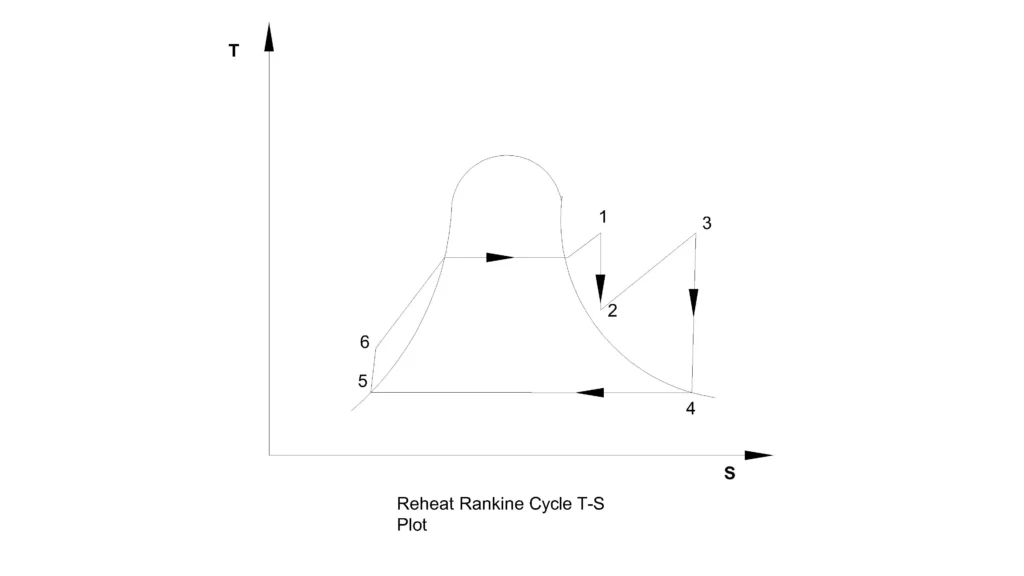
Without reheat, the turbine’s work output is
Wt =h1−h2
With reheat, the steam is expanded into two or more stages,
Wt = (h1−h2) + (h3−h4)
The second expansion of the steam increases the net turbine work output.
Although additional heat is supplied to increase the turbine work,
Qin = (h1−h6) + (h3−h2)
The increase in work output is usually greater than the increase in heat input. And hence, the efficiency increases slightly. Although, it may be noted that reheating is done to reduce the moisture content at the turbine exit.
Regenerative feedwater heating
Initially, the heat input is Q in = h1−h4
After regeneration, the feed water temperature increases from h4 to hfw
Therefore, Qin new = h1−hfw
Since hfw > h4, the heat input decreases Qin new < Qin
Also, as the steam does not fully expands in the turbine, there is a slight work reduction but a significant reduction in the heat input increases the thermal efficiency of the plant, bring it closer to Carnot efficiency.
Combined cycle
In this process both Brayton and Rankine cycle is combined together to produce the work. The exhaust gas of the gas turbine is at very high temperature and is thus utilised in a heat recovery steam generator to produce steam at high pressure and is expanded in steam turbine to produce additional work from the same fuel used in the gas turbine. Since the net work is more WGT + WST, with same amount of fuel or heat input Qin, the thermal efficiency is more than normal gas turbine working on Brayton cycle or steam turbine working on Rankine cycle.
Advanced turbine blade cooling
Cooling of the turbine blades allows for higher firing temperature, which increases the turbine work output significantly. As the work output increases with same heat input, the thermal efficiency of the plant increases and gets closer to Carnot efficiency.
Better thermal insulation
Heat loss is approximately equal to U A ΔT, where U is the overall heat transfer coefficient, A is the area of heat transfer and ΔT is the temperature difference.
Reducing the heat loss with better insulation makes the useful heat remain in the cycle to produce more work or it results in significant reduction in heat supplied. This results in higher thermal efficiency of the plant.
Carnot Efficiency vs Real plant efficiency
| Parameter | Carnot Efficiency | Real Plant Efficiency |
| Nature | Theoretical | Actual |
| Cycle | Ideal reversible | Real irreversible |
| Friction | None | Present |
| Heat Loss | None | Present |
| Entropy Generation | Zero | Positive |
| Practical Achievability | Impossible | Achievable |
| Depends On | Temperature limits only | Equipment design and operating conditions |
Sources
- Çengel, Y. A., Boles, M. A., & Kanoğlu, M. Thermodynamics: An Engineering Approach
- Practical Power Plant Engineering: A Guide for Early Career Engineers
This article is a part of thermal system, where other related articles are discussed.