
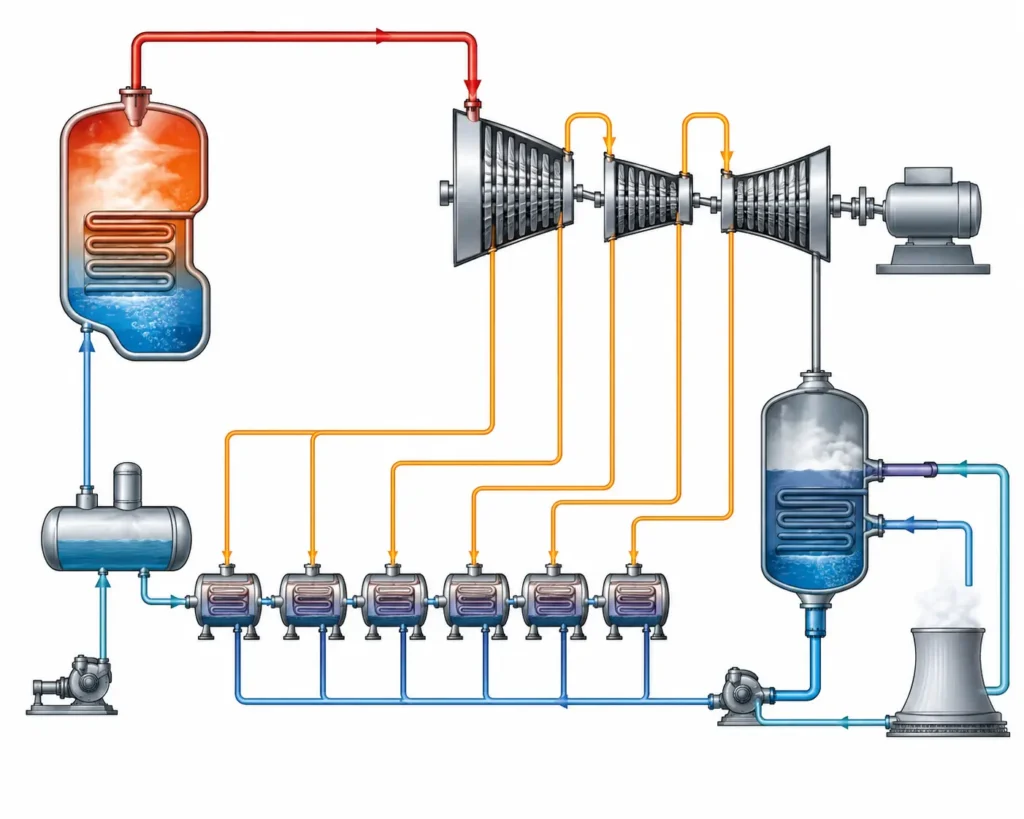
Regenerative Rankine cycle is an improvised version of the Rankine cycle, in which a portion of partially expanded steam is bled from an intermediate stage of the turbine, is utilized to preheat the feed water before entering the boiler. Thus, by increasing the temperature of the feed water before it enters the boiler, less heat will be required to be added in the boiler. This increases the cycle’s efficiency.
Table of Contents
Why is regeneration needed
- Regenerative Rankine cycle aids in improving the thermal efficiency by reducing the heat input in the boiler.
- By increasing the feed water temperature, average temperature of heat addition is increased and this moves the regenerative Rankine cycle closer to Carnot cycle.
- With regeneration, the fuel consumption also reduces as the preheating of the water is done via the portion of expanded steam.
- Regeneration also decreases the energy wasted at the condenser, which otherwise (full expansion) would result in little to no significant work output.
- Regenerative Rankine cycle reduces the thermal shock in the boiler as preheating of the feed water results in less temperature gradient.
- Regenerative Rankine cycle improves the overall heat rate of the plant as less heat input is required per unit of electricity generated.
- The efficiency of the steam power plant working on regenerative Rankine cycle can increase anywhere between 3 to 8% depending upon numbers of feed water preheaters used.
The Cycle
In Rankine cycle, the condensate, which is at fairly low temperature, is pumped and mixed with the boiler water which is at a hotter state. This large temperature gradient decreases the cycle efficiency. Therefore, in regenerative Rankine cycle, the feed water is heated before entering the boiler drum, by exchanging heat within the system from bled steam of the turbines.
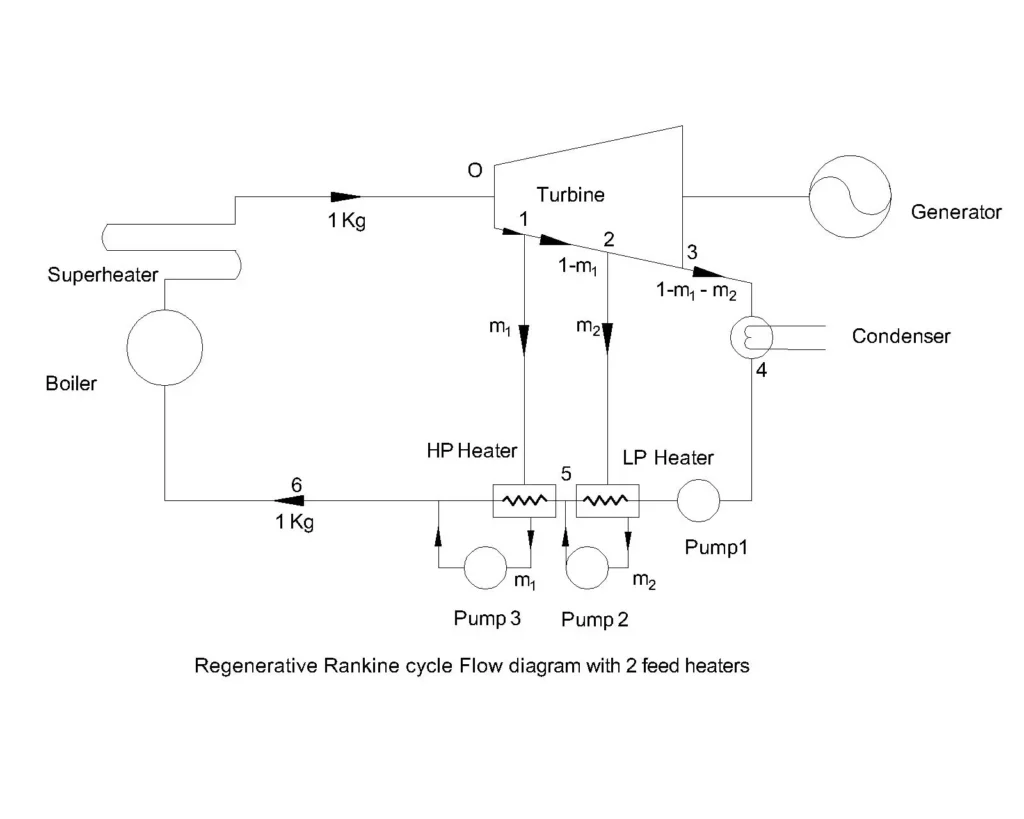
In this system, the saturated or superheated steam enters the turbine, where the steam expands and provides the work output. In an intermediate stage of the turbine, a portion of steam (say m1 kg) is bled out to exchange its heat with the feed water in a heat exchanger or High-pressure heater. The remaining steam (1-m kg) continues to expand in the turbine until some more is extracted or bled for heating the feed water in a low-pressure heat exchanger or heater.
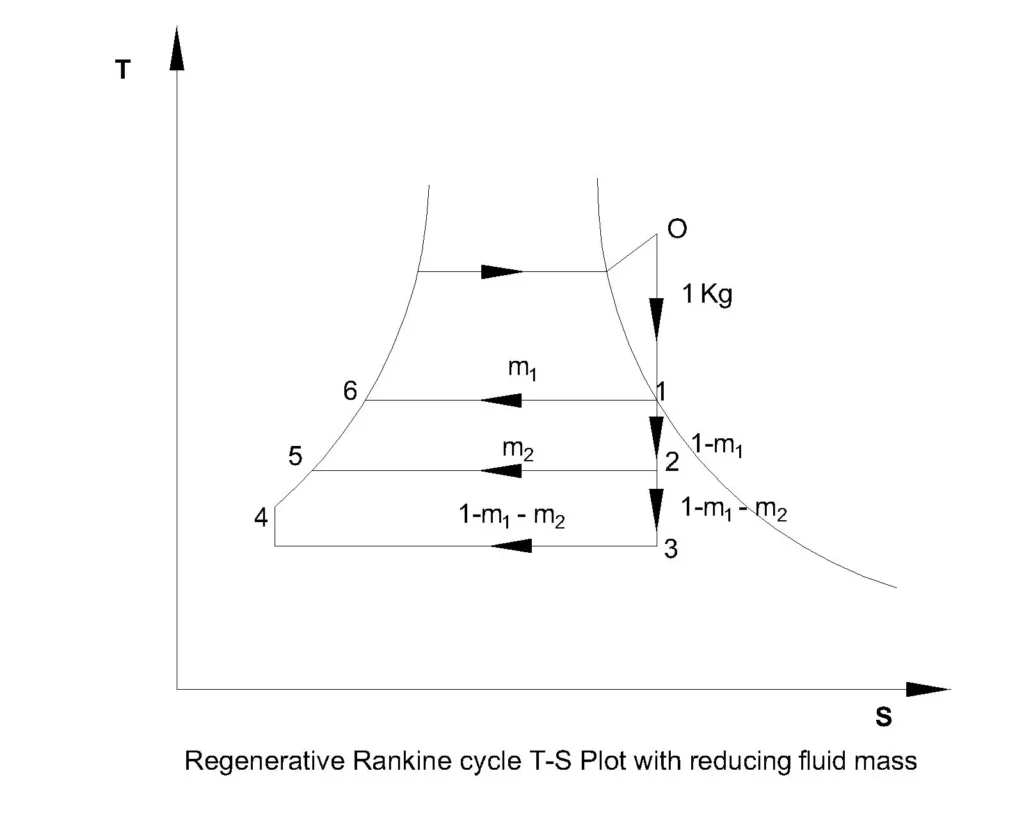
The rest of the steam (1-m1-m2 kg) expands in the turbine and flows through the condenser, gives up the heat and the condensate adds up to the feed water, which is pumped back to the boiler after passing through the heaters and gaining the heat.
Let, m1 be the mass of high-pressure steam bled per kg of steam flow,
m2 be the mass of low-pressure steam bled per kg of steam flow, and
1-m1-m2 be the mass of steam entering the condenser per kg of steam flow.
Equating the energy balance for the high pressure heater
m1 (h1 – hf6) = (1 – m1) (hf6 – hf5)
or, m1[(h1 – hf6) + (hf6 – hf5)] = (hf6 – hf5)
or, m1 = hf6 – hf5 / h1 – hf5
Energy balance for the low-pressure heater
m2 (h2 – hf5) = (1 – m1 – m2) (hf5 – hf3)
or, m2[(h2 – hf5) + (hf5 – hf3)] = (1 – m1) (hf5 – hf3)
or, m2 = (1-m1) (hf5 – hf3) / (h2-hf3)
Note: Heat gained by the feed water = Heat given off by the bled steam in the heat exchangers. The heat exchangers / heaters are assumed to be adequately insulated and no heat is gained or lost in the surroundings.
Considering all enthalpies can be determined, the masses m1 and m2 can be calculated from the above energy balance equations.
Total external heat supplied in the cycle is
Q = h0 – hf6
The isentropic work done is
W = m1 (h0 – h1) + m2 (h0 – h2) + (1 – m1 – m2) (h0 – h3)
The work done may also be calculated by adding up the work done by the steam at all stages of the turbine which is the product of steam flow and heat drop at different stages.
W = (h0 – h1) + (1 – m1) (h1 – h2) + (1 – m1 – m2) (h2 – h3)
Therefore, the thermal efficiency of the regenerative Rankine cycle is
ηthermal = Work done / Heat supplied
= [ m1 (h0 – h1) + m2 (h0 – h2) + (1 – m1 – m2) (h0 – h3)] / h0 – hf6
The feed water heating temperature is kept 50-60°C below the boiler’s saturated steam temperature in order to prevent evaporation of the feed water in the feed mains. The temperature of the bled stream is so selected for each heater that its temperature is 4 to 10°C higher than the final feed water temperature.
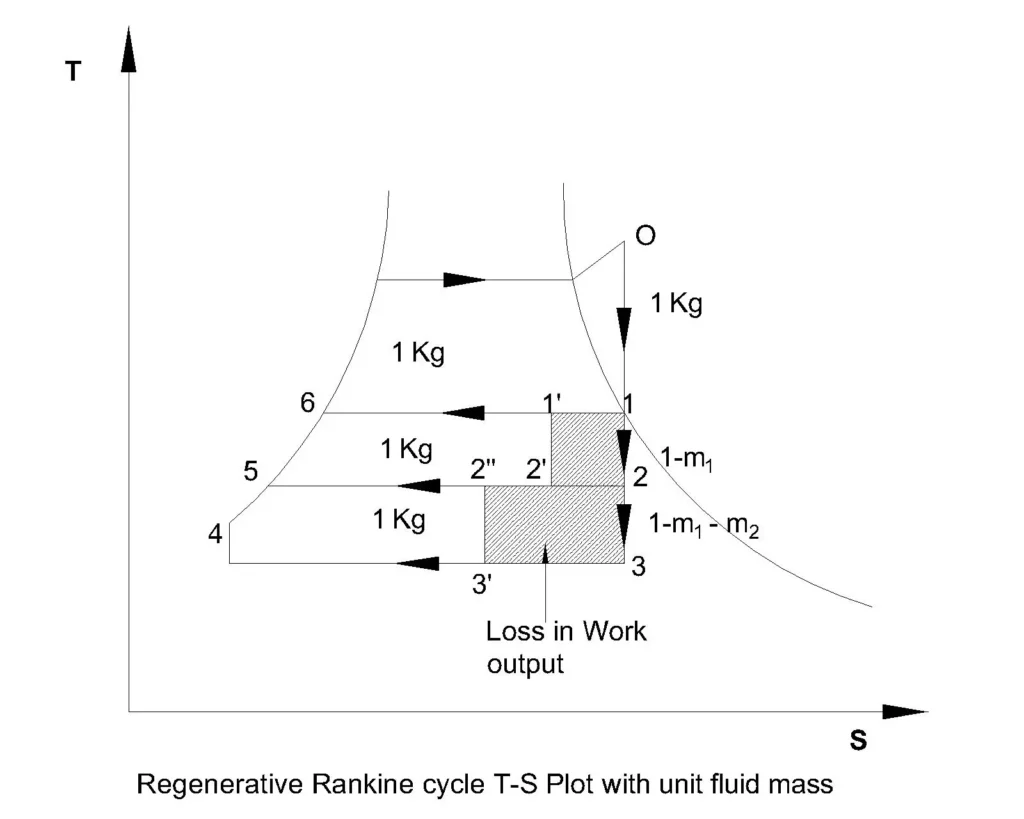
The heat rejected in the Regenerative Rankine cycle decreases from h3-h4 to h3′-h4 . Also there is a loss in the work output, which is shown by the hatched area as the steam is bled from the turbine to heat the feed water. This makes the steam rate of the cycle to increase because of regeneration. This means more steam has to circulate to produce unit shaft output.
The number of feed water heaters employed depends upon the throttling condition of the turbines. For medium capacity turbines, not more than 3 heaters are employed. For high pressure and high-capacity turbine, the number is 5 to 7. For turbines working under supercritical conditions, it can be anywhere between 8 to 9.
Feed water heater vs Efficiency Gain
The first few feedwater heaters provide significant gain in efficiency because of the increase in average temperature of heat addition. But with addition of more water heaters, the feedwater temperature approaches saturation, making the cycle to approach Carnot. This means with addition of more heaters, change in feed water temperature becomes less significant. And as the cycle’s efficiency is proportional to the change in feed water temperature, the efficiency gains follow the law of diminishing returns.
The number of feed water heater is therefore fixed by the energy balance of the entire plant when cost of adding another heater does not justify the savings in the heat input of the boiler Q or the marginal increase in cycle’s efficiency. Also in certain cases, increase in feedwater temperature, decreases the boiler and hence the number of feed water heater is optimized accordingly.
| Feedwater Heater Added | Approx. Feedwater Temperature Rise (°C) | Incremental Efficiency Gain (%) |
| 1st heater | 35–45 | 1.5–2.0 |
| 2nd heater | 25–35 | 0.9–1.2 |
| 3rd heater | 20–25 | 0.6–0.8 |
| 4th heater | 15–20 | 0.4–0.6 |
| 5th heater | 10–15 | 0.3–0.4 |
| 6th heater | 8–12 | 0.2–0.3 |
| 7th heater | 5–8 | 0.1–0.2 |
| 8th heater | 3–5 | 0.05–0.10 |
This article is a part of thermal system, where other related articles are discussed.