
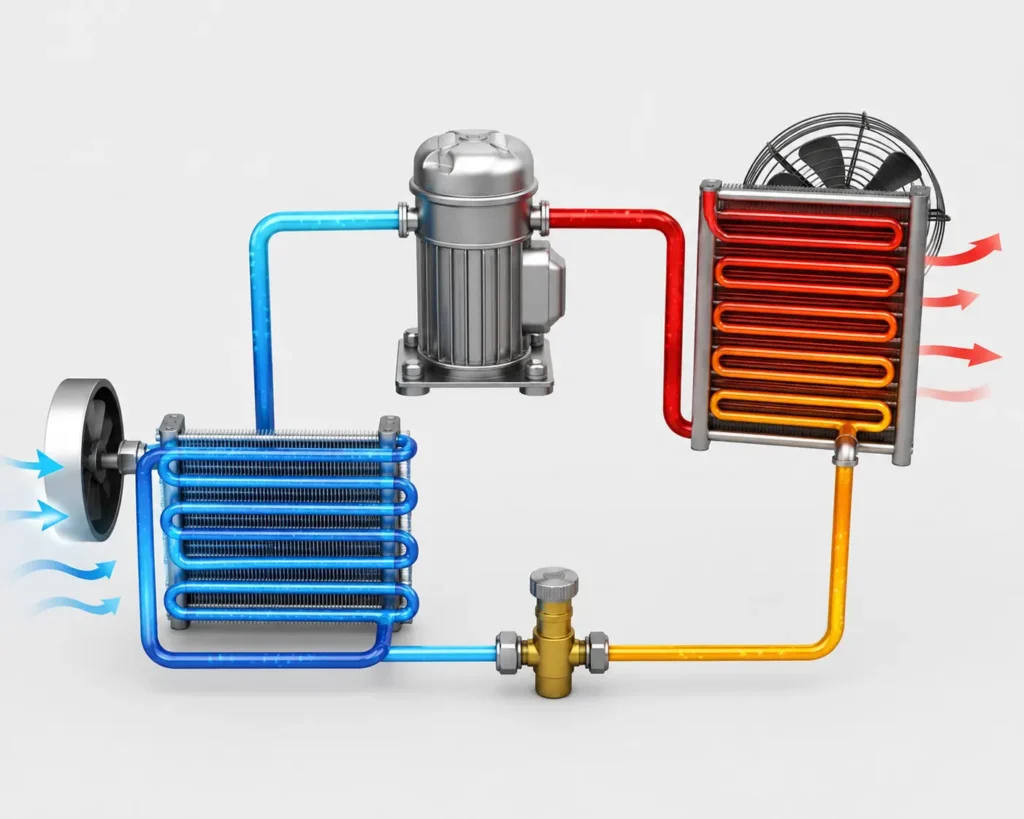
The vapour compression refrigeration cycle or VCR is widely used refrigeration cycle for cooling and air conditioning applications. The overall effect of vapour compression refrigeration cycle is to transfer heat from a low temperature space to a high temperature environment with the help of mechanical work, supplied to a compressor, which enables the heat flow in opposite to its natural direction.
Table of Contents
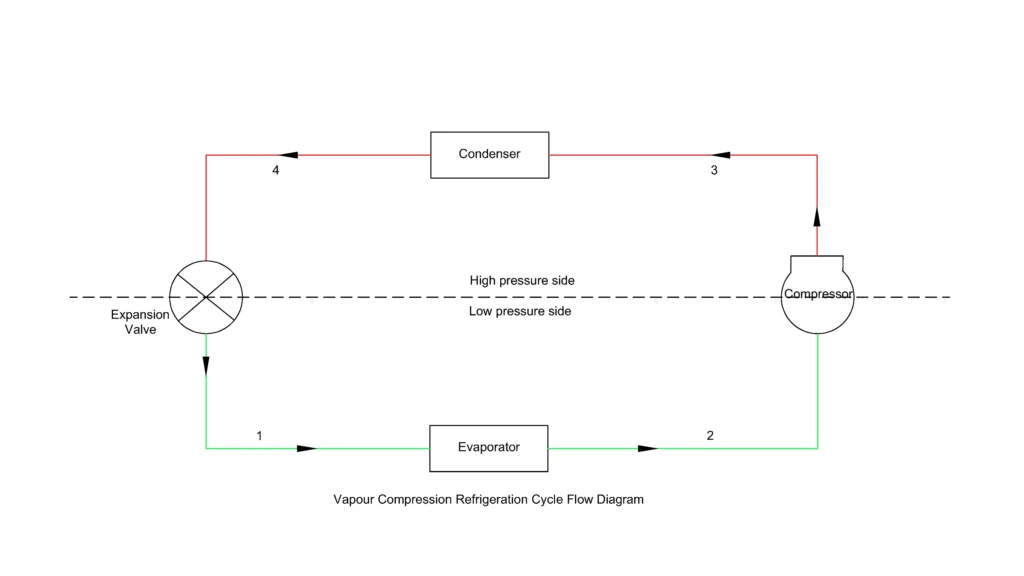
The Vapour compression refrigeration cycle encompasses four fundamental thermodynamic processes. These are compression, which increases the refrigerant’s pressure and temperature, condensation, where the refrigerant rejects the heat to the environment, expansion, where the refrigerant pressure is reduced through the expansion valve and evaporation, where the refrigerant absorbs the heat from the low temperature refrigerated space. The cycle continues to provide efficient and reliable cooling effect to domestic, commercial and industrial systems.
Main components of a Vapour compression refrigeration cycle or VCR
The following description is based on a typical refrigeration system with R134a refrigerant operating with a evaporator temperature of -10 °C and a condensing temperature of 40 °C.
Evaporator (Process 1-2)
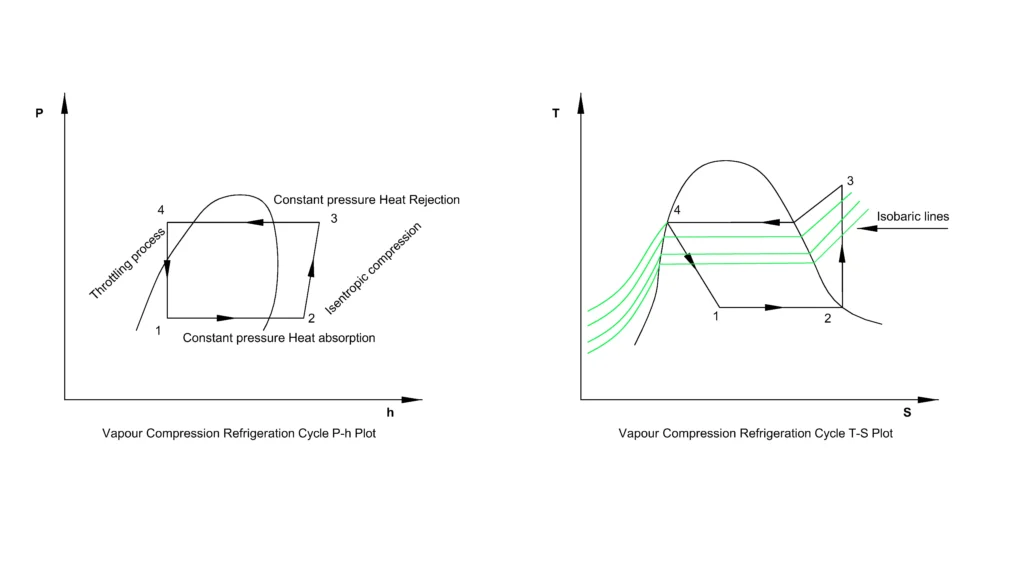
The low-pressure liquid-vapour mixture enters the evaporator at approximately 2 bar and -10°C, in same state as of the exit state from the expansion valve. The refrigerant absorbs the heat from the evaporator/refrigerated space at nearly constant pressure, vaporizing completely with slightly becoming superheated before going to the compressor as a low-pressure vapour.
The thermodynamic process involved here is constant pressure heat absorption, creating a refrigerating effect which is
Compressor (Process 2-3)
In the vapour compression refrigeration cycle, the refrigerant enters the compressor at a low pressure and slightly superheated vapour state at say approximately 2 bar pressure and -5°C temperature. The compressor work is nearly isentropic and it increases the refrigerant pressure to 10 bar with temperature of about 70-90°C. The refrigerant leaves the compressor with high pressure and as superheated vapour.
The thermodynamic process at the compressor is nearly isentropic with work input
Condenser (Process 3-4)
The high pressure superheated vapour enters the condenser at same condition as it exits the compressor, in this case at 10 bar with 70-90°C. The refrigerant undergoes de-superheating and then condenses at constant pressure, rejecting the heat to cooling air or water. The refrigerant leaves the condenser at a high pressure, saturated or slightly subcooled liquid at approximately 40°C and 10 bar pressure for this case (say).
The thermodynamic process in the condenser is constant pressure heat rejection, the heat rejected at the condenser is
Expansion Valve (Process 4-1)
The liquid refrigerant from the condenser passes through the expansion valve, where the pressure of the refrigerant drops abruptly as in this case 10 bar to 2 bar approximately. The thermodynamic process involved here is throttling which is isenthalpic, causing the part of liquid to flash into vapour. The refrigerant leaves this equipment as low pressure liquid-vapour mixture at approximately -10°C. The energy equation here is
Coefficient of performance (COP)
The coefficient of performance (COP) is the measure of efficiency of the refrigeration system, which is defined as the ratio of the refrigeration effect produced to the compressor work input required to achieve that effect.
Where QA is the refrigeration effect and WC is the compressor work.
A higher COP indicates that the system produces more cooling for the same amount of power input, making the system more energy efficient. Unlike the thermal efficiency of the heat engine, the COP of the refrigeration cycles can be greater than 1 because the mechanical work in the compressor does not creates the cooling but instead it moves the existing heat from the low temperature region to high temperature surrounding air.
Since the compressor only supplies the energy needed to transport the heat, the amount of heat removed from the refrigerated space is often multiple times larger than the work input. Typical COP values for domestic refrigerators are 2-4, for air conditioners it is 3-5 and 4-6 for industrial refrigeration.
Factors affecting the COP
Evaporator Temperature
Increasing the evaporator temperature reduces the compressor pressure ratio and work input. With higher evaporator temperature, the COP can increase by 10-30% depending upon the operating conditions.
Condenser temperature
Lowering the condenser temperature reduces the compressor work and improves the heat rejection. The COP usually increases by 2-4% for every 1°C reduction in the condenser temperature.
Compressor efficiency
A higher isentropic efficiency (usually 75-90%) reduces the compressor power consumption. Increasing the compressor efficiency by 10% improves the COP of the vapour compression refrigeration cycle by 5-10%.
Refrigerant properties
Refrigerant with high latent heat, low specific volume and proper thermodynamic properties can provide higher refrigeration with low compressor work, improving the COP by 5-15% in comparison to less suitable refrigerants.
Practical ways to improve the COP of a Vapour compression refrigeration cycle
Other than improving on the above factors influencing the COP of Vapour compression refrigeration cycle, VCR, the following points will also improve the COP of the cycle.
Minimizing the pressure drop
The pressure losses in the pipes, valves and heat exchangers must be limited to 0.2 bar, which will reduce the compressor work load and increase the COP.
Keeping the heat exchanger coils clean
Regular cleaning of the heat exchanger coil maintains effective heat transfer and increases the COP by 5-15%.
Use of variable speed compressors
Variable frequency drive compressors can reduce the energy consumption in vapour compression refrigeration cycle by 15-30% under part load conditions by matching the cooling capacity to the actual load.
References
- Vapor Compression Cycle: A State-of-the-Art Review on Cycle Improvements
- Recent Advances in Vapor Compression Refrigeration Cycle Technologies
This article is a part of thermal system, where other related articles are discussed.