
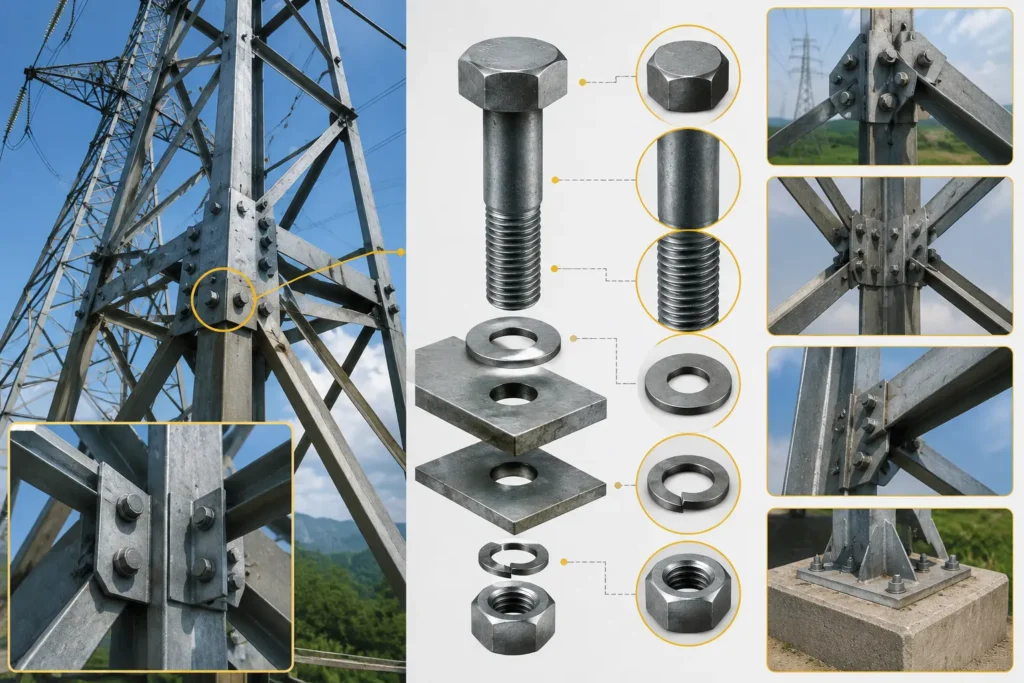
Hexagonal bolts and the bolted connections are critical components of transmission line tower as they join individual steel members into a stable and load carrying structure. Hexagonal bolts provide 6 wrench positions to tighten it allowing the joining of tower member and gusset plates, even when the access to the bolt is limited by space.
Hexagonal bolts also offer better grip for spanners and impact wrenches, which enables efficient lighting and preloading during tower erection. The hexagonal bolt’s head also requires less material compared to square head, while providing necessary bearing area and wrench grip. This reduces the weight of the bolt, which helps in optimization of the tower’s self-load.
Table of Contents
Components of the standard tower bolt assembly
A standard transmission tower bolt assembly consists of a hexagonal bolt, hexagonal nut and one or more washers. The bolt passes through the aligned holes in the steel tower members and the nut provides the clamping force. The washer distributes the bearing pressure, protecting the galvanised surfaces and help thus help maintain the secure connection under the designed tower loading.
Spring washer is also used in the assembly to minimize the possibility of the nut loosening caused by vibration, dynamic loading and structural movement.
Forces acting on the hexagonal bolts
The hexagonal bolts of transmission tower are subjected to various forces while maintaining the efficient joints in the tower. These forces are
Shear force
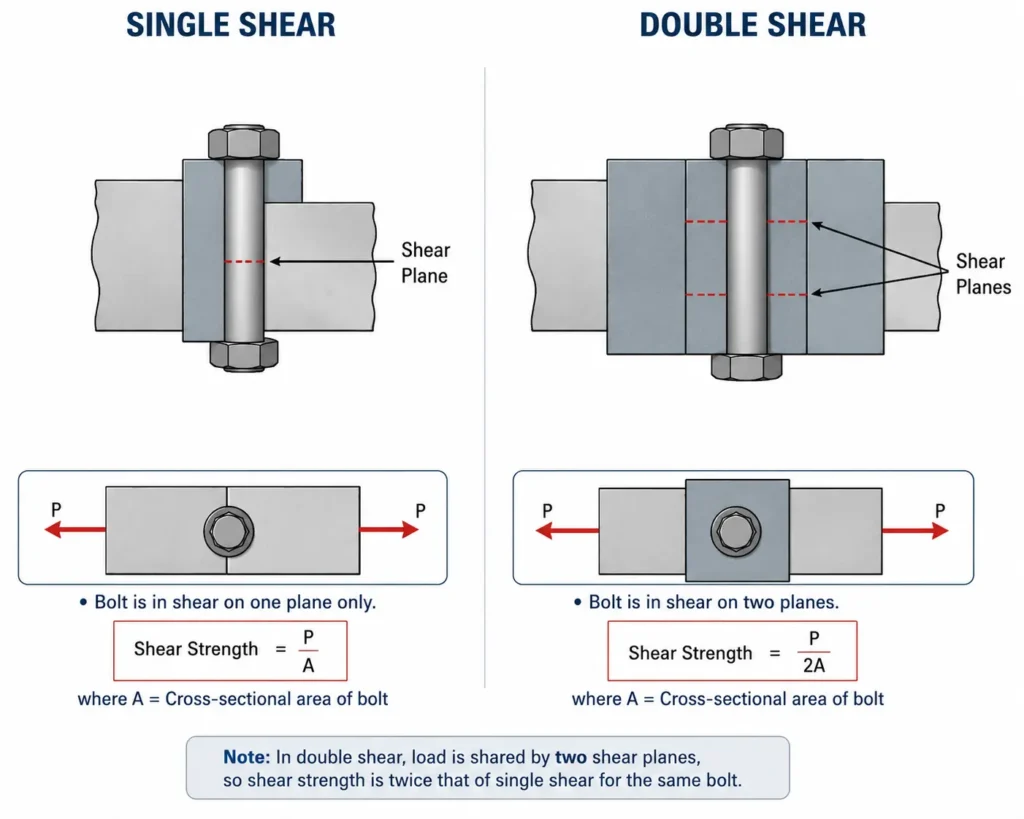
It occurs when the connected tower members tend to slide relative to each other, causing the bolt to resist the movement across its cross section. There are two types of shear failure that occurs in the bolts. One is single shear, where the bolt has only one shear plane and it carries the load across that plane. In Double shear, the bolt is sheared across two planes, which means two paths are present through which the shear force acts.
Bearing force
It is the force because of which the hexagonal bolt presses against the edge of the hole in the connected steel member. As the load gets transferred through the connection, the shank of the bolt bears against the surrounding steel and the contact pressure between the bolt and the hole wall is called the bearing stress. The bearing capacity of the joint depends upon the diameter of the bolt, thickness of the plate, edge distance, pitch distance and strength of the connected steel.
Tension force
It is the force that acts along the axis of the hexagonal bolt and attempts to pull the bolt apart. The bolt must therefore possess sufficient tensile strength to prevent yielding or rupture. Although most of the bolts used in the tower are designed for shear and bearing, direct tension some times occurs in the cross-arm attachment, stub and foundation connection, special gusset plate arrangement, eccentric loaded joints, etc. Hence, the tensile capacity of the bolts must also be checked in addition to shear and bearing capacities.
Anatomy of the hexagonal bolt
Hexagonal head
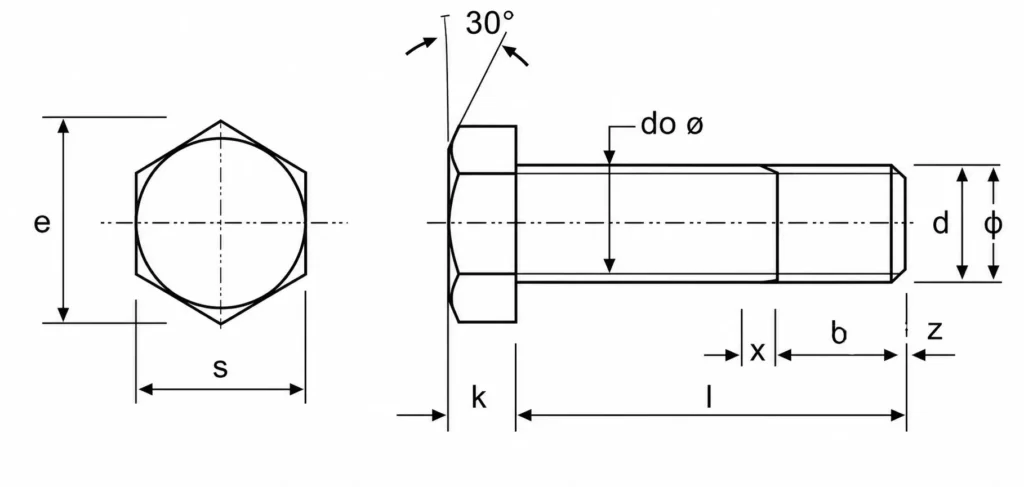
It is the six sided portion of the bolt which is designed for tightening and loosening it using standard spanner, socket or impact wrench. The width across the opposite corner is denoted by ‘e’ and that across the opposite flats by ‘s’.
e determines the minimum clearance required around the bolt head for it to turn, so that it does not interferes with other steel members.
s determines the size of spanner/wrench needed.
Bearing surface under the head
The underside of the hexagonal bolt is the bearing surface which comes in direct contact with the connected steel member. It transfers the clamping force generated during tightening, distributes the pressure over a larger area and prevents crushing or indentation of the galvanized steel surface.
Shank
The shank is the cylindrical part of the bolt, located between the head and the threaded portion. It acts as a primary load carrying section of the bolt, transfers the shear force between the connected tower members. The shank offers larger cross-sectional area than the threaded part and improves the shear resistance and fatigue performance.
Threaded portion
The threaded portion contains the helical grooves that connects with the nut to create the clamping force for connection. It is the threaded portion that has the highest stress concentration and governs the tensile strength of the bolt. The bolts used in transmission lines, uses standard metric threads such as M12, M16, M20 or M24.
Bolt end
The bolt end is the terminal portion of the bolt beyond the threaded portion with a chamfer. The chamfer is provided to help insertion of the bolt through the holes, aligning of nuts and protect the thread edges from damage.
Bolt head height (k)
The bolt head height, k, is important because it provides sufficient strength and wrench engagement for the tightening operations, while ensuring reliable load transfer, resistance to deformation and long term durability of the connection. If the head is too thin, head may crack under high tightening torque or wrench engagement can become unreliable. Proper head size aids in torque transmission.
| Bolt Size | d (Nominal Diameter, mm) | s (Width Across Flats, mm) | e (Width Across Corners, Min, mm) | k (Head Height, mm) | r (Fillet Radius, Max, mm) | da (Bearing Diameter, Max, mm) | b (Thread Length, mm) |
| M12 | 12 | 19 | 20.88 | 8 | 1 | 15.2 | 20 |
| M16 | 16 | 24 | 26.17 | 10 | 1 | 19.2 | 23 |
| M20 | 20 | 30 | 32.95 | 13 | 1 | 24.4 | 26 |
| M24 | 24 | 36 | 39.55 | 15 | 1 | 28.4 | 30 |
Nomenclature
- d = Nominal bolt diameter
- s = Width across flats of hexagonal head
- e = Width across corners of hexagonal head
- k = Head height
- r = Radius under head (fillet radius)
- da = Effective bearing diameter under the head
- b = Standard threaded length
Mechanical Property Class 4.6/4 Bolts (IS 1367)
- Ultimate shearing stress = 2220 kg/cm2
- Ultimate bearing stress = 4440 kg/cm2
| Bolt Dia (mm) | Single Shear (kg) | Double Shear (kg) | Bearing Strength @ 3 mm (kg) | @ 3.175 mm (kg) | @ 4 mm (kg) | @ 5 mm (kg) | @ 6 mm (kg) | @ 7 mm (kg) |
| 12 | 2511 | 5022 | 1598 | 1692 | 2132 | 2664 | 3197 | 3730 |
| 16 | 4464 | 8928 | 2131 | 2256 | 2842 | 3552 | 4263 | 4973 |
| 20 | 6974 | 13948 | 2664 | 2820 | 3552 | 4440 | 5328 | 6216 |
| 24 | 10043 | 20086 | 3197 | 3383 | 4263 | 5328 | 6394 | 7460 |
Mechanical Property Class 5.6/5 Bolts (IS 1367)
- Ultimate shearing stress = 3161 kg/cm2
- Ultimate bearing stress = 6322 kg/cm2
| Bolt Dia (mm) | Single Shear (kg) | Double Shear (kg) | Bearing Strength @ 3 mm (kg) | @ 3.175 mm (kg) | @ 4 mm (kg) | @ 5 mm (kg) | @ 6 mm (kg) | @ 7 mm (kg) |
| 12 | 3575 | 7150 | 2276 | 2409 | 3035 | 3793 | 4552 | 5311 |
| 16 | 6356 | 12712 | 3035 | 3212 | 4046 | 5058 | 6070 | 7081 |
| 20 | 9931 | 19862 | 3793 | 4015 | 5058 | 6322 | 7587 | 8851 |
| 24 | 14300 | 28600 | 4552 | 4818 | 6070 | 7587 | 9104 | 10621 |
Spacing of bolts and edge distance on finished material
| Bolt Dia. (mm) | Weight (kg) | Spring Washer Thickness (mm) | Hole Dia. (mm) | Bolt Spacing (mm) | Edge Distance to Rolled/Sawn Edge (Min.) (mm) | Edge Distance to Sheared/Flame-Cut Edge (Min.) (mm) |
| 12 | 0.004 | 2.5 | 13.5 | 32 | 16 | 20 |
| 16 | 0.009 | 3.5 | 17.5 | 40 | 20 | 23 |
| 20 | 0.015 | 4.0 | 21.5 | 48 | 25 | 28 |
| 24 | 0.026 | 5.0 | 25.5 | 60 | 33 | 38 |
This article is a part of the Transmission line page, where other articles related to topic are discussed in details.