
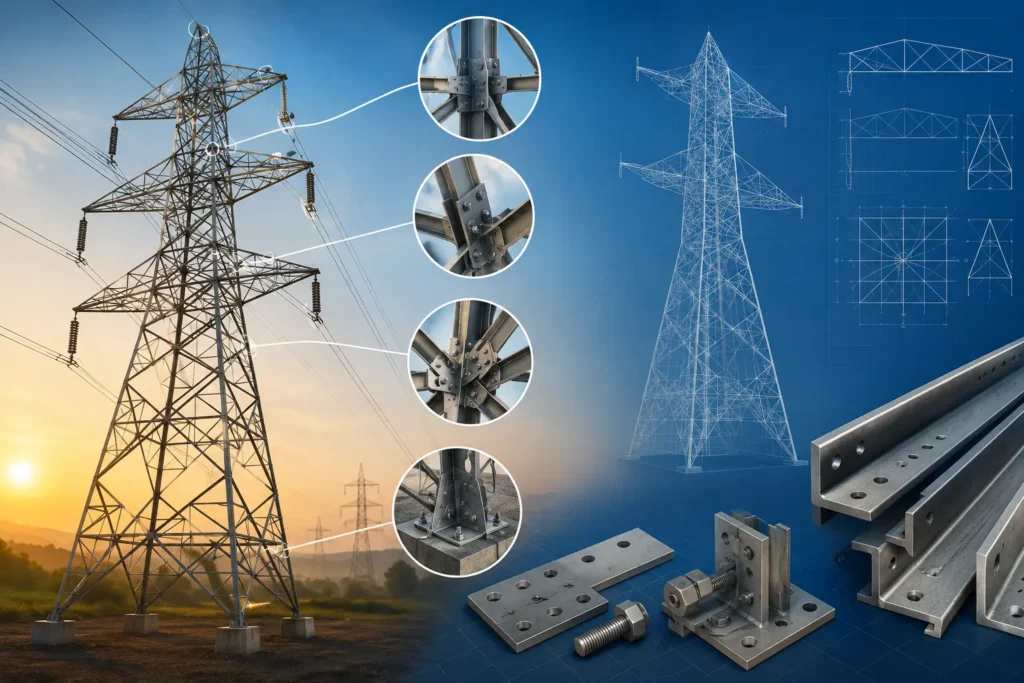
Individual steel tower members constitute a transmission line tower. The tower members include legs, main diagonals, horizontals, secondary bracing, cross-arm members, redundant members etc. The purpose of the tower member design is to ensure that every member resists the compression, tension, bending and combined stresses which they are subjected to, under varying loading conditions without buckling or yielding.
Table of Contents
Design input required for tower members
The fundamental design input required for the design of tower members of a transmission tower includes essentially tower configuration, tower loading conditions and material characteristics which governs the structural behaviour of the tower.
Tower height
The height of the tower is basically determined by transmission line clearances, mainly from the phase to ground clearance requirement at the midspan of the bottom conductor with the maximum possible sag taken into account. With addition to the vertical clearances of phase to phase conductors required as per standard and top conductor to ground wire clearance. Tower height influences the wind load acting on the structure. Taller towers experiences more bending moment compared to the smaller ones and requires stronger members.
Base width
The distance between the tower legs at the ground level provides stability against overturning forces. The wider the base is, better is the structural stability of the tower. In lattice towers, the base width is kept at 1/6th to 1/8th of the height of the tower.
Panel dimension
Panels are the sections formed in the tower by two horizontal bracing levels. The panel dimensions effects the member length, slenderness ratio and load distribution in the tower.
Loading data
Wind load
Wind load usually governs the design of transmission tower as it acts on the tower structure, conductors, ground wire, insulators and fittings producing transverse forces and overturning moments.
Broken wire loads
Broken wire condition occurs when one or more conductor or ground wire snaps unexpectedly, resulting in unbalanced forces generating high longitudinal force that must be resisted by the tower.
Security load
Security loading conditions are used to ensure tower stability during exceptional events such as cascading failure or abnormal operating conditions. It offers additional safety margin for critical towers.
Material properties
The strength of the tower members largely depends on the steel grade selected for construction.
Mild steel
It is commonly used for lightly loaded tower members because of its good ductility and ease of fabrication and economic reasons. The yield strength of the mild steel used in tower members is around 250 Mpa.
High tensile steel
High tensile steel offers higher strength than mild steel with a yield stress of around 350 Mpa, allowing use of smaller and lighter sections for the same load, reducing tower weight. It is particularly used in heavily stressed tower members.
Structural analysis of tower
The data is first entered into computer software popularly PLS Tower, Staad pro, etc. Data includes, tower geometry, loadings. The software analyses axial force in every member of the tower, identifying if the member is under tension or compression. These forces on the member becomes the basis of selecting the suitable section and verify the structural adequacy.
Tower member selection
The tower members are generally of equal angles or unequal angles. Equal angles are more commonly used as tower members because symmetrical geometry, similar stiffness in both principal axes, easier detailing and fabrication, readily available in standard sizes.
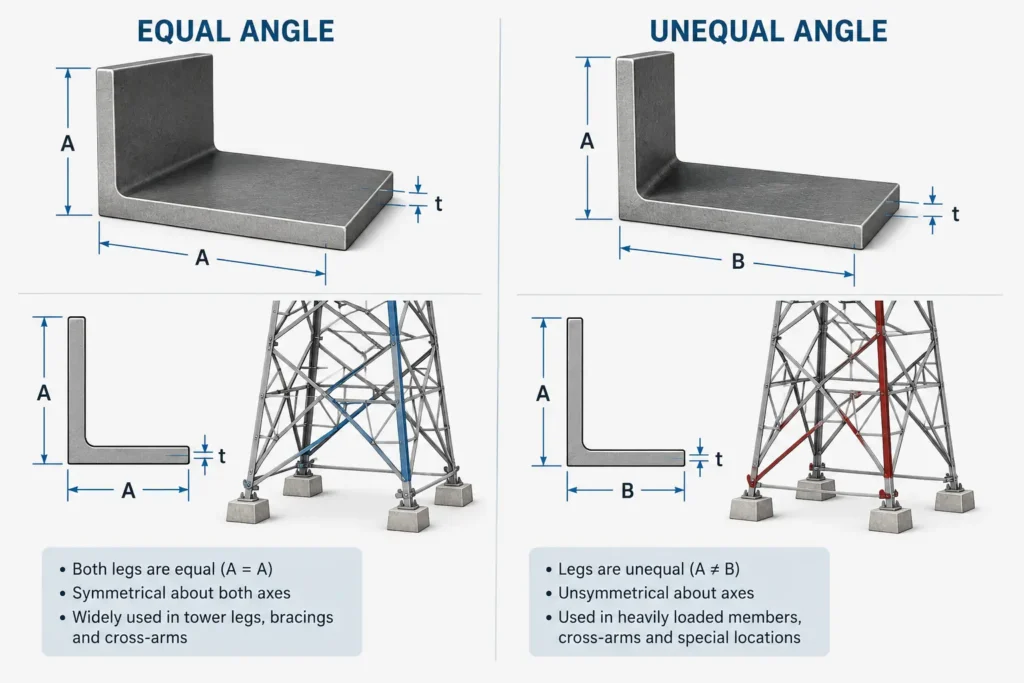
Unequal angles provides greater flexibility in connection design and allows efficient use of steel where loading is directional. Unequal angles also provides higher section properties in one direction and can result in weight saving. Typically used in heavily loaded compression members, redundant members and locations where connection eccentricity has to be minimized.
Selection list of equal angles commonly used as tower members
| Size | Sectional Area (cm²) | Unit Weight (kg/m) | Centre of Gravity (cm) | Ixx-Iyy (cm⁴) | Rxx (cm) | Rvv (cm) | Modulus of Section (cm³) | |||||||||
| 35x35x5 | 3.27 | 2.6 | 1.04 | 3.5 | 1.04 | 0.67 | 1.4 | |||||||||
| 40x40x3 | 2.34 | 1.8 | 1.08 | 3.4 | 1.21 | 0.77 | 1.2 | |||||||||
| 40x40x4 | 3.07 | 2.4 | 1.12 | 4.5 | 1.21 | 0.77 | 1.6 | |||||||||
| 40x40x5 | 3.78 | 3 | 1.16 | 5.4 | 1.2 | 0.77 | 1.9 | |||||||||
| 40x40x6 | 4.47 | 3.5 | 1.2 | 6.3 | 1.19 | 0.77 | 2.3 | |||||||||
| 45x45x3 | 2.64 | 2.1 | 1.2 | 5 | 1.38 | 0.87 | 1.5 | |||||||||
| 45x45x4 | 3.47 | 2.7 | 1.25 | 6.5 | 1.37 | 0.87 | 2 | |||||||||
| 45x45x5 | 4.28 | 3.4 | 1.29 | 7.9 | 1.36 | 0.87 | 2.5 | |||||||||
| 45x45x6 | 5.07 | 4 | 1.33 | 9.2 | 1.35 | 0.87 | 2.9 | |||||||||
| 50x50x3 | 2.95 | 2.3 | 1.32 | 6.9 | 1.53 | 0.97 | 1.9 | |||||||||
| 50x50x4 | 3.88 | 3 | 1.37 | 9.1 | 1.53 | 0.97 | 2.5 | |||||||||
| 50x50x5 | 4.79 | 3.8 | 1.41 | 11 | 1.52 | 0.97 | 3.1 | |||||||||
| 50x50x6 | 5.68 | 4.5 | 1.45 | 12.9 | 1.51 | 0.96 | 3.6 | |||||||||
| 55x55x4 | 4.26 | 3.3 | 1.51 | 11 | 1.67 | 1.06 | 2.96 | |||||||||
| 55x55x5 | 5.27 | 4.1 | 1.53 | 14.7 | 1.67 | 1.06 | 3.7 | |||||||||
| 55x55x6 | 6.26 | 4.9 | 1.57 | 17.3 | 1.66 | 1.06 | 4.4 | |||||||||
| 60x60x4 | 4.71 | 3.7 | 1.6 | 15.8 | 1.83 | 1.18 | 3.58 | |||||||||
| 60x60x5 | 5.75 | 4.5 | 1.65 | 19.2 | 1.82 | 1.16 | 4.4 | |||||||||
| 60x60x6 | 6.84 | 5.4 | 1.69 | 22.6 | 1.82 | 1.15 | 5.2 | |||||||||
| 65x65x4 | 5 | 4 | 1.73 | 19.76 | 1.99 | 1.26 | 4.16 | |||||||||
| 65x65x5 | 6.25 | 4.9 | 1.77 | 24.7 | 1.99 | 1.26 | 5.2 | |||||||||
| 65x65x6 | 7.44 | 5.8 | 1.81 | 29.1 | 1.98 | 1.26 | 6.2 | |||||||||
| 65x65x8 | 9.76 | 7.7 | 1.89 | 37.4 | 1.96 | 1.25 | 8.1 | |||||||||
| 70x70x5 | 6.77 | 5.3 | 1.89 | 31.1 | 2.15 | 1.36 | 6.1 | |||||||||
| 70x70x6 | 8.06 | 6.3 | 1.94 | 36.8 | 2.14 | 1.36 | 7.3 | |||||||||
| 70x70x8 | 10.58 | 8.3 | 2.02 | 47.4 | 2.12 | 1.35 | 9.5 | |||||||||
| 75x75x5 | 7.27 | 5.7 | 2.02 | 38.7 | 2.31 | 1.46 | 7.1 | |||||||||
| 75x75x6 | 8.66 | 6.8 | 2.06 | 45.7 | 2.3 | 1.46 | 8.4 | |||||||||
| 75x75x8 | 11.38 | 8.9 | 2.14 | 49 | 2.28 | 1.45 | 11 | |||||||||
| 80x80x6 | 9.29 | 7.3 | 2.18 | 56 | 2.46 | 1.56 | 9.6 | |||||||||
| 80x80x8 | 12.21 | 9.6 | 2.27 | 72.5 | 2.44 | 1.55 | 12.6 | |||||||||
| 80x80x10 | 15.05 | 11.8 | 2.34 | 87.7 | 2.41 | 1.55 | 15.5 | |||||||||
| 90x90x6 | 10.47 | 8.2 | 2.42 | 80.1 | 2.77 | 1.75 | 12.2 | |||||||||
| 90x90x7 | 12.22 | 9.59 | 2.46 | 93 | 2.76 | 1.77 | 14.2 | |||||||||
| 90x90x8 | 13.79 | 10.8 | 2.51 | 104.2 | 2.75 | 1.75 | 16 | |||||||||
| 90x90x10 | 17.03 | 13.4 | 2.59 | 126.7 | 2.73 | 1.74 | 19.8 | |||||||||
| 100x100x6 | 11.67 | 9.2 | 2.67 | 111.3 | 3.09 | 1.95 | 15.2 | |||||||||
| 100x100x7 | 13.62 | 10.7 | 2.71 | 129 | 3.08 | 1.97 | 17.7 | |||||||||
| 100x100x8 | 15.39 | 12.1 | 2.76 | 145.1 | 3.07 | 1.95 | 20 | |||||||||
| 100x100x10 | 19.03 | 14.9 | 2.84 | 177 | 3.05 | 1.94 | 24.7 | |||||||||
| 100x100x12 | 22.59 | 17.7 | 2.92 | 207 | 3.03 | 1.94 | 29.2 | |||||||||
| 110x110x8 | 17.08 | 13.4 | 3 | 196.8 | 3.4 | 2.18 | 24.6 | |||||||||
| 110x110x10 | 21.12 | 16.6 | 3.09 | 240.2 | 3.37 | 2.16 | 30.4 | |||||||||
| 110x110x12 | 25.08 | 19.7 | 3.17 | 281.3 | 3.35 | 2.15 | 35.9 | |||||||||
| 110x110x16 | 32.76 | 25.7 | 3.32 | 357.3 | 3.3 | 2.14 | 46.5 | |||||||||
| 120x120x8 | 18.7 | 14.7 | 3.23 | 255 | 3.69 | 2.37 | 29.1 | |||||||||
| 120x120x10 | 23.2 | 18.2 | 3.31 | 313 | 3.67 | 2.36 | 36 | |||||||||
| 120x120x12 | 27.5 | 21.6 | 3.4 | 368 | 3.65 | 2.35 | 42.7 | |||||||||
| 130x130x10 | 25.12 | 19.7 | 3.59 | 405.3 | 4.02 | 2.57 | 43.1 | |||||||||
| 130x130x12 | 29.88 | 23.5 | 3.67 | 476.4 | 3.99 | 2.56 | 51 | |||||||||
| 150x150x10 | 29.21 | 22.9 | 4.08 | 635.5 | 4.66 | 2.98 | 58 | |||||||||
| 150x150x12 | 34.77 | 27.3 | 4.16 | 746.3 | 4.63 | 2.97 | 68.8 | |||||||||
| 150x150x15 | 43 | 33.8 | 4.25 | 898 | 4.57 | 2.93 | 83.5 | |||||||||
| 150x150x16 | 45.65 | 35.8 | 4.31 | 958.9 | 4.58 | 2.94 | 89.7 | |||||||||
| 150x150x18 | 51 | 40.1 | 4.37 | 1050 | 4.54 | 2.92 | 93.7 | |||||||||
| 150x150x20 | 56.21 | 44.1 | 4.46 | 1155.5 | 4.53 | 2.93 | 109.7 | |||||||||
| 180x180x15 | 52.1 | 40.9 | 4.98 | 1590 | 5.52 | 3.54 | 122 | |||||||||
| 180x180x18 | 61.9 | 48.6 | 5.1 | 1870 | 5.49 | 3.52 | 145 | |||||||||
| 180x180x20 | 68.3 | 53.7 | 5.18 | 2040 | 5.47 | 3.51 | 159 | |||||||||
| 200x200x16 | 61.82 | 48.5 | 5.56 | 2366.2 | 6.19 | 3.96 | 163.8 | |||||||||
| 200x200x20 | 76.38 | 60 | 5.71 | 2875 | 6.14 | 3.93 | 201.2 | |||||||||
| 200x200x24 | 90.6 | 71.1 | 5.84 | 3333 | 6.06 | 3.9 | 235 | |||||||||
| 200x200x25 | 94.13 | 73.9 | 5.9 | 3470.02 | 6.07 | 3.91 | 246 | |||||||||
Design of tower members in tension
Step 1: The axial tensile force is determined by the computer software say T = 120 KN.
Step 2: Calculate the net sectional area of the member after deducting the bolt holes, An = Ag−∑(dht), where Ag is the gross area of the member perpendicular to the force, dh is the dia of the hole and t is the thickness of the member.
Step 3: check the tensile capacity of the member using the net sectional area.
Where, Td= Design tensile strength
An= Net sectional area
fy= Yield strength of steel
γm= Partial safety factor for material strength.
Now, if Td ≥ T, then the member selection is safe to resist the tensile load.
It can be noted that the ultimate tensile strength of a tower member in tension must not exceed 2550 kg/cm2 and the slenderness ratio of the tower member carrying the axial tension must not exceed 400.
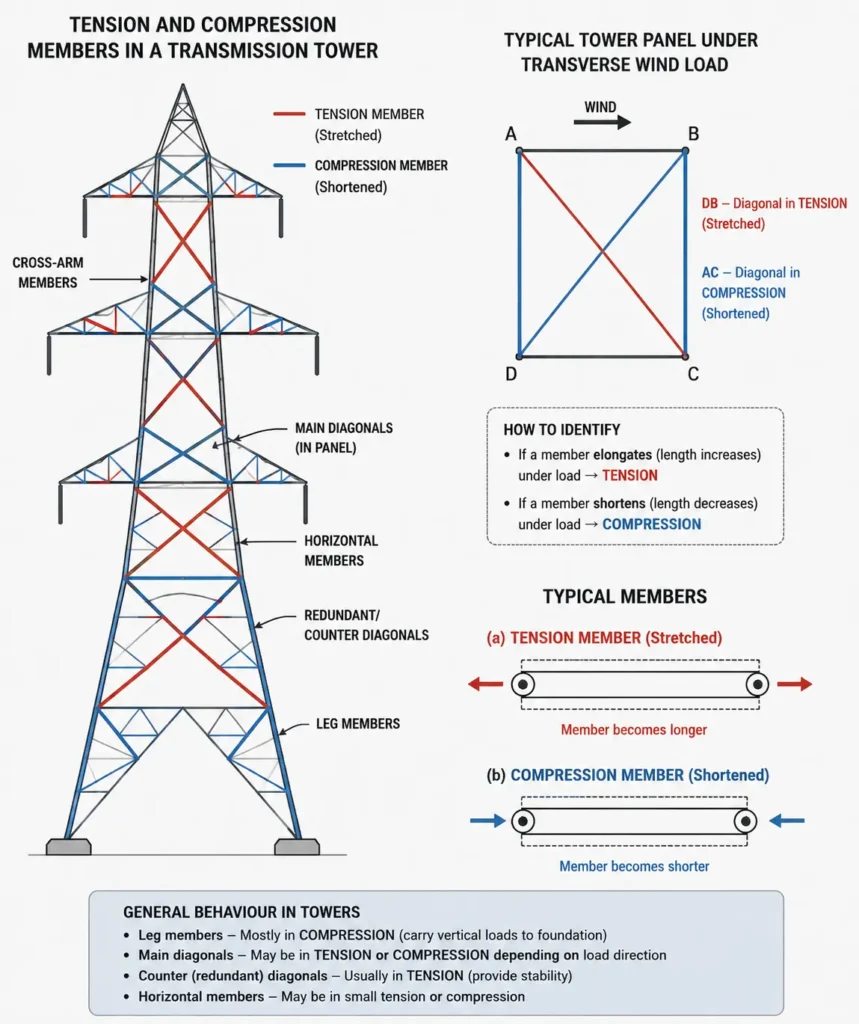
Design of tower members under compression
The compression tower members are generally more susceptible to buckling, which can occur at loads significantly lower than the yield strength of the steel.
The buckling strength of the compression tower member depends on the effective length, which differes from the actual length depending on how the member is connected in the tower. The effective length is expressed as Le = KL,
Where, K is the effective length factor and L is the actual length of the tower member. The value of K depends on the bolts arrangements, degree of end restraint, bracing configurations and connection stiffness. A tower member with better end restraint has smaller effective length and more resistance to buckling.
The susceptibility of a member to buckling is measured by its slenderness ratio given by,
λ=KL/r
λ is the slenderness ratio, KL is the effective length and r is the radius of gyration.
Higher is the slenderness ratio, lower is the compressive strength of the tower member.
Now the design stress, fcd is found out or interpolated based on the slenderness ratio from standard compression table as in IS 802.
For a compression tower member to be safe, Pd ≥ P,
Where Pd is the designed compression force on the member = Ag . fcd
Ag is the gross area of the member and fcd is the designed compressive stress.
Redundant tower members
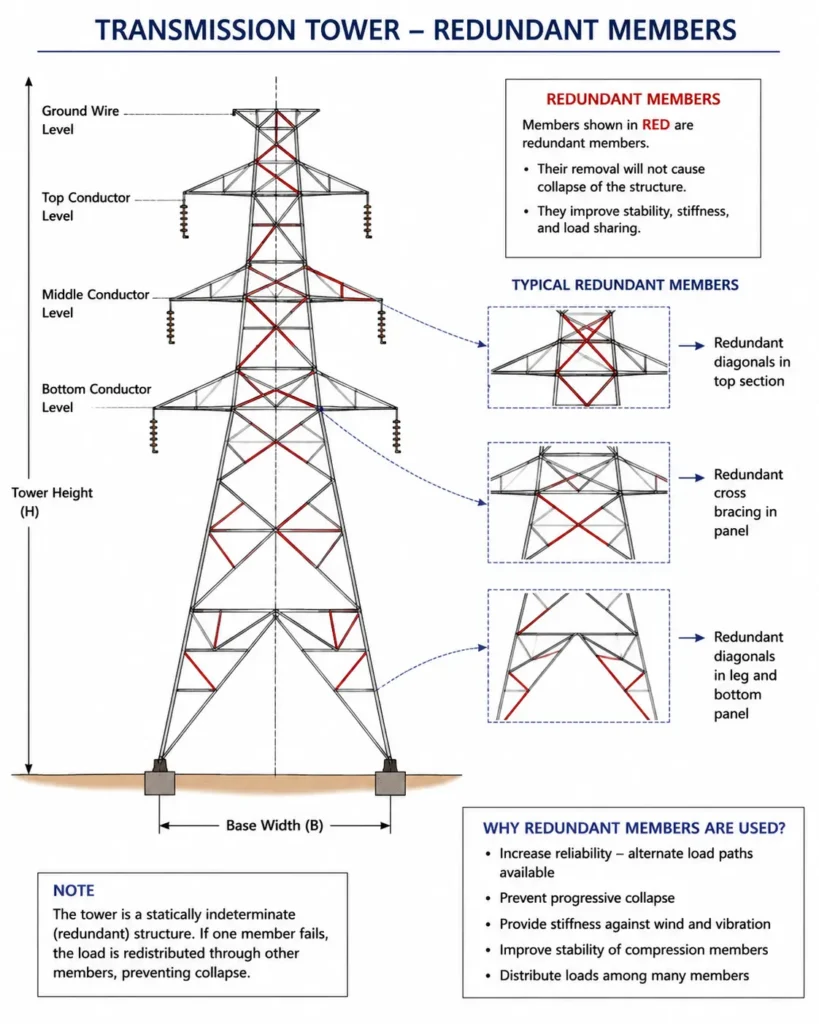
The redundant tower members are used to lower the slenderness ratio of the main tower members and also to carry 2.5% of the stress of the main members. The slenderness ratio of the redundant member is capped or restricted at 250. The redundant members placed at an angle less than 15° are required to be checked for bending due to mid-point concentrated load of 153 kg, independent of other loads.
This article is a part of the Transmission line page, where other articles related to topic are discussed in details.