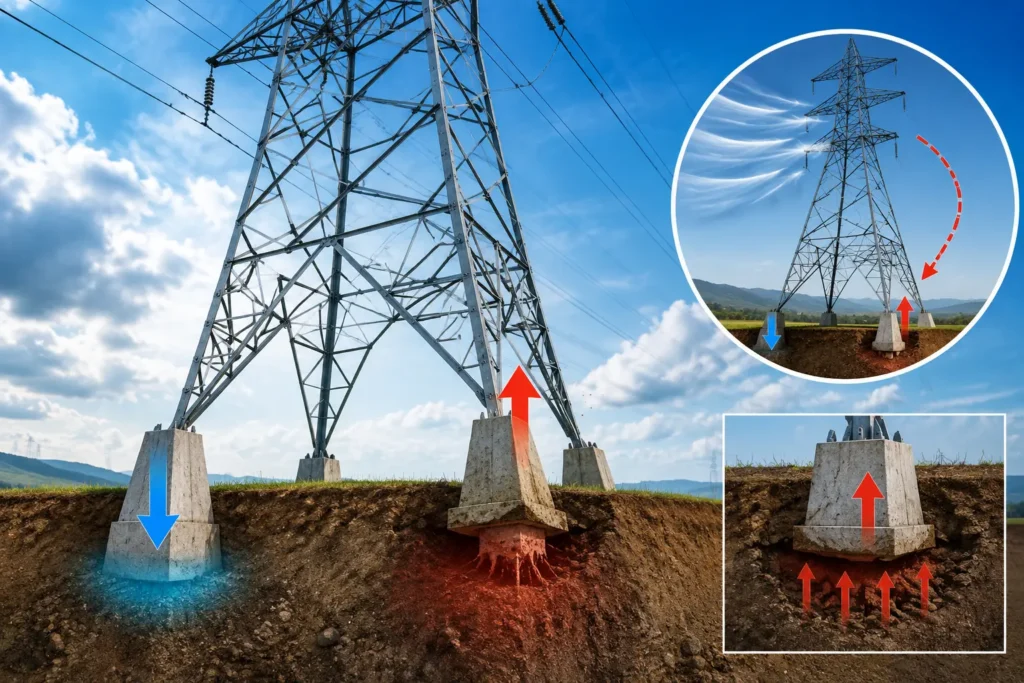
Uplift in transmission tower is basically a force that is developed in transmission line tower’s legs and act upwards, when external load creates overturning tendency in the tower structure. Uplift in transmission tower commonly occurs because of wind load, broken conductor condition and unbalanced longitudinal loads.
As the tower tends to rotate about its base, compression increases in two legs, while the other two (opposite) leg experiences the upward pull, known as uplift reaction. Uplift in transmission tower is a critical consideration for both the tower structure and the foundation as it must safely resist the tensile forces and prevent the pull out of stubs.
Table of Contents
Causes of uplift in transmission tower
Uplift in transmission towers occur when the external load generates overturning moments that cause one or more legs of the tower to experience upward pull. To ensure structural reliability and stability, this uplift in transmission tower has to get full consideration under all load cases.
Wind load
Wind load acts on conductors, insulators, ground wires and the tower structure itself and creates significant transverse forces. These forces generate overturning moment about the tower base, which creates compression on one side of the tower and uplift on the other. Wind loading is a governing condition for the uplift in transmission towers , specially for suspension type towers located in the high wind zones.
Broken wire condition
When the conductor or ground wire breaks unexpectedly, the mechanical tension on both sides of tower becomes unbalanced as on side has the tension and the other side loses tension because of the broken wire. This generates large longitudinal force, which generates overturning moment at the base of the tower, causing significant uplift reaction in one or two legs. Dead end towers, angle towers are specially susceptible to this condition.
Line angle load
At the angle towers, conductors change the direction and this change in direction generates the transverse force. The larger is the horizontal deviation of the conductors, more is the transverse force generated. This force adds to the overturning moment and consequently to the uplift reaction in the tower legs.
Security and containment load
The security and containment loads are considered to prevent the progressive collapse or cascading failure of towers from loss of conductor or ground wire or adjacent tower. These exceptional load cases can generate large overturning moments and uplift reactions. Terminal towers and major angle towers are designed to withstand this substantial uplift reaction, which ensures reliability and resilience of the transmission line system.
Design requirement
After analysis of tower, the engineer usually gets the leg reactions for all load cases. Say for a tower leg, for normal wind the uplift is 120 KN, for security condition it is 180 KN and for broken wire condition it is 320 KN.
The uplift capacity Uc of the foundation must be greater than the uplift reaction from tower analysis RU.
Ru ≤ Uc.
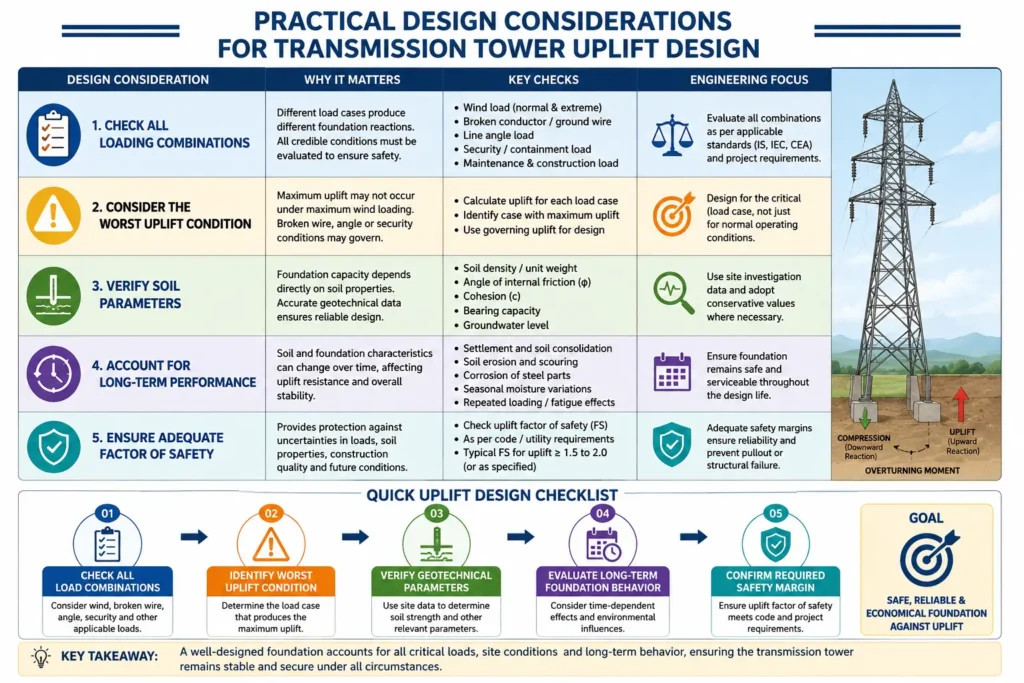
The resistance against the uplift in transmission tower usually comes from the weight of the concrete, weight of the soil above footing and side friction which depends on the foundation design.
Methods of reducing the uplift in transmission tower
Several engineering measures can be adopted to reduce the uplift force and improve the uplift resistance. The selection of the measure depends upon the magnitude of uplift, soil condition, tower type and economic consideration.
Increasing the foundation size
A larger foundation block provides greater self-weight and includes more surrounding soil. It increases the resistance against the upward forces. This method is effective for shallow foundation in good soil condition.
Increase embedment depth
Increasing the depth of the foundation, enhances the resistance by engaging a larger volume of soil. The deeper is the foundation, the greater is the weight of the soil and skin friction available for opposing the uplift forces. This measure is used where soil strength near the surface is limited.
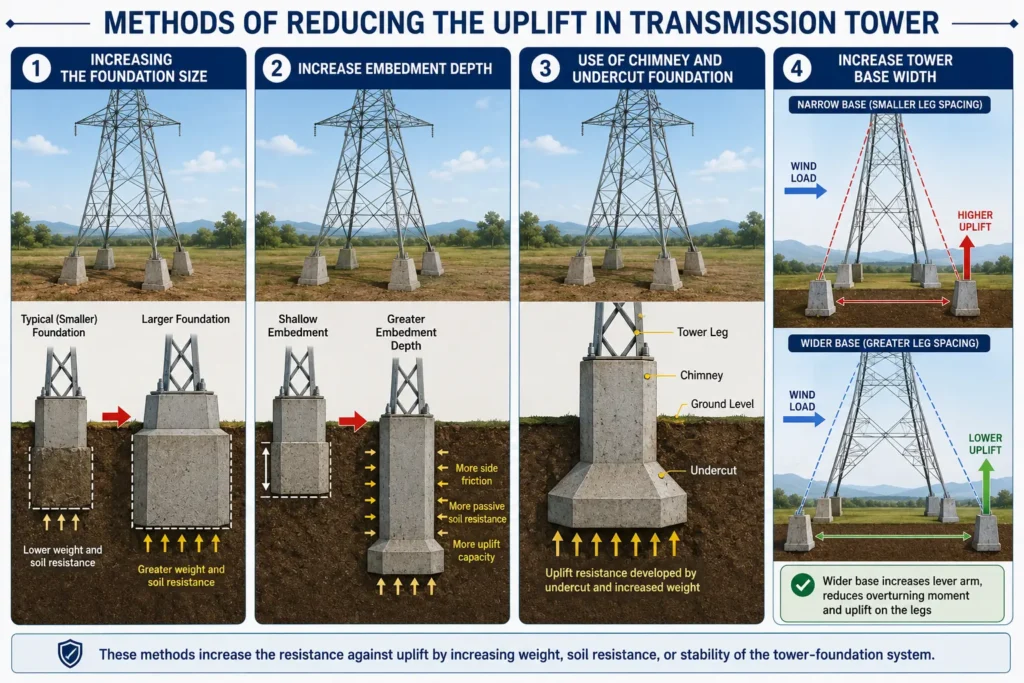
Use of chimney and undercut foundation
Chimney and undercut foundations are specially designed, which improves the uplift resistance. The chimney transfers the uplift load through both foundation weight and soil friction along the chimney surface. While undercut foundation has additional resistance gained via the mechanical interlocking between the foundation and surrounding soil, making it highly effective for stiff, cohesive or stiff clay soil types.
Increase tower base width
A wider tower base increases the lever-arm between tower legs, which reduces the uplift force generated for a given overturning moment. As the load is distributed over a larger footprint, the tower becomes more stable with less severe foundations.
This article is a part of the Transmission line page, where other articles related to topic are discussed in details.