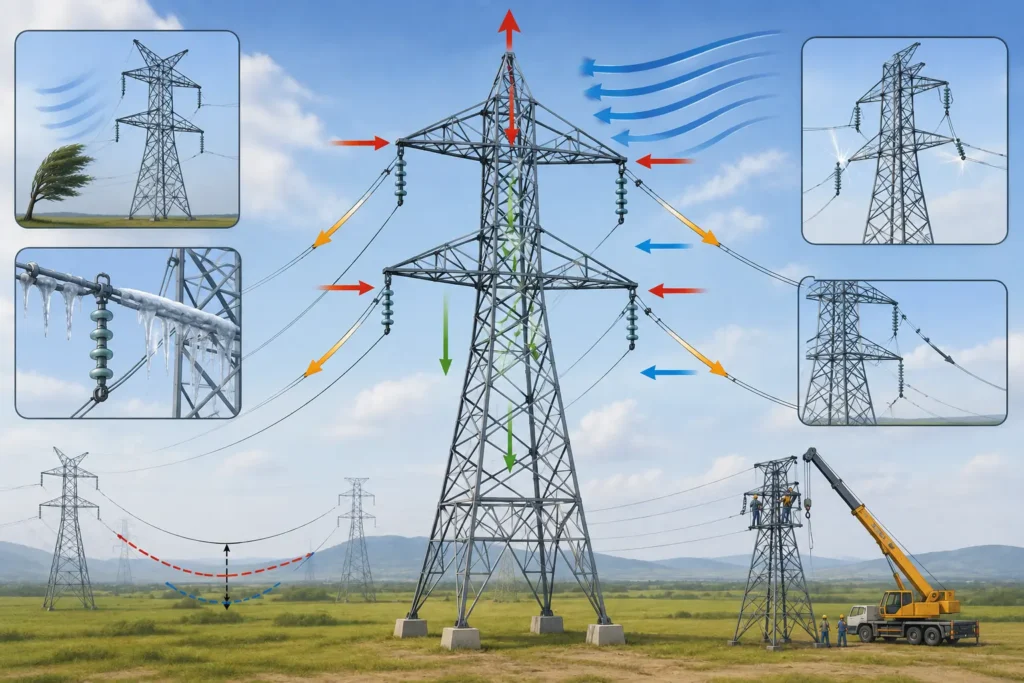
Tower loading is the most important part of transmission line tower design. A single error in the assessment of the tower loading will make the design erroneous and will lead to potential financial impact to redo the calculations and make correction or modification at a later stage. Various tower loading types are to be calculated accurately based on the design of transmission line.
In tower loading calculations, wind plays a pivotal role. The correct assessment of the wind load, leads to proper load assessment and reliable design of the transmission tower structures.
Table of Contents
Various tower loading on transmission lines
Overhead lines are exposed to variety of loads in their service life. For reliable operation, the transmission line components must be so designed that the transmission tower structure and its foundation withstand these loads. They are classified as
Climatic load
It arises from environmental condition that occurs during the normal operation of the transmission line. It includes wind load in transverse and oblique direction, ice load, temperature variation and other weather-related effects.
Failure containment loads (Security Requirement)
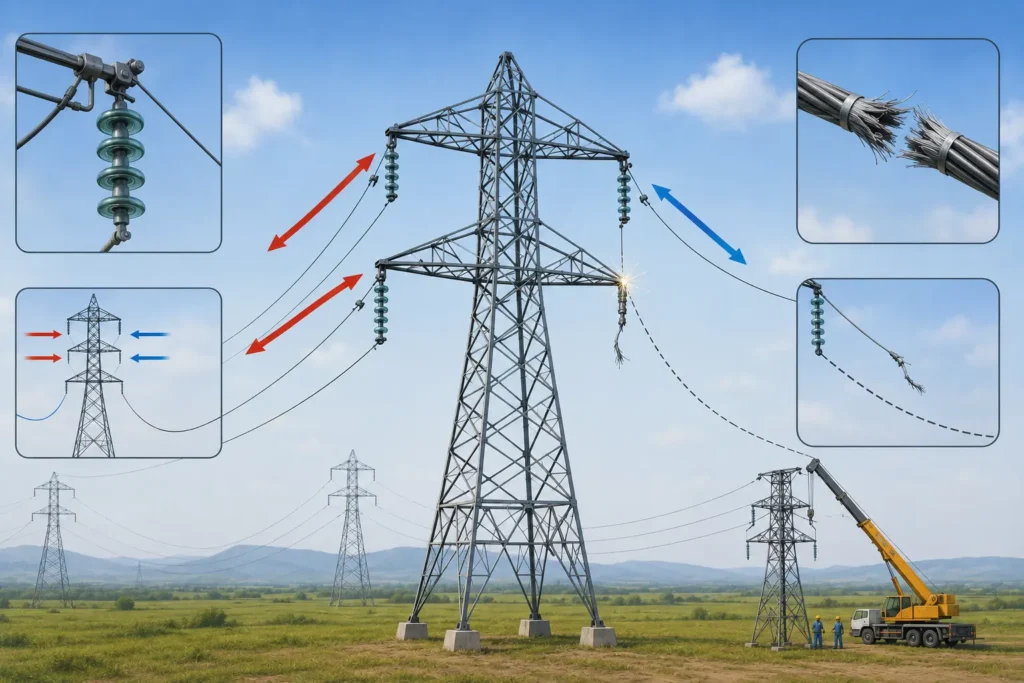
These loads are associated with the abnormal events such as conductor breakage, ground wire failure or insulator failure causing longitudinal and torsional stress. The objective of including these loads is to ensure that local failure does not causes progressive failure of adjacent towers or sections, thereby maintaining the security of the transmission system. For this reason all angle towers are checked for anti-cascading load for all conductor and earth wire broken in the same span under nil wind condition.
The suspension towers are designed considering the narrow front wind load where wind velocity is higher in narrow width and acts in the tower, no wind is considered in conductor, earth wire and insulator in this case.
Construction and maintenance load (Safety Requirement)
These load occurs during the erection, stringing, inspection, maintenance and repair activities. It includes load imposed by construction equipment, worker, temporary conductor tension and maintenance operations. The purpose of this load consideration is to provide safety to the personnel and ensure structural stability of the transmission line during installation and maintenance phase.
Nature of loads
Transverse load
Loads that acts on the transverse direction such as component of wind load on tower structure, conductor, ground wire and insulator strings. In this tower loading type, transverse component of mechanical tension of conductor and ground wire is also considered.
Vertical load
These tower loading includes load due to weight of conductors and ground wire based on the weight span, weight of the insulator strings and hardware fittings. It also includes self-weight of the structure and construction and maintenance loads.
Longitudinal load
These loads acts in the longitudinal direction and includes component of the wind load on tower structure and insulator strings. It also includes unbalanced horizontal load in longitudinal direction due to mechanical tension of conductor and ground wire during broken wire condition.
Tower loading criteria
Because of wind action, load imposed on the tower because of the following criteria
Case 1: Everyday temperature and design wind pressure, where pd for transverse wind and pd Sin2Ω for oblique wind.
Case 2: Everyday temperature and 75% design wind pressure.
Case 3: Minimum temperature and 36% design wind pressure.
Case 1 and 2 is adopted for suspension towers while 1,2 and 3 is mandatory for angle towers.
Transverse Load Reliability condition
Wind load on each conductor and ground wire normal to line applied at supporting point can be determined by
Fwc = Pd Sin2 Ω. L. d. Gc. Cdc
where Fwc is the Wind load in Newtons
Pd is Design wind pressure in N/m2
L is the Wind span in meters
d is the Diameter of conductor/ground wire in meters
Cdc = Drag Coefficient for conductor, ground-wire/OPGW depending on its diameter,
Gc = Gust response factor.
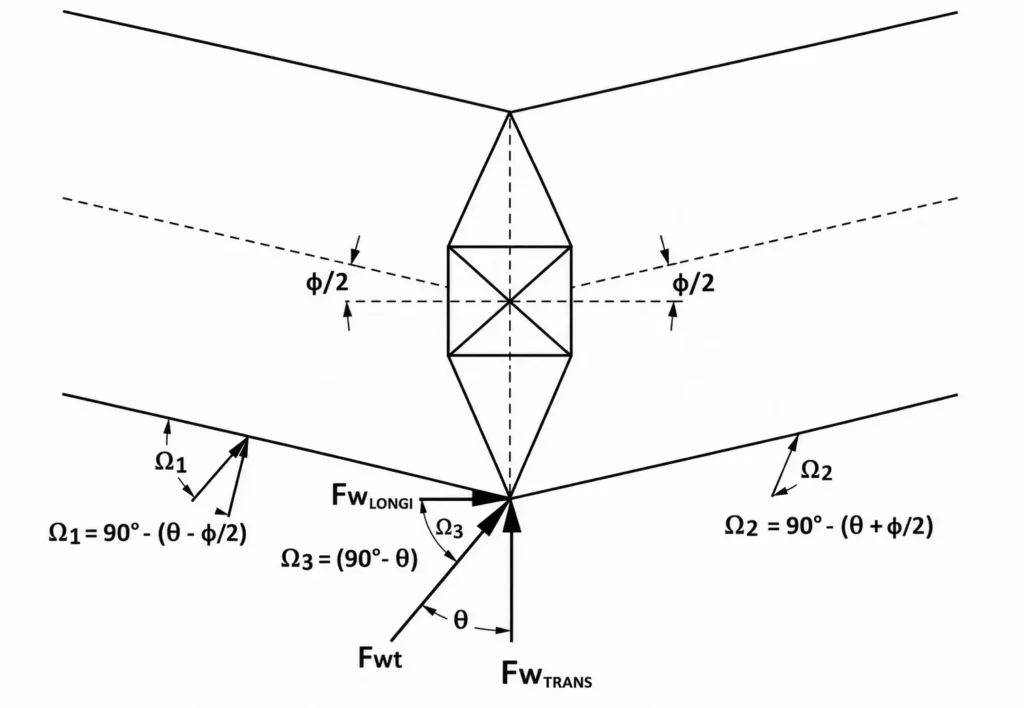
sin²Ω is the angle between wind direction and conductor or ground wire. This value is to be considered maximum of sin²Ω1, sin²Ω2 and sin²Ω3 (See diagram below) and is to be applied on total wind span for calculating wind load on conductor.
Wind load on insulator string
The wind load on insulator string is determined by
Fwi = Pd. Ai. Gi. Cdi
The drag coefficient of insulator, Cdi is taken as 1.2,
Pd is the design wind pressure in N/m2,
Ai is the 50% of the area of insulator string projected in a plane parallel to the longitudinal axis of the insulator string.
Gi is the gust response factor.
Wind load on tower
The wind load on tower can be calculated by
Fwt = Pd (1 + 0.2 sin²2θ) (AeL *CdtL *cos²θ + AeT CdtT sin²θ) GT
This formula can be simplified into components as
Transverse direction Fwt TRANS = Pd (1+0.2 sin²2θ) (AeT *CdtT *sinθ) GT
Longitudinal direction where Fwt LONGI = Pd (1+0.2 sin²2θ) (AeL *CdtL *cosθ) GT
Where Fwt is the wind load,
Pd is the design wind pressure,
Θ is the angle of incidence of wind direction perpendicular to the longitudinal face.
GT is the gust response factor.
Transverse load from mechanical tension of conductor and ground wire because of line deviation angle
This tower loading, acts on the tower as a component of mechanical tension and is given by
Fwd = 2 T Sin ф/2 where
Fwd is the wind load in newton,
T is the tension of the conductor or ground wire corresponding to wind pressure,
Ф is the angle of deviation of the line.
Total transverse load under reliability condition
The total transverse load under reliability condition is given by
TR = Fwc + Fwi + Fwt + Fwd
The Fwc, Fwi and Fwd tower loadings will be applied to all conductors or ground wire points. But, the Fwt load has to be applied at ground wire peak and cross arm level. For towers of 400 kv and above, Fwt can be applied anywhere between bottom cross arm and ground level. In case of body extended tower for may voltage level, the panel at the top of extension can also be considered.
Transverse load Security condition
Suspension tower
Transverse load due to wind action on tower, conductor, insulator and ground wire shall be taken corresponding to 75 % of the full wind pressure at everyday temperature.
For line deviation, the transverse load shall be based on the component of mechanical tension of unbroken conductor and ground wire corresponding to every day temperature and 75% wind pressure.
For broken conductor condition, the component shall correspond to 50% of mechanical tension of the conductor and 100 % of mechanical tension of the ground wire at every day temperature and 75% wind pressure.
Tension tower
Transverse load due to wind action on tower, conductor, insulator and ground wire shall be computed for 75% of the wind pressure. The wind span to be considered is 100% for intact wire and 60% for broken wire.
Transverse load because of line deviation shall be the component of 100% mechanical tension of the conductor and ground wire at every day temperature and 75% of full wind pressure.
Narrow front wind requirement
Transverse load due to wind on conductor, ground wire and insulator shall be taken as nil.
Transverse load due to wind action on tower and insulator shall be with a wind speed which is 1.5 times the basic wind speed. The wind speed is to be considered as reference wind speed and gust factor shall be taken as 1..
Transverse load because of line deviation shall be based on mechanical tension of conductor and ground wire corresponding to every day temperature and nil wind.
Transverse load during construction and maintenance
Transverse load due to wind on tower, conductor, insulator and ground wire shall be taken as nil.
Transverse load due to mechanical tension of the conductor or ground wire at every day temperature and nil wind because of line deviation is
TM = 2 x T1 . sin ф/2 , where T1 is the tension in the conductor corresponding to everyday temperature and nil wind. Ф is the angle of deviation of the line.
Broken wire condition
Transverse load due to wind on tower, conductor, ground wire is taken as nil.
Transverse load due to mechanical tension of conductor or ground wire at every day temperature and nil wind because of line deviation is
TM = T1 x sin ф /2, Where T1 is 50% of the tension of the conductor and 100% of the tension of the ground wire for suspension tower and 100% of the tension for conductor and ground wire for angle towers.
Vertical load Reliability condition
Load due to weight of each conductor and ground wire based on appropriate weight span, weight of insulator strings and hardware accessories.
Vertical load security condition
Tower loading due to weight of each conductor and ground wire based on appropriate weight span, weight of insulator strings and hardware accessories taking into account broken wire condition, where load due to weight of the broken conductor or ground wire is to be considered 60% of the weight span.
Vertical load due to construction and maintenance
Tower Loading due to weight of each conductor and ground wire based on appropriate weight span, weight of insulator strings and hardware accessories and it should be multiplied by a overload factor of 2.
Self weight of the structure shall be considered upto the point under consideration of tower panel.
Load of 1500 N shall be considered at each crossarm tip as a provision for weight of line man with tools. Also load of 3500 N at cross arm tip is to be considered for cross arm design upto 220 KV and 5000 N for 400 KV and higher voltages.
The cross arm of the tension tower should also be designed for the following construction loads at specified lifting points
| Tension Tower Conductor Configuration | Vertical Load (N) | Lifting Point Distance from Cross-arm Tip (mm) |
| Twin Bundle Conductor | 10,000 | 600 |
| Triple / Quadruple Bundle Conductor | 20,000 | 1,000 |
| Hex Bundle Conductor | 30,000 | 1,000 |
| Octa Bundle Conductor | 40,000 | 1,000 |
All bracing and redundant members of the tower which are horizontal or inclined at 15 degree from horizontal shall be designed to withstand 1500 N, acting at the center, independent of all other loads.
Longitudinal load reliability condition
Longitudinal load (tower loading) for suspension and tension tower because of wind on conductor and ground wire and also component of wire tension shall be taken as nil.
Under oblique wind condition, the wind load on insulator and component of wind on suspension and tension tower shall be considered as described above.
Longitudinal load (tower loading) caused on tension tower because of adjacent span of unequal length shall be neglected.
Therefore, longitudinal load (tower loading) under reliability condition = Fwi +Fwt LONGI
Longitudinal load Security Condition
Suspension tower
Longitudinal load (tower loading) corresponding to 50% of the mechanical tension of conductor and 100% of mechanical tension of ground wire is to be considered for everyday temperature and 75% full wind pressure under broken wire condition.
Tension tower
Horizontal load (tower loading) in longitudinal direction because of component of mechanical tension of conductor and ground wire shall be considered under everyday temperature and 75% of full wind pressure for broken wire. For intact wires, this load shall be considered nil.
Dead end tower
Horizontal load (tower loading) in longitudinal direction because of component of mechanical tension of conductor and ground wire shall be considered under everyday temperature and 75% of full wind pressure for intact wire. For broken wires, this load shall be considered nil.
Longitudinal load during construction and maintenance
Normal condition
The longitudinal loads (tower loading) shall be taken as nil for suspension and tension towers. However, for dead end tower, the longitudinal load shall be considered corresponding to mechanical tension of conductor or ground wire at everyday temperature and nil wind. Longitudinal load due to unequal span can be neglected.
Broken wire condition
Suspension tower
When conductors are pulled during stringing through stringing blocks, a longitudinal force acts on the suspension tower due to friction and block movement. It is assumed as tower loading of 10000 N per sub conductor and 5000 N per ground wire.
Dead end tower
When a dead end tower is being strung on one phase, the conductor pull exerts a large unbalanced force on the tower. The tower therefore must resist the load which is twice the sagging tension for one ground wire and or one phase conductor in the process of stringing. The sagging tension is 50% of tension at every day temperature and no wind. At the other ground wire or conductor attachment point, where the stringing has been completed, longitudinal tower loading equal to 1.5 times the sagging tension is considered.
This article is a part of the Transmission line page, where other articles related to topic are discussed in details.