
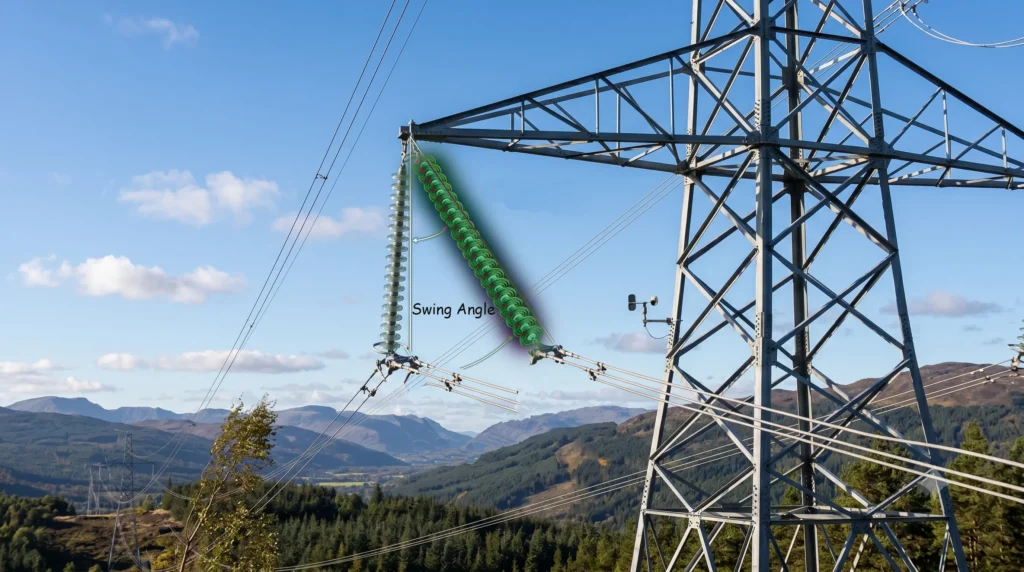
Swing angle in transmission line design is the angle by which the suspension insulator string or jumper in strain insulators, deviates from its original vertical position, closer to the metal part of the crossarm or tower body, thus reducing the live metal clearance upon application of external forces. The external forces can be wind pressure on the conductor, wind pressure on the insulator string, unbalanced conductor tension, broken wire condition.
How is the swing angle calculated?
The swing angle of a suspension insulator string is calculated as below
Θ = tan-1 (Horizontal Force / Vertical Force)
Wind load on the conductor, Wc = 0.6 x Vr 2 x Cd x Dia of Conductor x Wind span x Number of sub Conductors per bundle.
Wind load on the insulator, Wi = 0.6 x Vr 2 x Cd x Gust response factor x Dia of Insulator x Length of insulator string x 0.5
Cd is the drag coefficient of conductor and insulator which is 1 and 1.2 respectively.
Vertical load of conductor, Vc = Number of sub conductor x weight per meter x weight span
Vertical load of insulator, Vi = weight of the insulator string.
Why is swing angle important?
Swing angle is a critical parameter in the transmission line design as it determines the extent of conductor movement under influence of external forces such as wind. As the swing angle increases, the electrical clearance between the conductor and grounded tower member decreases. Hence, proper evaluation of swing angle helps to ensure adequate electrical clearance to prevent flashover.
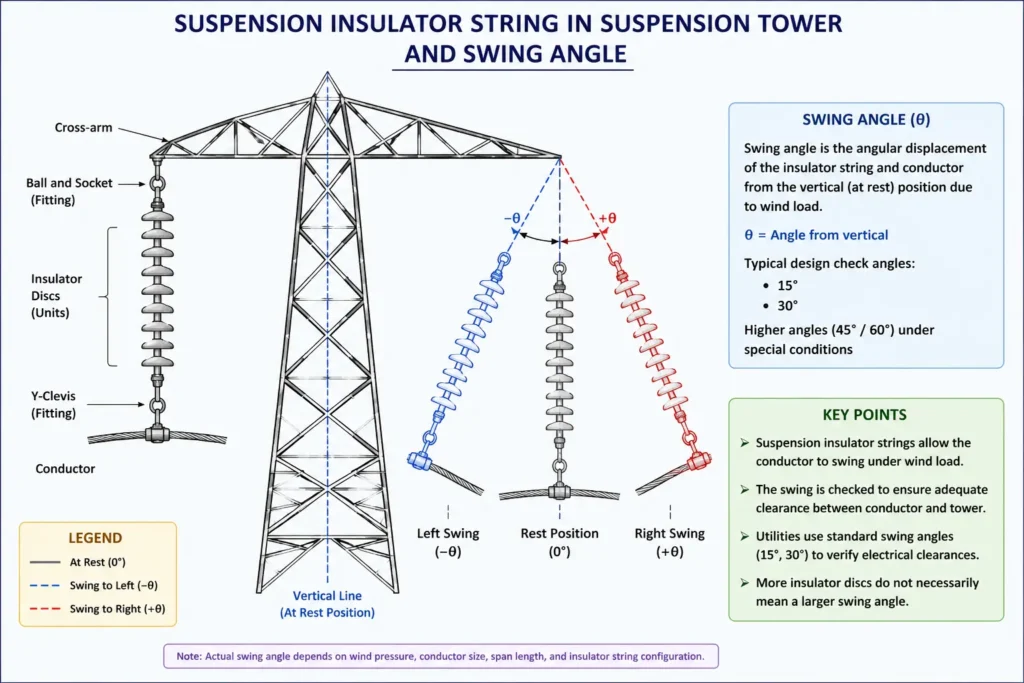
The design of transmission towers includes probabilistic approach as ensuring too much clearance will add up to the cost, hence, at 0 degree swing angle, the clearance is kept according to the lightning impulse or switching impulse levels. But at maximum swing angle say 60 degrees, lighting and switching is least probable and so at this swing angle, power frequency transient overvoltage dictates the clearance. Thus the swing angle influences the length of crossarm and design of the tower.
Typical swing angle checks in transmission lines
In the transmission line design, there is a distinction made in the calculated swing angle and the design check swing angle. The calculated swing angle from the above mentioned formula represents the expected conductor deviation under specific loading condition. The design check swing angle however is a predefined value used to verify that adequate clearances are maintained as per probabilistic line design. Utilities commonly perform clearance checks at 15 ° and 30 ° swing angle, while for higher angles such as 45 ° or 60 ° is considered for extreme wind conditions and critical locations. These standard checks help ensure a safe conductor-to-tower clearance and reliable operation under various service condition.
Swing angle vs insulator string length
The number of insulator discs in a string does not helps to determine the swing angle. The insulator disc count is primarily selected based on system voltage, insulation level, pollution condition and required creepage distance. But, the swing angle depends upon the mechanical loading conditions such as wind pressure, conductor weight and insulator configuration. Therefore, the conductor and environmental loading conditions are the key factors that governs the insulator string swing.
Restricting the jumper swing
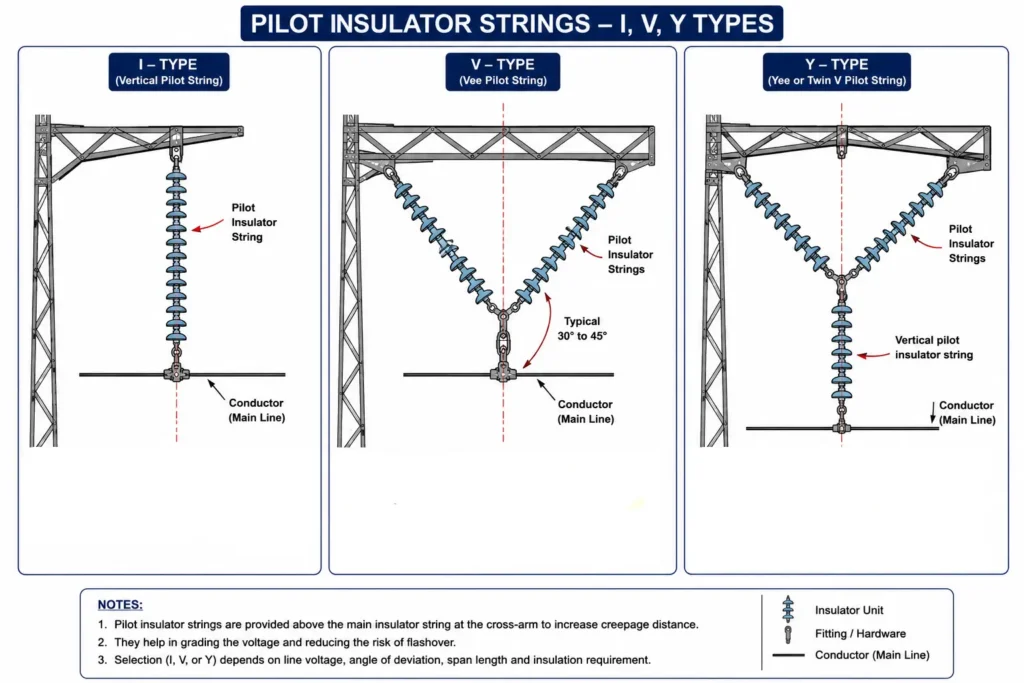
In strain insulator strings of tension towers, the swing of the jumpers can be restricted by application of custom-made jumpers (rigid or ladder type), by introducing appropriate configuration of the pilot string (I,V,Y or strut type), suitably designing the crossarm of the tension tower, or by suitably positioning the pilot string attachment point. Above 765 KV lines, these alternatives does provide better economics and hence requires serious consideration during the design of clearance with type of pilot strings used, with its positioning and the construction of jumper.
Swing angle and electrical clearance for suspension insulator string
| AC Voltage Level (Nominal / Highest) | Clearance (m) | Swing Angle (°) | Remarks |
| 66 / 72.5 kV | 0.610 | 60 | |
| 66 / 72.5 kV | 0.610 | 45 | |
| 66 / 72.5 kV | 0.760 | 30 | |
| 66 / 72.5 kV | 0.915 | 15 | |
| 66 / 72.5 kV | 0.915 | 0 | |
| 110 / 125 kV & 132 / 145 kV | 1.07 | 60 | |
| 110 / 125 kV & 132 / 145 kV | 1.22 | 45 | |
| 110 / 125 kV & 132 / 145 kV | 1.37 | 30 | |
| 110 / 125 kV & 132 / 145 kV | 1.53 | 15 | |
| 110 / 125 kV & 132 / 145 kV | 1.53 | 0 | |
| 220 / 245 kV | 1.675 | 45 | |
| 220 / 245 kV | 1.83 | 30 | |
| 220 / 245 kV | 1.98 | 15 | |
| 220 / 245 kV | 2.13 | 0 | |
| 400 / 420 kV | 1.20 | 36.5 (WZ-1) | Wind Zone 1 |
| 400 / 420 kV | 1.20 | 46.2 (WZ-2) | Wind Zone 2 |
| 400 / 420 kV | 1.20 | 53.0 (WZ-3) | Wind Zone 3 |
| 400 / 420 kV | 1.20 | 56.7 (WZ-4) | Wind Zone 4 |
| 400 / 420 kV | 1.20 | 60.2 (WZ-5) | Wind Zone 5 |
| 400 / 420 kV | 1.20 | 65.0 (WZ-6) | Wind Zone 6 |
| 400 / 420 kV | 3.05 | 12.2 (WZ-1) | Wind Zone 1 |
| 400 / 420 kV | 3.05 | 16.6 (WZ-2) | Wind Zone 2 |
| 400 / 420 kV | 3.05 | 20.55 (WZ-3) | Wind Zone 3 |
| 400 / 420 kV | 3.05 | 23.0 (WZ-4) | Wind Zone 4 |
| 400 / 420 kV | 3.05 | 25.6 (WZ-5) | Wind Zone 5 |
| 400 / 420 kV | 3.05 | 29.9 (WZ-6) | Wind Zone 6 |
| 400 / 420 kV | 3.05 | 0 | |
| 765 / 800 kV | 1.30 | 55 | |
| 765 / 800 kV | 4.40 | 25 | |
| 765 / 800 kV | 5.60 | 0 | Single Circuit |
| 765 / 800 kV | 6.10 | 0 | Double Circuit |
| 1150 / 1200 kV | 2.40 | 41.0 | |
| 1150 / 1200 kV | 8.00 | 10.0 | |
| 1150 / 1200 kV | 8.00 | 0 |
Swing angle and electrical clearance for Jumper
| AC Voltage Level (Nominal / Highest) | Clearance (m) | Swing Angle (°) – Jumper without Pilot String | Swing Angle (°) – Jumper with Pilot String |
| 66 / 72.5 kV | 0.610 | 30 | — |
| 66 / 72.5 kV | 0.610 | 20 | — |
| 66 / 72.5 kV | 0.915 | 10 | — |
| 66 / 72.5 kV | 0.915 | 0 | 0 |
| 110 / 125 kV & 132 / 145 kV | 1.07 | 30 | — |
| 110 / 125 kV & 132 / 145 kV | 1.22 | 20 | — |
| 110 / 125 kV & 132 / 145 kV | 1.53 | 10 | — |
| 110 / 125 kV & 132 / 145 kV | 1.53 | 0 | 0 |
| 220 / 245 kV | 1.675 | 20 | — |
| 220 / 245 kV | 2.13 | 10 | 15 |
| 220 / 245 kV | 2.13 | 0 | 0 |
| 400 / 420 kV | 3.05 | 25 | 15 |
| 400 / 420 kV | 3.05 | 0 | 0 |
| 765 / 800 kV | 1.30 | 55 | |
| 765 / 800 kV | 4.40 | 25 | |
| 765 / 800 kV | 5.60 (S/C) | 0 | |
| 765 / 800 kV | 6.10 (D/C) | 0 | |
| 1150 / 1200 kV | 2.40 | 60 | |
| 1150 / 1200 kV | 8.00 | 23 | |
| 1150 / 1200 kV | 8.00 | 0 |
This article is a part of the Transmission line page, where other articles related to topic are discussed in details.