
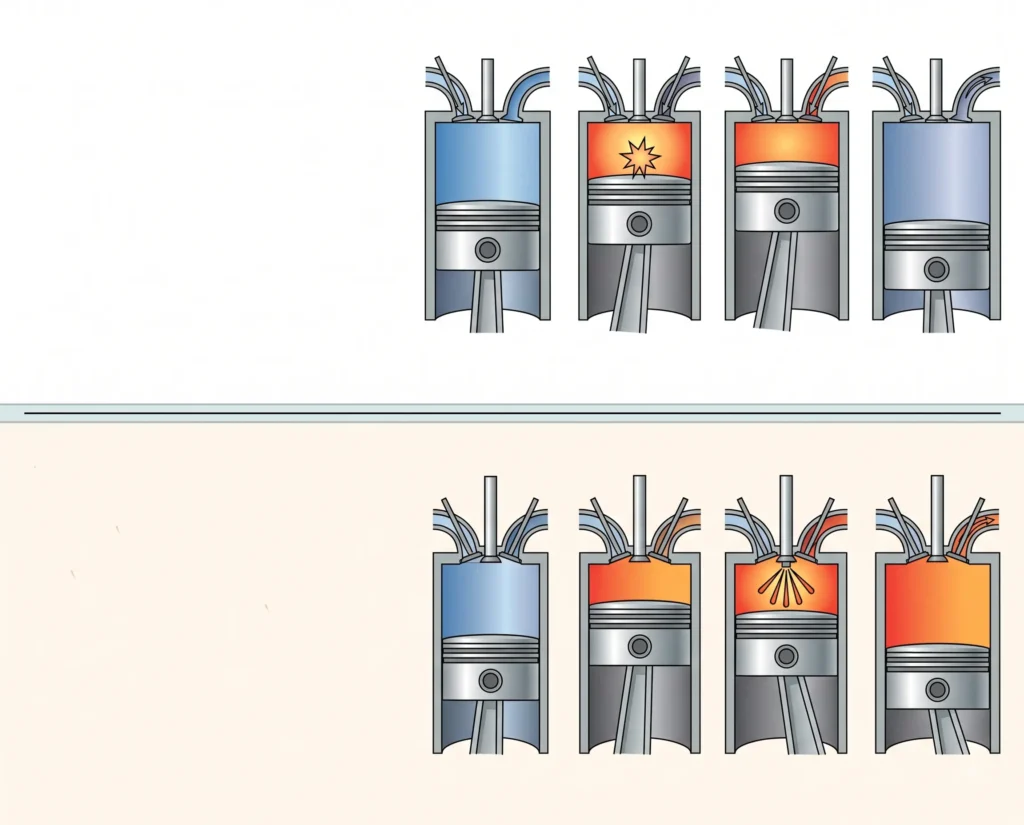
Otto cycle vs Diesel cycle at a Glance
| Parameter | Otto Cycle | Diesel Cycle |
| Practical Engine Type | Spark-ignition (SI) engine | Compression-ignition (CI) engine |
| Typical fuel | Gasoline / petrol | Diesel |
| Ignition method | Spark ignition | Compression ignition |
| Air–fuel preparation | Air–fuel mixture is generally formed before or during intake, depending on engine design | Air is compressed first and then fuel is injected into the hot compressed air |
| Heat addition | Constant volume | Constant pressure |
| Heat rejection | Constant volume | Constant volume |
| Compression process | Isentropic in the ideal cycle | Isentropic in the ideal cycle |
| Expansion process | Isentropic in the ideal cycle | Isentropic in the ideal cycle |
| Compression ratio | Generally lower (8:1-12:1) | Generally higher (14:1-25:1) |
| Knock limitation | Knocking limits compression ratio | Knocking mainly occurs due to ignition delay. High compression ratios are typical |
| Ideal efficiency depends on | Compression ratio and γ | Compression ratio, cut-off ratio, and γ |
| Typical application | Cars, motorcycles, small engines | Heavy-duty vehicles, generators, trucks, industrial engines |
| Main advantage | High power-to-weight ratio and relatively simple SI operation | Higher efficiency and strong low-speed torque |
| Main limitation | Knock limits compression ratio | Higher weight, cost, and combustion-system complexity |
Table of Contents
Heat addition: Constant Volume vs Constant pressure
The fundamental difference between the Otto cycle and diesel cycle lies in the process of heat addition to the working fluid.
In an ideal Otto cycle, the air fuel mixture is compressed during the compression stroke and near the end of the compression, the spark plug ignites and initiates the combustion. Since, the process of combustion is modelled as complete and instantaneous, the piston inside the cylinder is assumed to have a negligible movement during the heat addition, with no change in volume. However, the pressure and the temperature rise sharply.
In ideal diesel cycle, only air is compressed during the compression process and near the end of compression, fuel is injected into the hot and highly compressed air and undergoes self-combustion. Since, the fuel injection and combustion are assumed to continue while the piston moves downwards from top dead center, the volume increases during the heat addition while keeping the pressure constant. During this process, the temperature as well as the volume increases.
Compression Ratio and Ignition
In Otto cycle engine, the air fuel mixture is compressed before the ignition. And if the compression ratio is too high, the temperature and pressure of the compressed mixture can become sufficiently high to cause auto ignition ahead of the spark. This phenomenon is called the knocking and is detrimental to the engine. Thus, this limits the compression ratio of the spark ignition engines.
However, in contrast, a diesel cycle engine, compresses only air. The fuel is injected at the end of the compression stroke to the hot and compressed air causing self ignition. As there is no fuel mixture that is being compressed, the diesel engine can thus operate at substantially higher compression ratios.
PV and TS diagram comparison
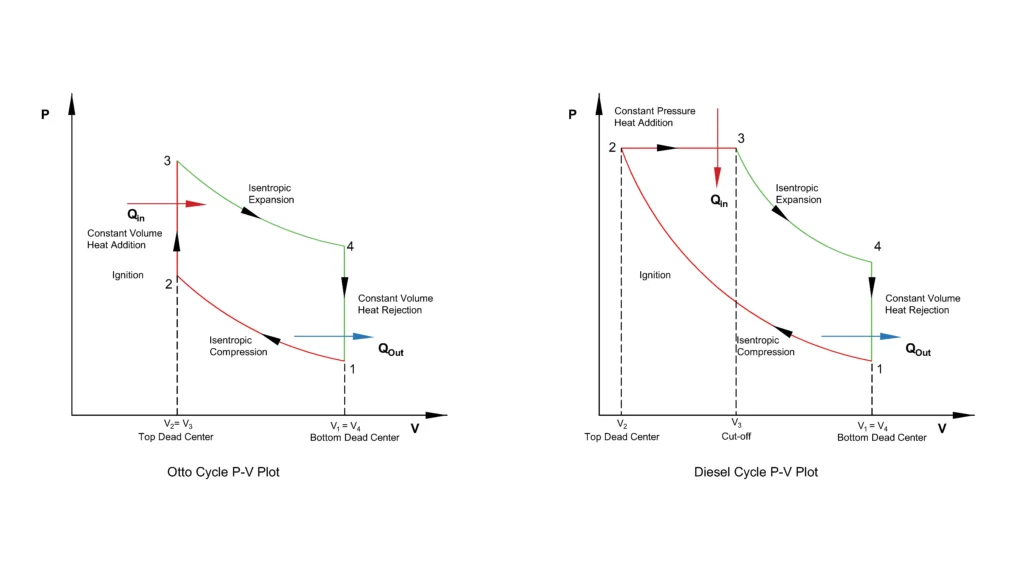
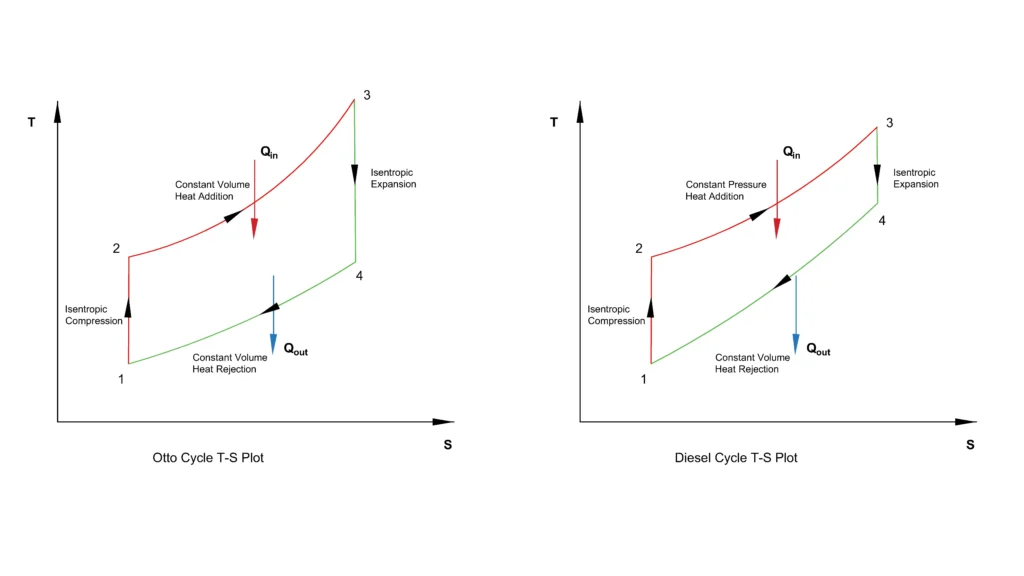
Thermal efficiency comparison
The thermal efficiency of an ideal Otto cycle is given by
Where,
- r is the compression ratio,
- γ = CP/CV, is the ratio of specific heats.
The thermal efficiency of ideal diesel cycle is given by
Where,
- r is the compression ratio,
- γ = CP/CV, is the ratio of specific heats.
- ρ is the cut off ratio (V3/V2)
It shall be noted that at same compression ratio and same ratio of specific heat, γ, the ideal Otto cycle has higher thermal efficiency compared to ideal diesel cycle.
This is because for cut-off ratio, ρ > 1, the term associated with diesel cycle’s thermal efficiency [(ργ-1) / γ(ρ-1)] becomes greater than 1. This reduces the thermal efficiency of the ideal diesel cycle compared to Otto cycle with same compression ratio and specific heat.
However, practical diesel engines operate at much higher compression ratio compared to petrol engines, which makes the diesel engine more efficient in thermal context.
This article is a part of thermal system, where other related articles are discussed.