
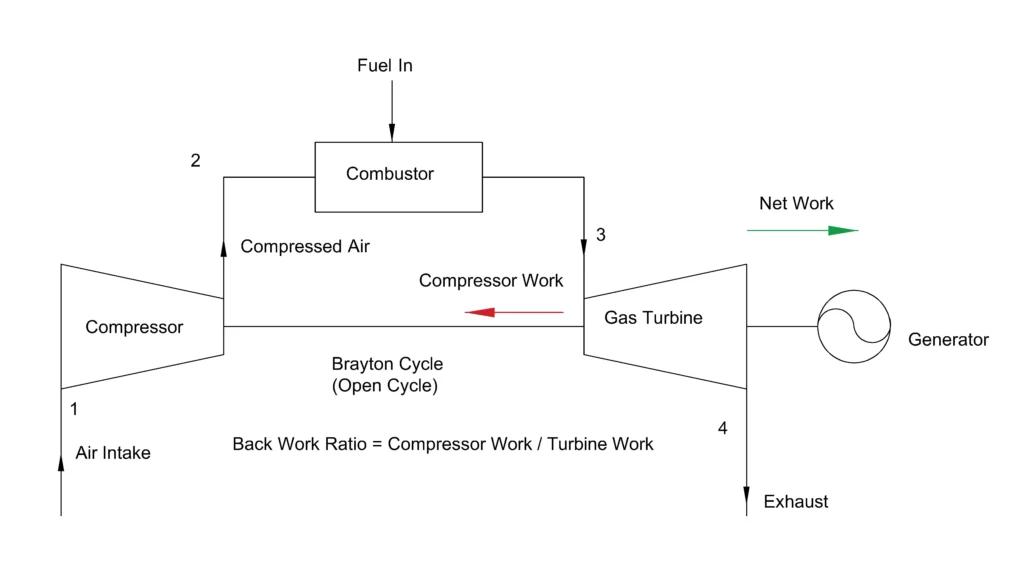
The Back Work Ratio is an important parameter of a Brayton Cycle, which is the fundamental thermodynamic cycle used in gas turbines and jet engines. Unlike the steam power plants that runs on Rankine Cycle, gas turbines require a substantial portion of turbine’s output to drive the compressor, which supplies the high-pressure air to the combustion chamber. This reduces the net useful work output produced in the gas turbine.
The Back Work Ratio therefore, quantifies the fraction of turbine’s power consumed by the compressor. The Back Work Ratio is the ratio of the compressor work input to the turbines work output. This ratio is called back work because a portion of turbines work output is fed back internally to operate the compressor. The Back Work Ratio is a key indicator in gas turbine design and performance evaluation as it directly influences the work output, thermal efficiency and over all performance of the Brayton cycle.
Table of Contents
Formula for Back Work Ratio
Since the Back Work Ratio is the ratio of compressor work input to the turbine work output. Therefore,
Where, WC is the compressor work input, and
WT is the turbine work output.
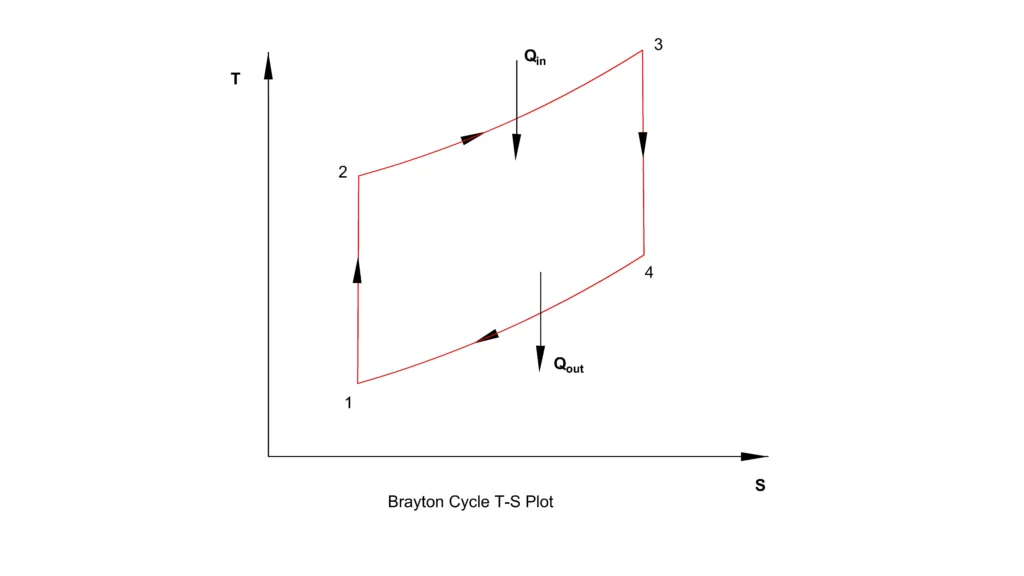
Since the isentropic compression of a Brayton cycle is the process 1-2
Therefore, Compressor work,
Also, for the isentropic expansion process 3-4
Turbine work,
Therefore, the Back Work Ratio becomes
Assuming the working fluid behaves like an ideal gas with constant specific heat,
Cancelling mCP, we get
Physical meaning of Back Work Ratio
The Back Work Ratio indicates fraction of turbine’s output that is consumed internally by the compressor in the Brayton cycle. It directly gives a measure of how much generated power is fed back internally to sustain the compression process before any external load consumes the power. A lower Back Work Ratio indicates that a larger portion of turbine output remains available as net work, which results in higher plant efficiency and greater power generation.
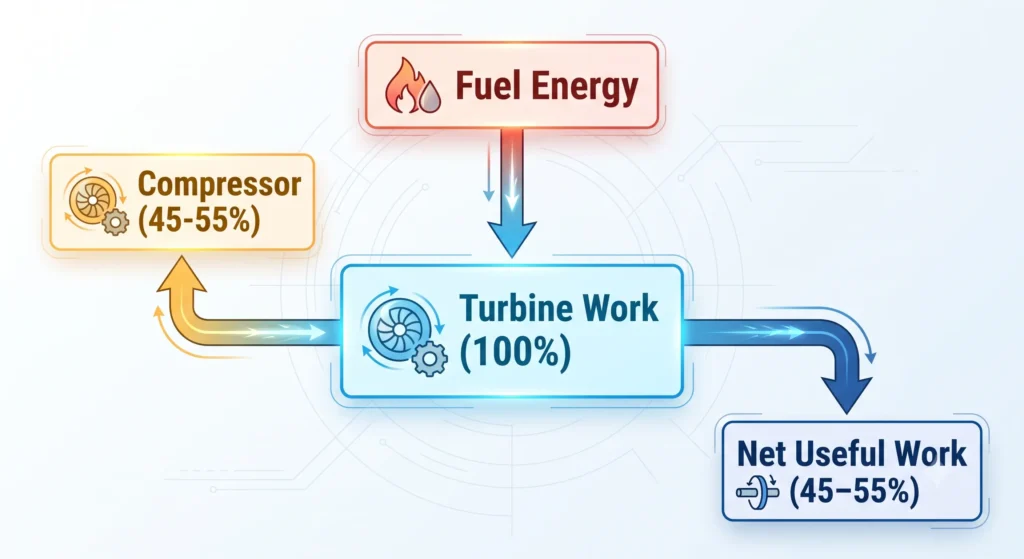
Conversely, a higher Back Work Ratio means the compressor is consuming more of the turbine’s generated power, reducing the net work output for electricity generation or mechanical application. For example if the Back Work Ratio is 0.5 (50%), the compressor consumes half of the power generated by the turbine, leaving the remaining half as useful net work. However, if the Back Work Ratio is 0.4, 40% of the turbine’s work is consumed to operate the compressor, while 60% remains available as useful net work.
Factors affecting the Back Work Ratio
Pressure Ratio
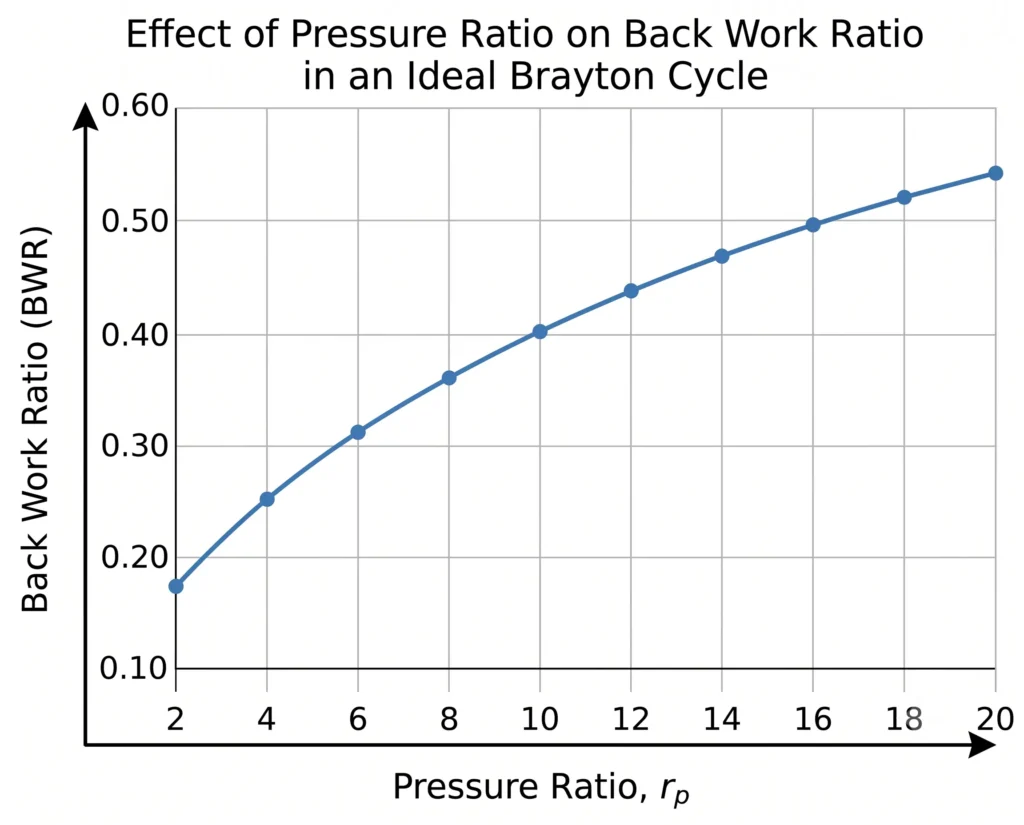
Pressure ratio is among the parameters of the Brayton cycle, which influences the Back Work Ratio. Increasing the pressure ratio increases the compressor pressure rise, thereby requiring more compression work. Although, the turbine work also increases by increasing the pressure ratio, the compressor work increases more rapidly beyond optimum pressure ratio which is 15:1 to 30:1 for modern gas turbines if the turbine inlet temperature is kept constant. Therefore, optimum pressure ratio selection is important to maximize work output and keep the Back Work Ratio Low.
Turbine Inlet Temperature
Increasing the turbine inlet temperature significantly increases the energy available for expansion. The turbine thus produces more work while the compressor work remains nearly unchanged. Consequently, the Back Work Ratio decreases, allowing a larger fraction of the turbine work output to be available for external loads. Modern Gas turbines achieve a lower Back Work Ratio and high efficiency by operating at a turbine inlet temperature of 1300-1700 °C using advanced cooling techniques and high temperature materials.
Compressor Efficiency
A higher isentropic efficiency of the compressor reduces the work required to operate the compressor at desired pressure. Less compressor work directly reduces the Back Work Ratio and improves the net work output and efficiency of the Brayton cycle. Efficient blade design of the compressor, leakage prevention and minimized aerodynamic losses contribute to a lower Back Work Ratio. An increase in compressor efficiency from 80 to 90% can reduce the BWR by 0.03-0.06 depending upon the cycle conditions.
Turbine Efficiency
A higher isentropic efficiency of the gas turbine allows more work extraction from the gases. It increases the turbine’s work output and thus reduces the Back Work Ratio, leaving more net work to be availed by the external loads. Modern gas turbines use advanced blade cooling, improved aerodynamics and nickel based super alloys ( Inconel 738, René N5, René N6, CMSX-4) to maximize the turbine’s efficiency. Increasing the turbine efficiency from 85% to 92%, increases the turbine’s work output by 5-8% and reduces the BWR by 0.02-0.05.
Importance of Back Work Ratio
Evaluation of the gas turbine performance
The BWR indicates how much of the turbine’s work is consumed to operate the compressor, making it a key parameter for accessing the overall performance of the cycle.
Access cycle modifications
The effect of the design improvements such as intercooling, reheating and regeneration is evaluated by comparing the BWR and determine the configuration required for the application.
Optimize pressure ratio
The Back Work Ratio or BWR helps engineers to identify the optimum pressure ratio where maximum net work and thermal efficiency is achieved without excessive consumption of the compressor.
Reference
- Back Work Ratio of Brayton Cycle (UNAM Journal)
- A Review of the Research and Development of Brayton Cycle Technology in Nuclear Power Applications
This article is a part of thermal system, where other related articles are discussed.