
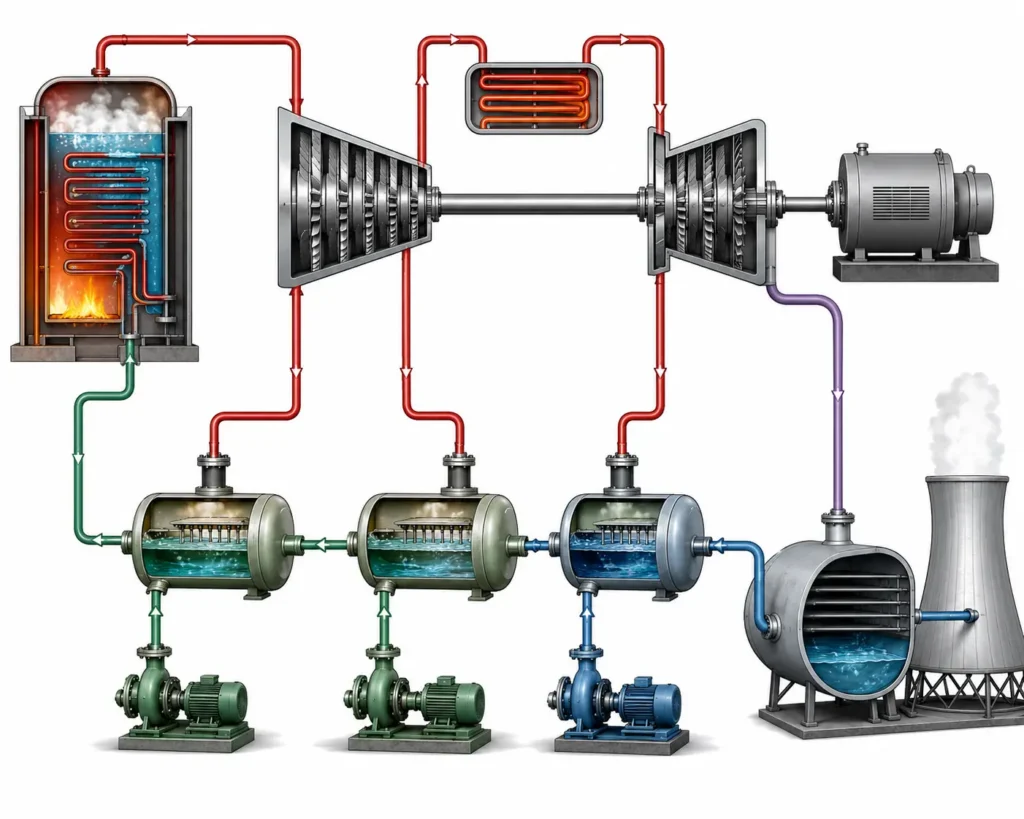
Regenerative feedwater heater is basically a heat exchanger, which is the main element of a Regenerative Rankine cycle. It is used for preheating the feedwater entering the boiler drum by utilizing the heat of the extracted steam from the intermediate stages of turbine. The Regenerative feedwater heater regenerates or recovers a portion of heat energy contained in the partially expanded steam from the turbine, which would otherwise be rejected at the condenser. As this recovered heat preheats the feedwater, the overall thermal efficiency of the power plant increases.
Table of Contents
Types of Regenerative feedwater heaters
Open Feedwater Heater
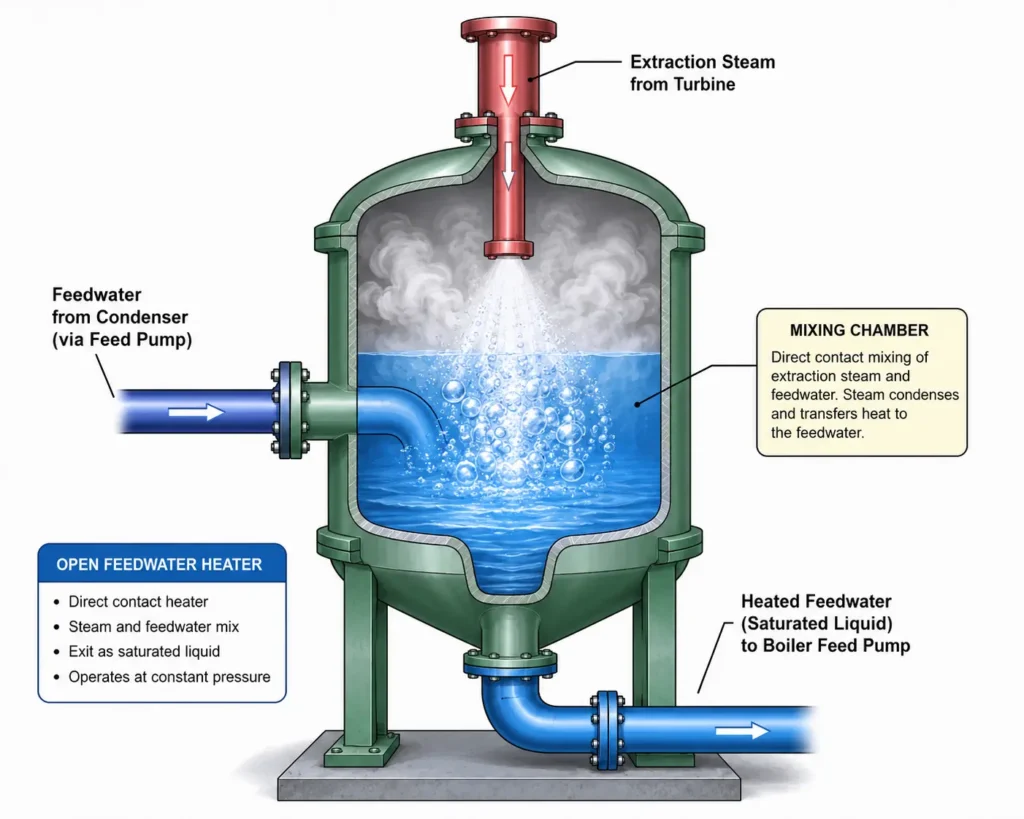
This regenerative feed water heater, also known as the direct contact feedwater heater, is a heat exchanger in which the extracted steam from the intermediate stage of the turbine, mixes with feedwater directly. The two fluid leaves the heater as saturated liquid at the heater pressure, providing a highly effective heat transfer.
Construction
The open feedwater heater consists of a mixing chamber, which has separate inlets for steam and feedwater and a common outlet for the heated feedwater. Because of direct mixing, the feedwater and the steam is at same pressure. This system needs an additional feedwater pump to raise the feedwater pressure.
Working principle
The steam extracted from the intermediate stage of the turbine is fed to the regenerative feedwater heater. Simultaneously the condensate from the condenser enters the heater after being pumped to the heater pressure or extraction steam pressure. The extracted steam condenses and transfers its energy directly to the feed water via direct mixing at constant pressure. This results in a saturated liquid which is pumped to the boiler pressure in the boiler drum.
Closed Feedwater heater
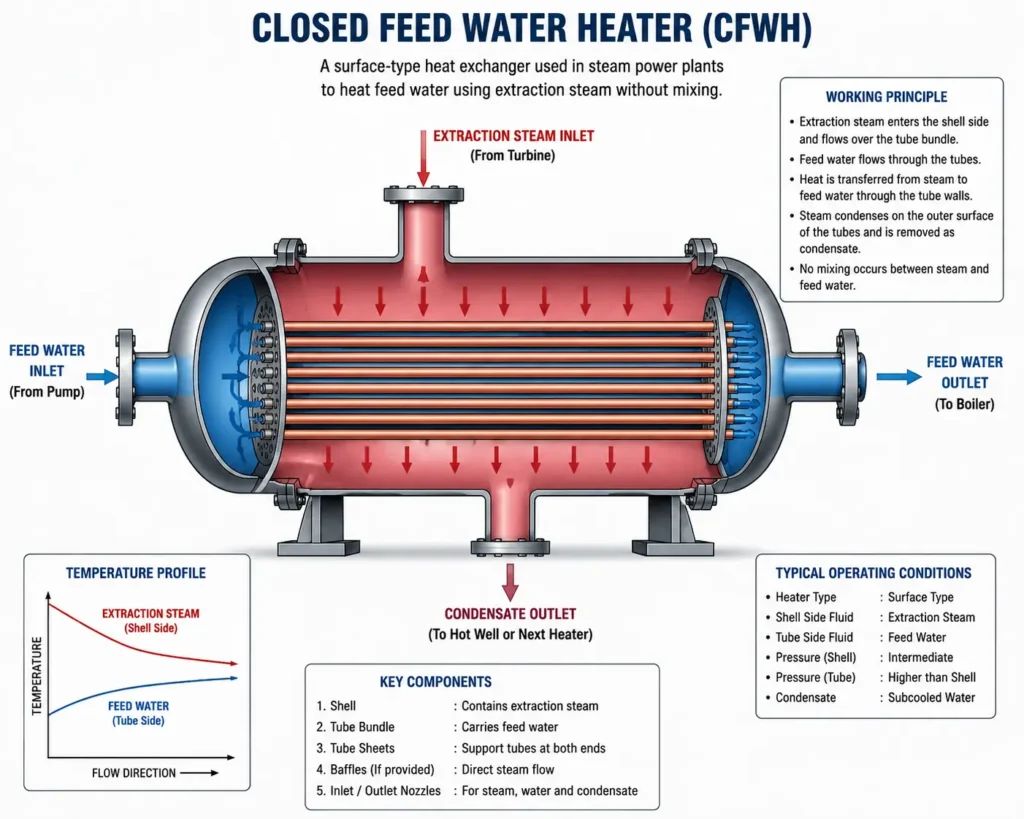
This regenerative feedwater heater is also known as surface feedwater heater, in which bled steam and the feedwater do not mix directly. The heat is transferred via the walls of tubes or plates, allowing the transfer of energy but keeping the fluids completely separate.
Construction
The closed regenerative feedwater heater consists of a shell and tube heat exchanger with feedwater flowing through the tubes and the bled steam in the shell side. As the steam gives up its heat, it condenses into water and is drained subsequently to the condenser via the drain lines and control valves.
Working principle
As the bled steam is extracted from the intermediate stage of the turbine, it is directed in the shell side of the heat exchanger. The steam condenses at nearly constant pressure and temperature, while releasing the latent heat. The feedwater is pumped via condenser pump and it flows through the tubes of the heat exchanger and absorbs the heat from the bled steam through the tube walls. As the two fluids remain separate, there is no intermixing involved as in case of open feedwater heater. The heated feed water then leaves the heat exchanger towards the boiler drum.
High pressure feedwater heater
A high-pressure feedwater heater is a closed regenerative feedwater heater, which is installed in the feedwater circuit between the boiler feed pump and the economizer. It uses high pressure bled steam from the HP turbine or intermediate turbine to preheat the feedwater before it enters the boiler drum. The construction of this regenerative feedwater heater is same as the closed feedwater heater.
Low pressure feedwater heater
The Low-pressure heater is a regenerative feedwater heater which is installed in the condensate flow path between the condenser and deaerator. It utilizes the low-pressure extraction steam from the later stages of the turbine to preheat the condensate, reducing the heat duty of the boiler. It is also a shell and tube type heat exchanger where the condensate flows through the tube and steam in the shell side.
| Parameter | Open Feedwater Heater (OFWH) | Closed Feedwater Heater (CFWH) |
| Heat transfer method | Direct mixing of extraction steam and feedwater | Indirect heat transfer through tubes |
| Mixing of fluids | Yes | No |
| Feedwater outlet condition | Saturated liquid at heater pressure | Subcooled or near-saturation liquid |
| Construction | Simple mixing chamber | Shell-and-tube heat exchanger |
| Cost | Lower | Higher |
| Maintenance | Lower | Higher |
| Heat transfer effectiveness | Very high due to direct contact | Slightly lower due to temperature difference across tubes |
| Additional pumps required | Usually yes, because water leaves at an intermediate pressure | Generally, no additional feed pump for the heater. |
| Pressure flexibility | Limited | Excellent |
| Typical location in power plant | Usually used as the deaerator, located between LP and HP heaters | Used as LP heaters (between condenser and deaerator) and HP heaters (between boiler feed pump and economizer) |
| Where it is used | Almost every large thermal plant has one deaerator-type OFWH | Multiple CFWHs are used in utility, supercritical, and nuclear plants |
| When it is preferred | When maximum heat transfer and deaeration are required | When feedwater and extraction steam must remain separate or operate at different pressures |
| Main advantage | Simpler design and excellent heat transfer | Better operational flexibility and suitable for high pressures |
| Main disadvantage | Requires pumping arrangement and direct mixing | Higher cost and more complex design |
| Typical contribution to efficiency improvement | About 1–2% thermal efficiency increases for a single OFWH | About 0.5–1.5% per heater depending on pressure level and cycle design |
Note: Modern power plants uses both the open and closed feedwater heaters as this arrangement gives the maximum practical efficiency gains while maintaining the cost and complexities involved. A typical 500 MW unit can use 3-4 low pressure closed feedwater heater, 1 open feedwater heater and 2-3 high pressure closed feedwater heater.
Sources
- ScienceDirect – Feedwater Heater Overview
- Comparative Thermo-Economic Analysis of Regenerative Rankine Cycles with Two Feed Water Heaters (ScienceDirect)
This article is a part of thermal system, where other related articles are discussed.