
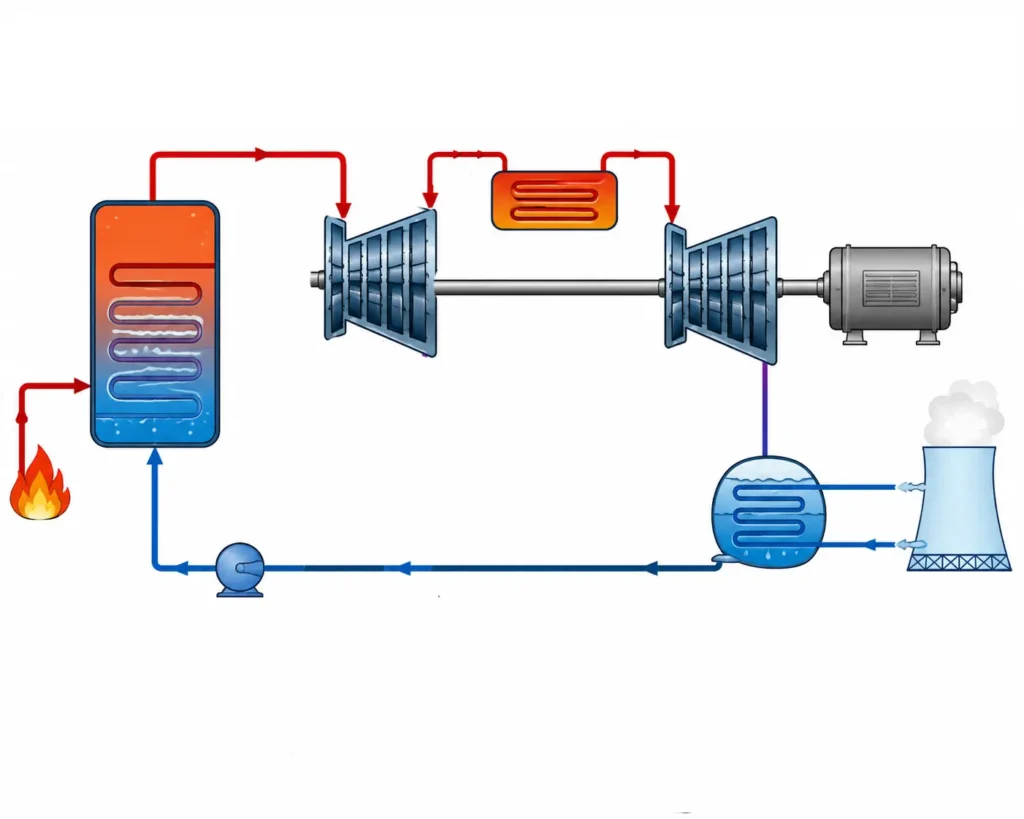
Reheat Rankine Cycle is basically a modification of the simple Rankine Cycle, where the steam from the boiler is expanded in stages, reheated between the expansions in order to improve the performance of the power plant.
In the Reheat Rankine Cycle, the high-pressure steam first expands in the high-pressure turbine and then is returned to the boiler or reheater, where the temperature of the steam is increased at almost constant pressure. The reheated steam then subsequently expands in intermediate or low-pressure turbine.
Table of Contents
Use of Reheat Rankine Cycle
In moderate pressure boilers, the quality of steam at the turbine exhaust is around 92 to 90 % dry. But at high boiler pressures, which is beneficial for efficiency, makes the turbine exhaust more wet because for same condenser pressure, the expansion line is more in the wet region of the T-S diagram. The quality of steam can significantly drop below 85%.
This is where reheating is introduced to reduce the moisture content of the steam at the turbine exhaust.
Reheating the steam prevents the erosion and damage to the low pressure turbine blades, usually caused by water droplets when moisture content is high.
In Reheat Rankine Cycle, total work output of the turbine is increased by allowing additional expansion of steam after reheating.
The Reheat Rankine Cycle slightly improves the thermal efficiency over simple Rankine cycle but allows the use of higher boiler pressures without detrimental effect on the turbine.
The Reheat Rankine Cycle
In this cycle, the thermodynamic processes involved are
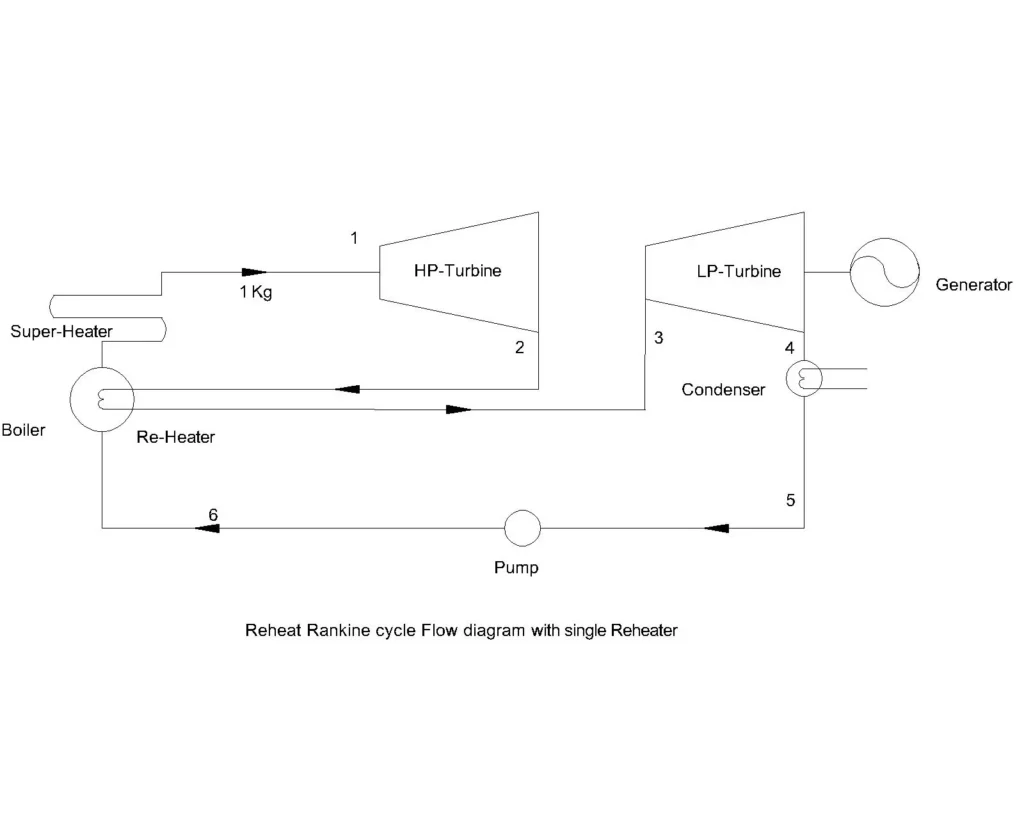
Process 1-2: Isentropic expansion of high-pressure high temperature steam into the high-pressure turbine.
Process 2-3: This is the constant pressure process, where the superheated steam from the HP turbine’s exhaust is reheated at a pressure usually 0.2-0.3 times the boiler drum pressure to about the same temperature as of the main steam.
Say
| Main Steam Conditions | Reheat Conditions |
| 540°C, 170 bar | Reheated to about 540°C at 43 bar |
| 565°C, 240 bar | Reheated to about 565°C at 60 bar |
| 600°C, 300 bar | Reheated to about 600°C at 75 bar |
Process 3-4: It is an isentropic expansion process, where the reheated steam enters the low-pressure turbine or intermediate turbine and is expanded there. The main reason of reheating the steam is to improve the dryness fraction of the steam at the exhaust of the LP turbine or intermediate turbine.
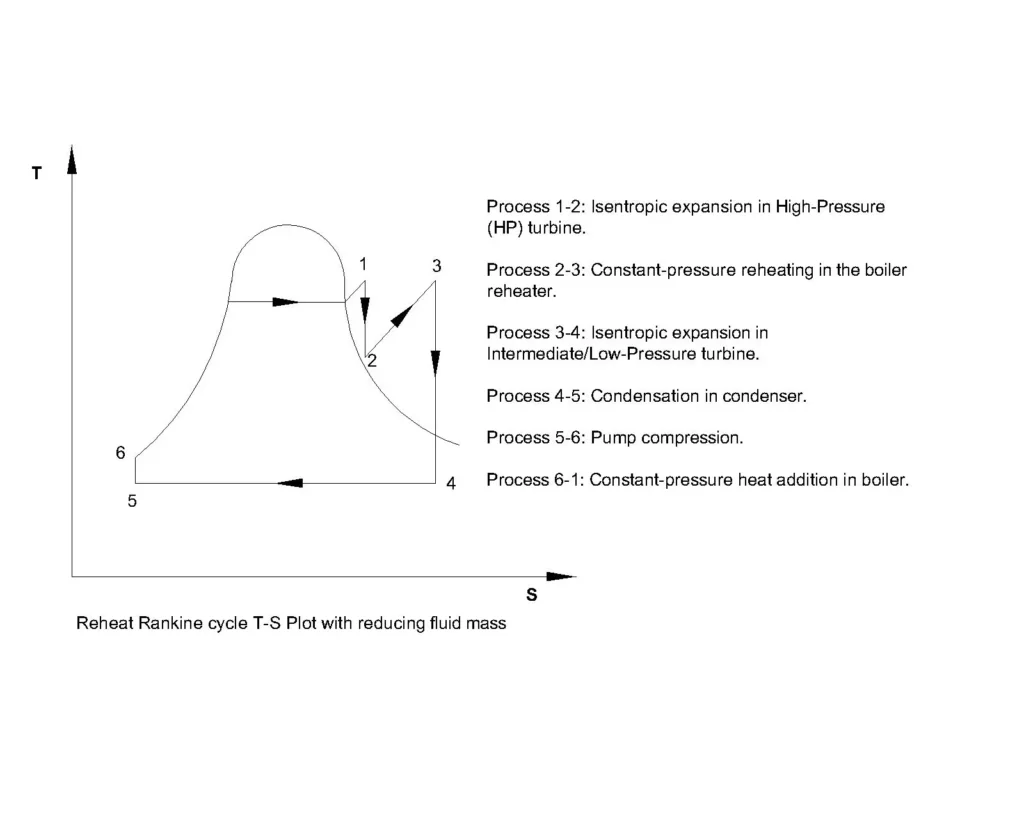
Process 4-5: It is the isobaric process where the condensation of steam to water takes place. The process also happens to be isothermal during the phase change portion of the condensation.
Process 5-6: This process is the isentropic compression, where the working fluid is pumped to higher pressure (boiler pressure).
Process 6-1: This is the process of constant pressure heat addition, where heat is added to the working fluid in the boiler, converting the water into superheated steam.
Efficiency of the Reheat Rankine Cycle
Work done at the turbine, Wt = (h1-h2) + (h3-h4)
Work done by the Pump = Wp = h6-h5
Heat Supplied, Qin = (h1-h6) + (h3-h2)
Thermal efficiency, η = Net work / Heat Supplied
η = (Wt – Wp) / Qin
Advantage of Reheat Rankine Cycle
| Advantage | Practical Benefit | Typical Numerical Impact |
| Lower turbine exhaust moisture | Reduces water droplet formation in the final-stage blades and minimizes the erosion. | Moisture content is usually kept below 8–10% (steam quality above 90%), whereas a simple Rankine cycle may have 15–20% moisture at the turbine exit. (ScienceDirect) |
| Higher specific work output | Additional expansion after reheating produces more turbine work. | Specific turbine work typically increases by 3–8%, depending on reheat pressure and steam conditions. (ScienceDirect) |
| Improved turbine reliability | Drier steam reduces blade erosion, vibration, and maintenance requirements. | Blade life and maintenance intervals are significantly improved due to the reduction in exhaust moisture. |
| Permits high-pressure operation | Higher boiler pressures are possible without producing excessively wet steam at the turbine exhaust. | Modern reheat plants commonly operate at steam pressures exceeding 9.8 MPa (98 bar), with supercritical units reaching 25–30 MPa. (ScienceDirect) |
| Slight increase in cycle efficiency | Rise in average temperature of heat addition and increases the net work output. | Thermal efficiency typically improves by 1–3 percentage points, although some examples show gains of only about 0.8%. (ScienceDirect) |
The primary reason of adopting the Reheat Rankine cycle is not the small efficiency gain but the substantial reduction in turbine’s exhaust moisture, protecting the low pressure turbine blades.
Number of Reheaters used
From thermodynamics and economics perspective, one reheater is considered optimal for most steam power plants. However, in super critical or ultra supercritical plants, two reheaters are sometimes needed, which gives a gain of additional 0.3-0.5 % in efficiency, and improves the turbine exhaust steam quality.
This article is a part of thermal system, where other related articles are discussed.