
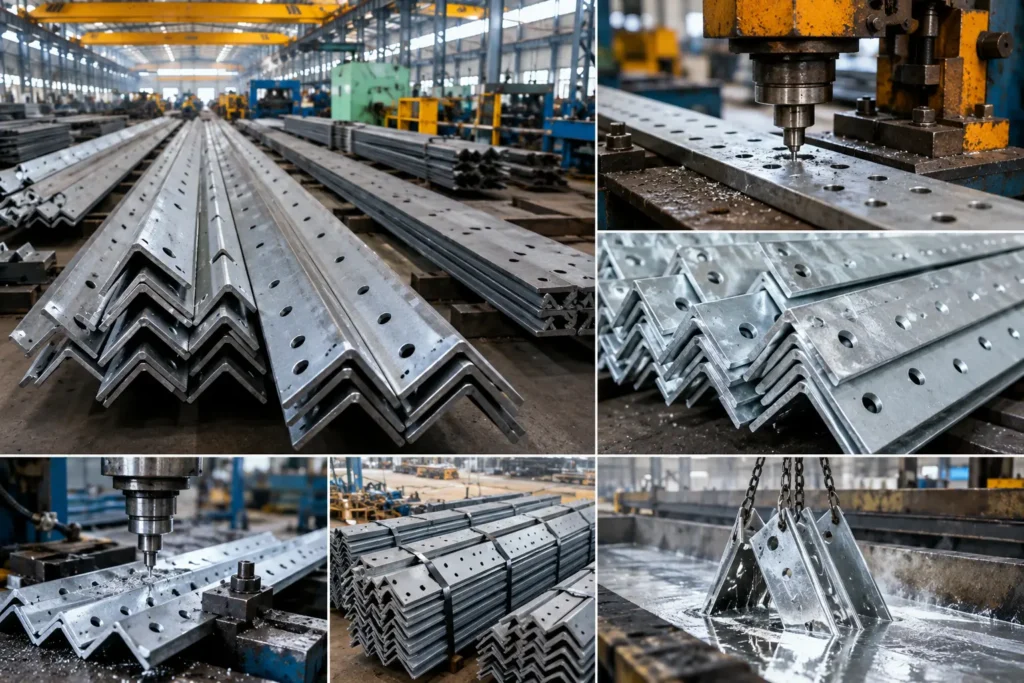
Fabrication of transmission tower is basically a combination of various processes, which converts raw steel section into accurately shaped, drilled, punched and galvanized structural member, finally used for construction of transmission line towers. Fabrication of transmission tower involves straightening, cutting, bending, punching, drilling and marking, such that each tower member meets the design specification, quality standards and erection requirements for reliable field assembly.
Table of Contents
Operations in fabrication of transmission tower
Straightening
All the tower members must be necessarily straight before being worked on. But if it is necessary, it should be straightened or flattened by pressure and made free from twists. The process of straightening should not damage the material and assembly must be in close contact throughout keeping the specified tolerance in view. For angle sections up to 150 x 150 x 12 mm, roller straightening machine of proper capacity can be used. For higher sections, beam bending or hydraulic press is to be used.
Cutting
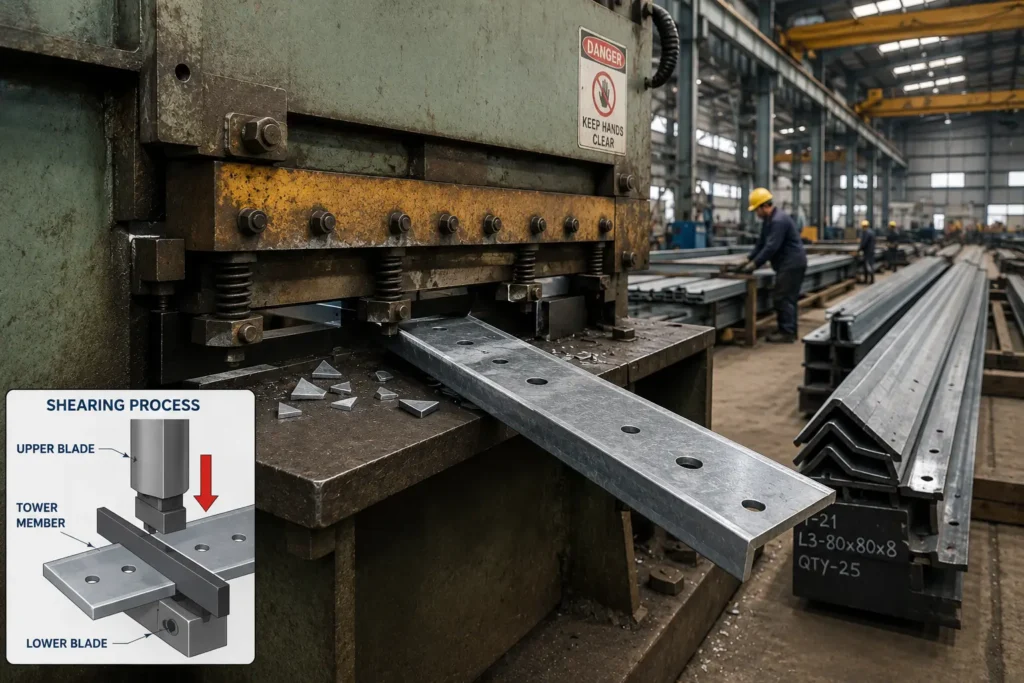
Cutting in fabrication of transmission tower is achieved by shearing, cropping, flame cutting or sawing. However, the surfaces cut should be clean smooth and reasonably square with no distortions in it.
Bending
In fabrication of transmission towers, Bending mild steel (MS) angle sections 75 x 75 mm with thickness up to 6 mm and bend angle up to 10 degrees shall be bent cold. The angle sections larger than 75 x 75 mm with thickness above 6 mm, including 100 x 100 mm with thickness up to 8 mm and bent angle up to 5 degrees shall also be bent cold. All other higher angle sections with higher bent angles shall be bent hot.
Plates up to 12 mm thickness and up to 15 degree bent angles should be bent cold. Higher thickness plates and higher degree of bent angles must be bent hot.
HT steel sections should be bent hot regardless of the section size and bent angles. All the bent materials must be naturally air cooled, free from surface damages with even profile. Mechanical press, Hydraulic press, beam bending machines can be used for bending purposes.
Punching and drilling
In the fabrication of transmission towers, punching is basically adopted for MS or HT steel sections up to 16 mm thick. For sections thicker than 16 mm, drilling must be done. Holes in the members must be drilled or punched to the jig but should never be formed by flame cutting. The burrs after punching or drilling should be removed.
The holes near the bend line of the bent member on sides must be punched or drilled after bending operation and relative positions of these holes should be maintained by the use of proper template or jigs.
The edge security and bolt gauges must also be maintained while punching and drilling operation as given below.
Edge Distance, Pitch, and Bolt Gauge Requirements for Transmission Tower Bolts
| Bolt Diameter (mm) | Hole Diameter (mm) | Minimum Pitch (mm) | Hole Centre to Rolled Edge (mm) | Edge Security Hole Centre to Sheared Edge (mm) |
| 12 | 13.5 | 32 | 16 | 20 |
| 16 | 17.5 | 40 | 20 | 23 |
| 20 | 21.5 | 48 | 25 | 28 |
| 24 | 26.0 | 60 | 33 | 38 |
Hole Diameter: Standard clearance hole provided for bolt installation.
Pitch: Centre-to-centre distance between adjacent bolts in the direction of the load.
Hole Centre to Rolled Edge: Minimum distance from the bolt centre to a factory-rolled or sawn edge.
Edge security Hole Centre to Sheared Edge: Minimum distance from the bolt centre to a sheared or cut edge maintained to prevent tearing, bearing failure, and excessive stress concentration around bolt holes.
Tolerance in holes
Holes for the hexagonal bolts in towers of transmission lines must be cylindrical. The diameter of the hole for bolt diameter up to 20 mm is equal to the diameter of the bolt + 1.5 mm. For 24 mm diameter bolts, the clearance between the bolt shank and the hole is 2 mm. While deciding the diameter of the hole, care should be taken in making the allowance for galvanization of bolt as well as the hole, and also for the bolt shank diameter tolerance. It is also observed that galvanized bolt shank diameter varies up to 0.3 mm for nominal diameter up to 20 mm. Hence, the final diameter for the holes
| Nominal diameter of the bolt | Final diameter of hole to be punched or drilled |
| Up to 20 mm | Bolt diameter + 1.5 mm + 0.3 mm |
| 24 mm | Bolt diameter + 2 mm + 0.4 mm |
Mis punched or excess holes
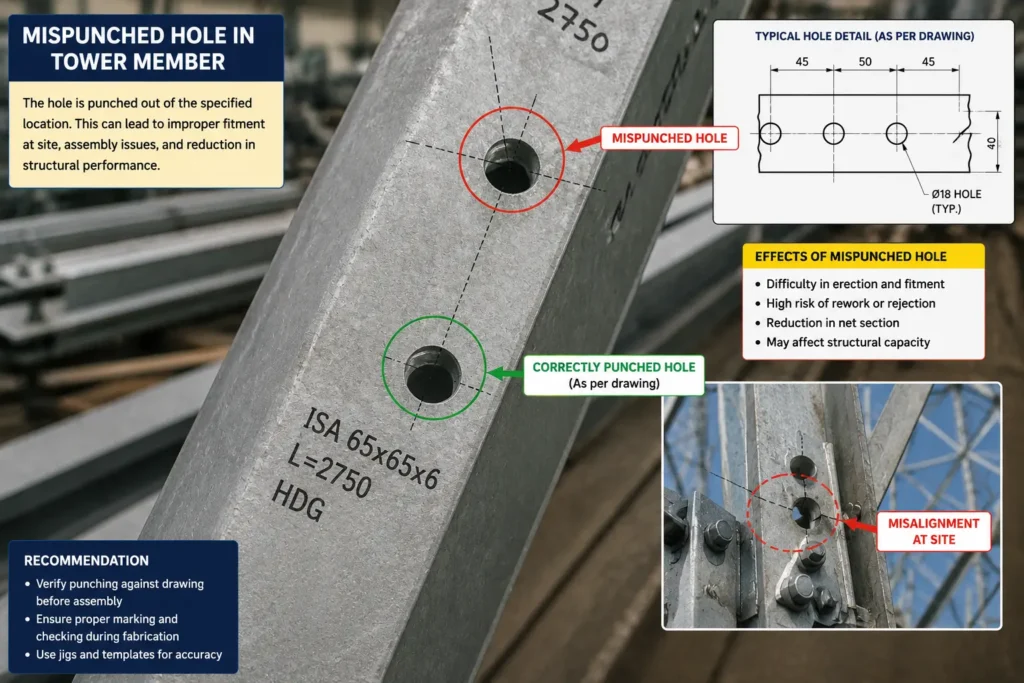
In fabrication of transmission towers, not more than one mis punched or excess hole per local surface area is allowed to be blocked by proper welding method. Total number of such blocking of holes is allowed only 3 per tower member as weld filled holes can create residual stress, distortion and potential galvanizing defects. No new holes are permitted to be drilled or punched overlapping the plugged / blocked hole.
Marking
In the process of fabrication of transmission tower, identification mark must be allotted to each tower member distinctly before galvanizing with marking dies of 16 mm size.
Tolerances in Fabrication of Transmission Towers
| Sl. No. | Description | Permissible Tolerance |
| 1 | Straightness (Camber) for sections up to 100 × 100 mm | 0.4% of member length |
| 2 | Straightness (Camber) for sections over 100 × 100 mm | 0.2% of member length |
| 3 | Maximum allowable difference in hole diameter on opposite sides of plate/angle (hole taper) | ± 0.8 mm |
| 4 | Overall length of angle members | ± 2 mm |
| 5 | Distance between consecutive holes | ± 1 mm |
| 6 | Distance from first hole to last hole in member | ± 2 mm |
| 7 | Gauge distances | ± 1 mm |
| 8 | Specified hole diameter on punch side (or where drilled) | +0.4 mm / -0.0 mm |
NB
- Camber is the deviation of a tower member from a perfect straight line.
- Gauge distance is the perpendicular distance between bolt lines.
- Hole taper is the difference between the hole diameter on the punch entry side and the exit side.
- The hole diameter tolerance (+0.4 mm, -0.0 mm) means the hole may be slightly larger than the nominal size but shall never be smaller.
This article is a part of the Transmission line page, where other articles related to topic are discussed in details.

An insightful look into the fabrication standards of transmission towers. It’s a great reminder that the reliability of our power grid starts in the factory, long before the first bolt is tightened in the field. As an Electrical Engineering student at Telkom University surabaya, this technical overview highlights the importance of ‘structural tolerances’ a concept that mirrors the precision we strive for in our own circuit design and hardware integration. If the fabrication fails, the electrical performance is moot.