
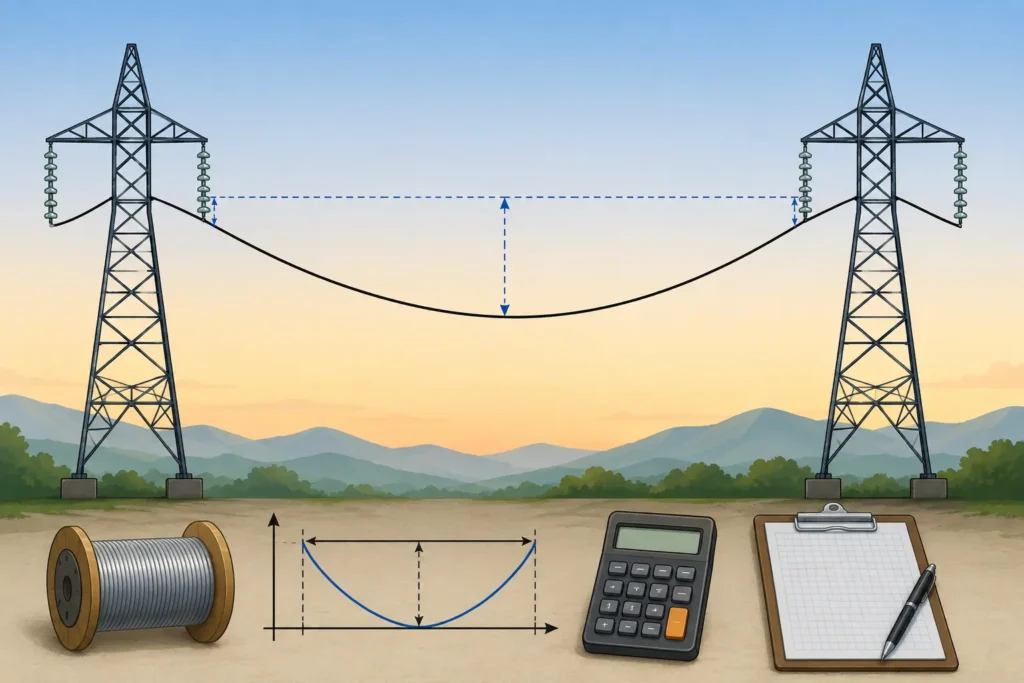
In transmission line design, sag tension calculation is one of the most important aspects of the design, that determines the behaviour of the conductors at various tension, span length, temperature and external load such as wind and ice. The conductor is suspended from adjacent transmission line tower or support, takes a shape known as catenary. Catenary is the curve which is assumed by a perfectly flexible and uniformly weighted cable or chain that hangs freely under its own weight, supported only at both ends. Sag is therefore the vertical distance between the support or tower and the lowest point of the conductor or null point.
Table of Contents
The sag of the conductor at null point is inversely proportional to the tension in the conductor. Thus, sag tension calculation helps in predicting the behaviour of the conductor under recommended tension limits and varying loading condition. As per standard, the recommended tension limit under everyday temperature and nil wind is 22 to 25 % of the breaking strength of the conductor and for everyday temperature and full wind is 50 to 70 % of the breaking strength of the conductor.
Formula for Sag tension calculation
For supports at same level
For normal spans in transmission lines where supports or towers are at same level, the catenary formed is nearly a parabola shape hence,
Sag, S = wx2 / 2T, but horizontal distance of null point from both support is x = L/2 unit distance.
Then, sag, S = w (L/2)2 / 2T = wL2 / 8T
Where, S is the sag in meters,
W is the weight of the conductor in kg/m,
L is the span length in meters, and
T is the working tension in the conductor in kg
For supports at different level
For transmission lines running through steep hills, two end of supports or tower may be at different levels of height. This difference in height will change the shape of the conductor strung between the supports and thus will form a part of catenary with null point shifting towards the lowest support from the center (as in case of supports at same level)
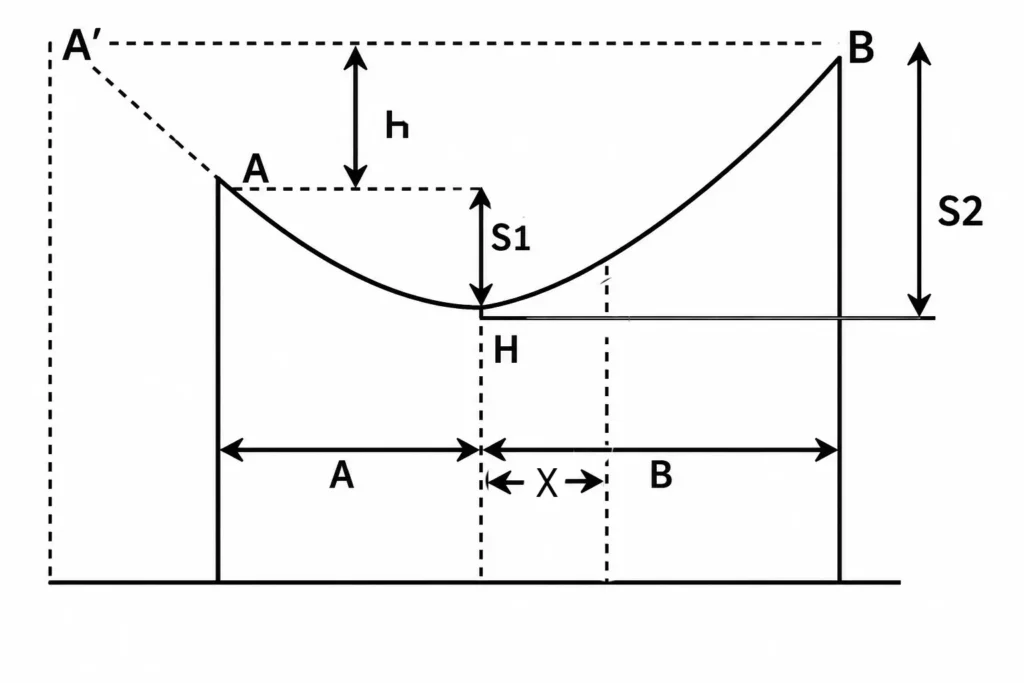
In the diagram, to complete the catenary as in supports at same level, we can extend the curve BHA to A’ so that A’ is at same level as B. H is the middle point of A’B and hence is the null point. Also the difference in the support levels of A and B is h units.
L is the span length between A and B. The null point H is at a distance of a units from support A and b units from support B. X be the distance of the center of the span to the null point.
Therefore, a = L/2 – X
b = L/2 + X,
where, X = T*h / w*L
Also, Sag corresponding to the smaller support (A), S1 = wa2 / 2T
Or multiplying the numerator and denominator by 4, we get S1 = w (2a)2 / 8T,
Similarly, for Sag corresponding to taller support (B), S2 = w (2b)2 / 8T
Also it can be noted that S2 = S1 + h
Loadings
Ice load = 3.14 * {(d/2 + t)2 – (d/2)2} * 973*10-6 [kg/m],
Wind load = p * (d+2t) * 10-3 [kg/m]
Net loading = √{(ice load + w)2 + (wind load)2} [kg/m]
Where, d is the diameter of the conductor in mm,
t is the thickness of ice in mm,
p is the wind pressure in the conductor in kg/m2
State change equation of sag tension calculation
The purpose of the state change equation in sag tension calculation is to find final tension in another condition once the initial tension with temperature and loading is known.
For example: initial condition 32 °C and no wind, final condition 5 °C, wind load 28%. The conductor tension changes because of elastic stretching, thermal expansion / contraction and change in conductor loading.
For normal spans, the catenary is approximated by a parabola and thus the conductor length becomes, l = L + [L3 (W/w)2 (w/A)2] / 24 f2
Where, L is the span, W is the net weight, w is the unit weight of the conductor, A is the area of the conductor and f is the stress.
At initial temperature t1, the initial length becomes l1 = L + [L3 (W1/w)2 (w/A)2] / 24 f12
At final temperature t2, the length becomes, l2 = L + [L3 (W2/w)2 (w/A)2] / 24 f22
Now considering hookes law, unstressed length at temperature t1 = l1-(l1t1 / EA),
Also unstressed length at temperature t2 = l2-(l2t2 / EA),
Therefore, l2-(l2t2 / EA) = { l1-(l1t1 / EA)} {1+g(t2-t1)},
Where g is the coefficient of linear expansion per °C and E is the modulus of elasticity of the conductor in kg/mm2, A is the area in mm2 and W1 is the net weight in initial condition in kg/m and W2 is the net weight during final condition in kg/m.
During initial loading condition W1 = w, which is bare conductor weight/m. But in final condition with wind and ice load W2 > w
Substituting the value of l1 and l2 in the above equation and simplifying while neglecting the very smaller values, we get
Therefore, from the above equation f2 can be calculated and the corresponding tension to the final stress can also be calculated by
T2 = f2 A.
Hence, the sag can be calculated by the sag tension relation S = wL2 /8T = W2L2 / 8 f2A
This article is a part of the Transmission line page, where other articles related to topic are discussed in details.