
The circuit breaker timing test is performed to verify the mechanical performance of the circuit breaker by measuring the opening, closing and contact synchronization time. Since, the protection system relays send trip command in milliseconds, if the circuit breaker opening time is delayed, the fault clearing time increases. More is the fault clearing time, more is the chance of equipment damage because of high fault current. Therefore, the circuit breaker timing directly affects the system stability and protection grading.
Total fault clearing time = Relay operating time + Circuit Breaker operating time + Margin
Table of Contents
What is measured in a circuit breaker timing test?
A circuit breaker timing test measures the dynamic mechanical performance of the circuit breaker during switching operations. The objective of the circuit breaker timing test is to verify that all the poles of the circuit breaker operate within the specified time limits by the manufacturer and maintain synchronism. The measured parameters are the following:
Opening time
It is the time interval between the energization of the trip coil and the instant when the main contacts separate and the process of arc extinction begins. It is measured from the trip coil voltage application to the first contact parting or current interruption detection. Excessive opening time delays the fault clearance and makes the equipment subject to increase fault stress.
Closing time
It is the time interval between energization of the closing coil and the instant when the main contacts touch and current path gets established. It is measured from the closing coil energization and till the electrical continuity of the main contact is detected. Slow closing of the circuit breaker indicates weak springs or low control voltage or mechanical friction.
Pole Discrepancy (phase to phase time difference)
The maximum time difference between the operation of the fastest and slowest pole observed during the circuit breaker timing test is called the pole discrepancy. The formula for pole discrepancy is
T max – Tmin, where Tmax is the time taken in operation of the slowest pole and T Min is the time taken in operation of the fastest pole. Large pole discrepancies cause unbalanced system stress, over voltages and protection malfunction and hence utilities restricts it to few milliseconds.
The pole discrepancy during opening of circuit breaker must be under 3ms and in closing operation must be under 5ms as per utility practice.
Contact Bounce
It is the duration during which the contacts oscillate after initial closing, before achieving the stable contact. It is observed as multiple interruptions immediately after first contact touch. Excessive contact bounce causes arcing and contact wear leading to premature failure.
Reclose time
It is the time interval between the circuit breaker opening due to a fault and its reclosing command. It is measured from the end of opening operation to the beginning of reclosing operation. Reclosing time matters for circuit breakers of transmission lines where transient faults must be cleared and circuit is restored quickly.
Close open operation time
During circuit breaker timing test, the total time taken by a circuit breaker to respond to a close command immediately followed by a trip command. The sequence of events is energization of close coil, contacts closed, trip coil energized and contacts open. This is used to verify the breaker’s ability to interrupt faults immediately after closing onto faults.
Open close open sequence time
During circuit breaker timing test, OCO sequence time is the total time required to complete the open-close-open operation cycle of the circuit breaker. It simulates the auto reclosing operations and ensures the spring charging mechanism, mechanical endurance and reliable multi operation capability of the circuit breaker.
Circuit breaker timing test equipment
Modern circuit breaker timing test is performed using digital circuit breaker analyzer also called as a timing kit. A professional timing analyzer consists of a main unit which has high resolution time measurement typically 0.01 ms resolution, multi-channel contact input, control coil trigger inputs, internal DC supply for trip/close operation, data acquisition, and graphical display unit.
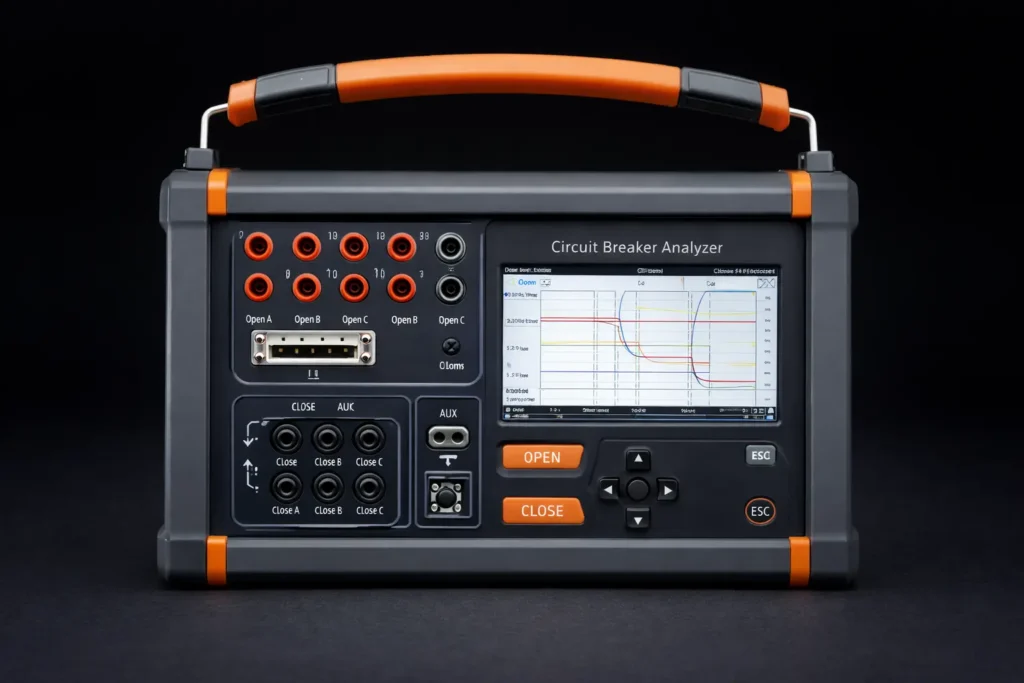
Each pole of the circuit breaker is connected to the timing channel which detects the contact open/close transitions via low voltage injection typically 24-30 V DC. The control coil trigger monitors the trip coil voltage and close coil voltage and determines the exact reference time when the coil energizes. Auxiliary inputs is used for the spring charge indication, auxiliary contact timing and motor operation monitoring.
For detailed analysis, a linear travel transducer is mounted on the operating rod to measure the contact travel, velocity, overtravel and rebound. This provides the mechanical signature of the breaker beyond timing.
Circuit breaker timing test connection
Each channel of the analyzer is connected to each phase of the circuit breaker on both line and load side terminals via which the analyzer injects the low sensing voltage. The trip and close coil connection of the analyzer is wired in series with the trip circuit and closing coil and voltage sensing leads across the coil’s terminals. The auxiliary contact is wired to additional channel to measure the mechanical to electrical delay and interlock functionality.
The transducer if used is mounted directly on the operating rod of the circuit breaker, with an electrical cable connecting the analyzer motion input port and calibrating the transducer for the stroke length. This allows the velocity curve plotting.
Circuit breaker timing test procedure
Step 1: Isolate the circuit breaker.
Step 2: connect the timing leads to the main contacts of the breaker.
Step 3: Connect the trip and close coil control cables.
Step 4: Initiate the trip/close command through the test kit.
Step 5: Record the time for each operation and for each pole.
Acceptance criteria
Although the acceptance criteria are highly dependent on the manufacturer’s data with ±10% variation yet typical acceptance range
| SF6 Circuit breaker | Vacuum Circuit breaker | |
| Opening time | 30-60 ms | 20-50 ms |
| Closing time | 40-80 ms | 30-70 ms |
| Pole Discrepancy Open | ≤ 3 ms | |
| Pole Discrepancy Close | ≤ 5 ms | |
During the maintenance testing, variation between 3 consecutive operations should be with in 2ms. A deviation on the higher side indicates, mechanical wear, lubrication issue of the mechanism or control voltage instability.
In the maintenance of 132-220 KV systems, most common reason for rejection of breakers are high pole discrepancy, increased opening time and inconsistent timing between operation.
Quick Diagnostic Table
| Symptom | Most Likely Cause | Secondary Cause |
| High pole discrepancy | Uneven lubrication | Linkage misalignment |
| Increased opening time | Mechanical friction | Low DC voltage |
| Inconsistent timing | Control voltage fluctuation | Sticky latch mechanism |
This article is a part of the Testing and commissioning page, where other articles related to topic are discussed in details.