
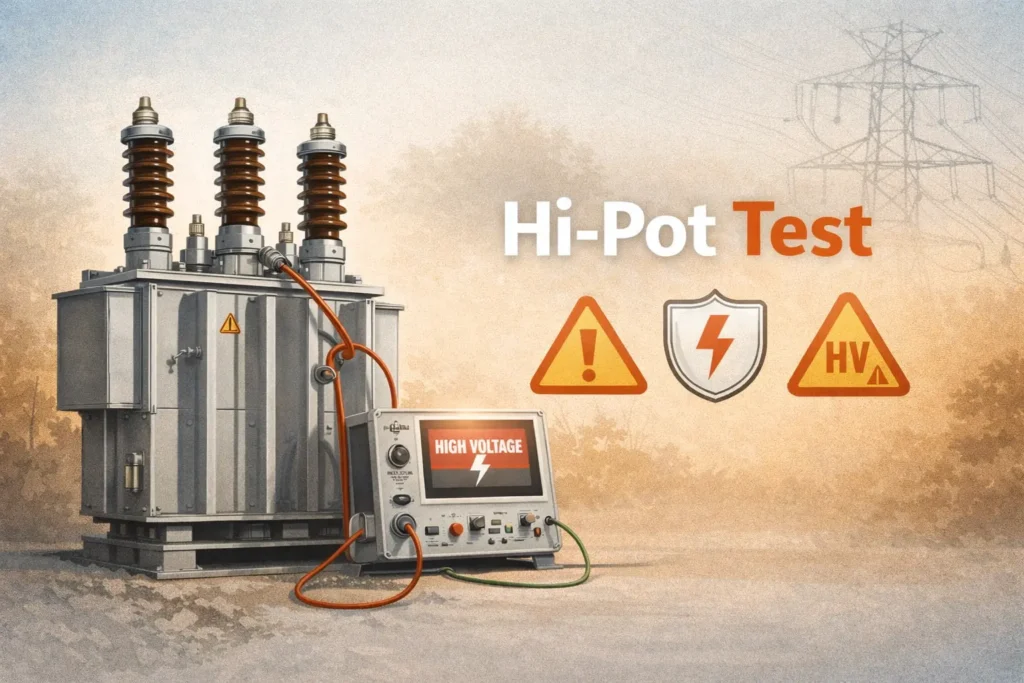
Hi pot test or high potential test is a dielectric withstand test of an insulation which is used to verify insulation integrity by applying significantly high voltage compared to the rated voltage of the insulation/equipment under test. The hi pot test is commonly conducted during commissioning or as a part of routine testing or after major repairs to detect defects in insulation from moisture or contamination that could eventually lead to flashover or failure under service condition.
Unlike diagnostic test such as tan delta test, hi pot test is not a condition monitoring test. The hi pot test is a stress test where the insulation is intentionally subjected to high voltage so that its integrity and safety margin is proven. It is typically applied to circuit breaker, power transformer, cables, busbar etc.
Table of Contents
Hi pot test principle
The principle of hi pot test is simple dielectric stress application. Whenever a voltage higher than the rated voltage of the equipment is applied phase to ground or phase to phase, and held for a specified duration typically 1 min, if the insulation is healthy, only a small leakage current flows without any flashover or puncture. And if the insulation is unhealthy or weak, the leakage current increases with failure of the insulation. The leakage current is monitored during the test and a sudden rise in the leakage current indicates that the insulation is weak.
Types of Hi pot tests
AC Hi pot test
It ensures application of sinusoidal high voltage typically 50/60 Hz, to evaluate insulation strength under condition like normal service condition because of application of AC voltage. This method of testing accurately represents the operational stress with high power capacity testing equipment.
DC hi pot test
In DC hi pot test, a high DC voltage is applied across the insulation under to verify the dielectric integrity of the insulation. Commonly used for power cable, this method requires low power compared to the AC hi pot test and allows easy leakage current monitoring.
Test Equipment
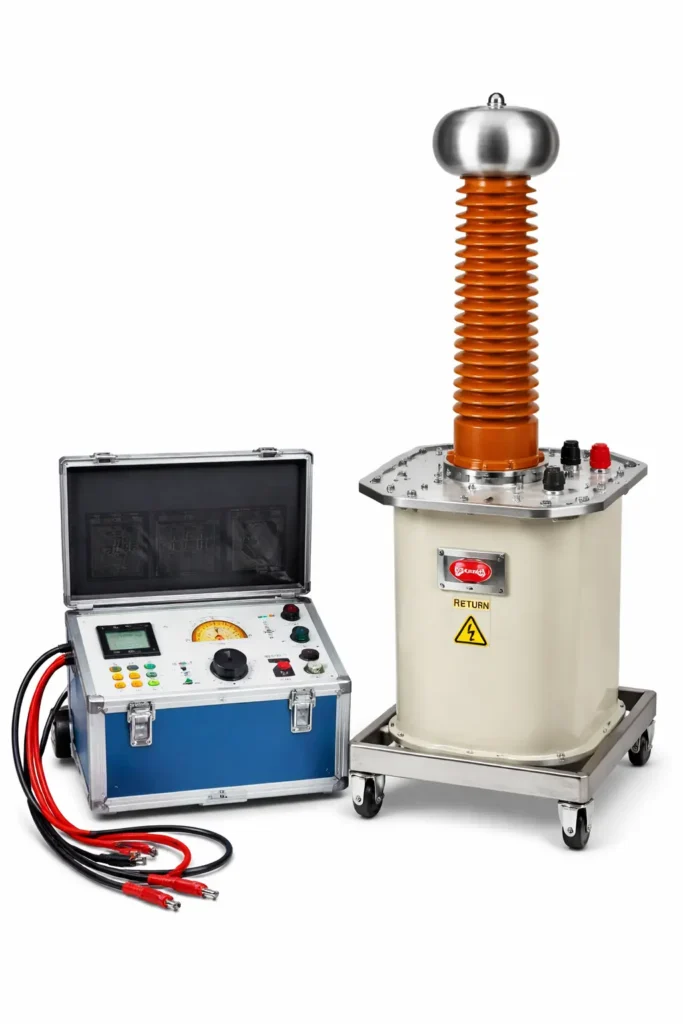
The test equipment or tester consists of a high voltage transformer, or DC voltage source, control unit, voltage regulator, and measurement system. The control panel allows for gradual voltage increase and displays the applied voltage and leakage current. A timer is included in the test kit to maintain the test duration typically 1 min. For AC test, the step-up transformer transforms the required high voltage at standard frequency while for DC test, a rectifier and smoothing circuit provides stable DC output. Safety feature includes emergency stop, zero-start interlock and auto trip in case of breakdown.
Test connection
The connection depends on the type of equipment under test yet the fundamental principle is to apply high voltage to the insulation under test.
Connect the HV terminal of the equipment under test to the test kit and connect the return terminal of the test kit to the equipment under tests’ body or tank which is grounded. Make sure the other phases of the equipment under test is solidly grounded for phase to ground test.

For phase to phase test, connect the HV lead from the test kit to one phase terminal of the equipment under test and connect the return terminal of the test kit to the second phase of the equipment under test. Make sure the remaining phase is grounded.
Test procedure
Step 1: Isolate the equipment to be tested completely by disconnecting the terminals.
Step 2: Make connections between the test kit and equipment to be tested.
Step 3: Ground all the non-tested phase terminals.
Step 4: Apply the test voltage gradually.
AC Hi pot test voltage = Rated voltage * 2 + 1000 V
DC Hi pot test voltage = 1.414 * AC Hi pot test voltage, to ensure DC voltage has the same value as peak of AC wave form.
Step 5: Monitor the leakage current.
Acceptance criteria
Since the test is a pass/fail test, therefore
| Test passed | Test Failed |
| No Breakdown of the insulation | Tripping of the test kit |
| No flashover | Sudden current spike |
| Stable leakage current | Visible discharge |
| Test voltage maintained for full duration | Insulation puncture |
This article is a part of the Testing and commissioning page, where other articles related to topic are discussed in details.