
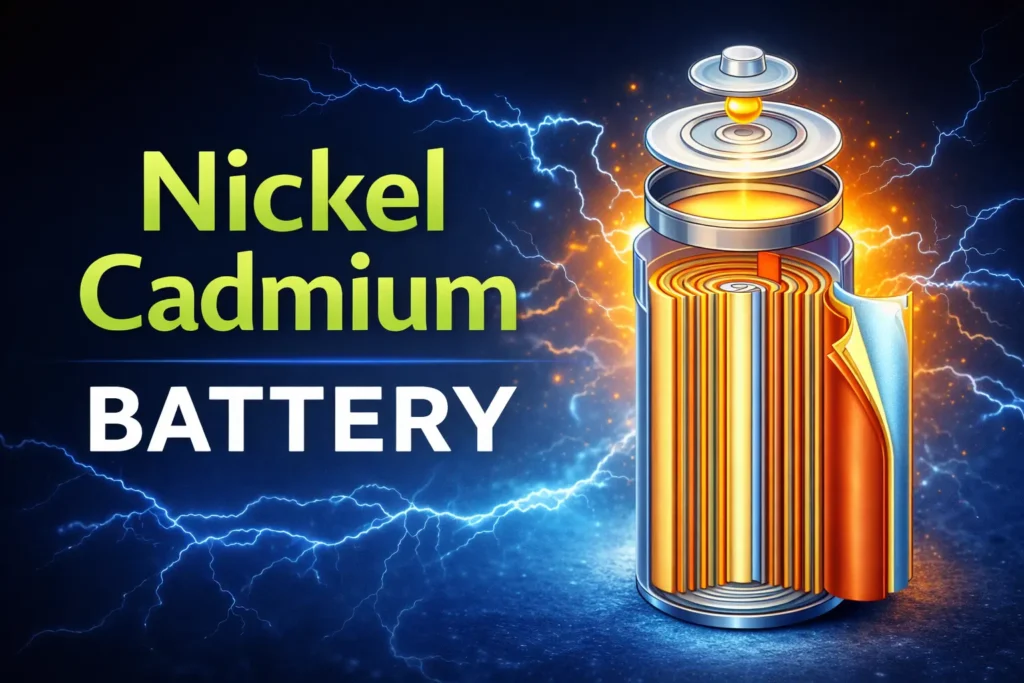
Nickel Cadmium battery is among the most reliable and oldest rechargeable battery technologies that is still in use. The Nickel Cadmium battery technology developed in 1899, is still in use for critical power systems like substation, telecom facilities, and control systems. The Nickel Cadmium battery remains operational under extreme temperature and electrical condition, where the modern chemistry fails. The stable voltage profile, low internal resistance, and ability to withstand many frequent charge discharge cycles makes the Nickel Cadmium battery suitable for control and tripping circuit in the power infrastructure.
Table of Contents
Construction
The Nickel cadmium battery consists of four core components viz the positive electrode, negative electrode, separator, and electrolyte. The positive electrode is made of nickel hydroxide, which transits to nickel oxyhydroxide (NiO(OH)) during charging and back while discharging. The negative electrode contains metallic cadmium, which is turned to cadmium hydroxide during discharge.
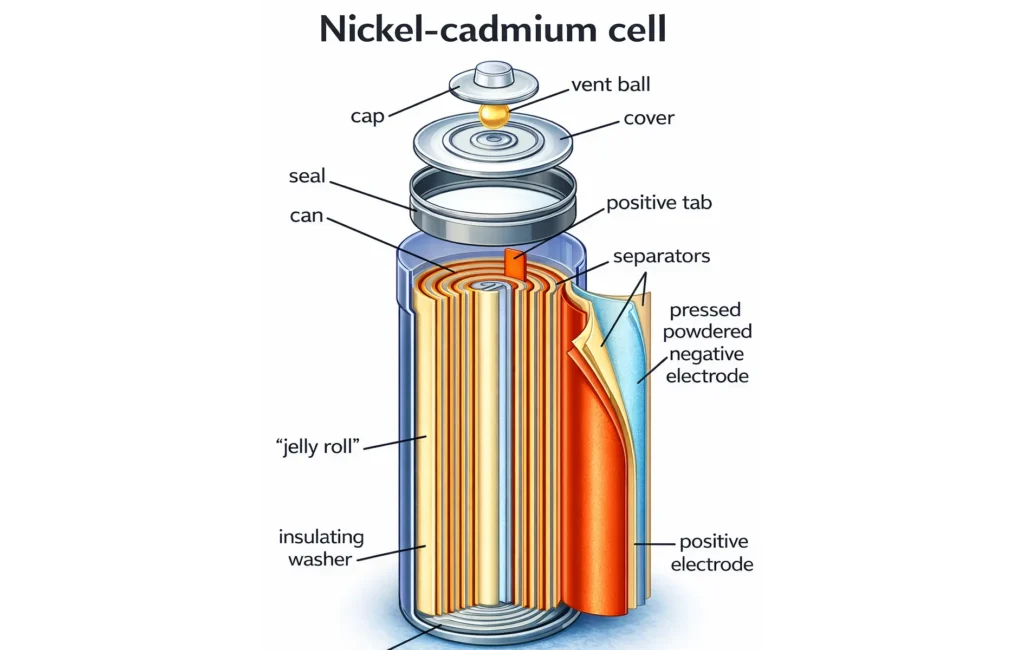
Both the electrodes are so engineered that a porous, high surface area plates are supported on metallic grids for facilitating the current flow and maximize active material contact with the electrolyte.
A microporous separator, which is typically made from polymers like nylon or polypropylene is used to provide electrical isolation to the electrodes while allowing only ionic transfer via the electrolyte. The electrolyte is a strong alkaline solution of potassium hydroxide (KOH) which do not take part in the chemical reaction with the electrode but only transfers the hydroxide ion between the electrodes.
Inside a metallic case, the positive and negative plates along with separator between them are wound together in a spiral arrangement and inserted into the cell casing. This arrangement increases the electrode surface area and enables high current delivery with lower internal resistance. A safety vent is provided for releasing excessive gas generated under fault or overcharging condition.
Electrochemical reactions
During discharge, reaction at positive electrode,
NiO (OH) + H2O + e– → Ni(OH)2 + OH–
At the negative electrode,
Cd + 2OH– → Cd(OH)2 +2e–
The overall reaction in the battery is
Cd + 2 NiO (OH) + 2H2O ↔ Cd(OH)2 + 2Ni(OH)2
During the charging, these reactions are completely reversed, restoring the original active materials. The KOH electrolyte serves as a pure ionic conductor and is not consumed in the reaction. Only the hydroxide ions shuttles between the electrodes which enables the charge transfer.
It is because the electrolyte remains stable and both electrodes involves solid state phase change, the nickel cadmium battery delivers very stable operating voltage and high life cycle. The Nickel cadmium battery also offers excellent performance under high discharge and extreme temperatures as KOH has a wide operating temperature range and porous solid electrode offers extremely low internal resistance.
Advantages of Nickel cadmium battery
Exceptional life cycle
Nickel cadmium battery is capable to sustain several thousand charge discharge cycle with gradual loss of capacity. In substations, where batteries are put on float charging and are periodically subjected to deep discharge events, service life of 15-20 years is routinely achieved with proper maintenance practices followed. This long operational life of nickel cadmium battery significantly exceeds the life of lead acid battery.
High reliability
The nickel cadmium battery exhibits exceptional tolerance to adverse electrical and mechanical conditions like deep discharge without permanent damage, prolonged overcharging, short durational overloads, mechanical vibration and shocks, irregular charging patterns and unstable supply. This rugged behaviour specially helps in substation environment where uninterrupted power is needed from the batteries to power protection system relays, substation SCADA equipment, circuit breakers, etc.
Rapid charge acceptance
The nickel cadmium battery’s chemistry allows high current discharge without thermal stress or any plate damage, which enables rapid recovery after the discharge events. After faulty operation or extended outage period, the nickel cadmium battery can recover to full readiness significantly faster than lead-acid alternative.
Stable output under load
The Nickel cadmium battery ensure consistent DC bus voltage throughout the discharge cycle because of its flat (constant) discharge voltage profile. This prevents the maloperation of the relays, logic malfunction and control system instability at the substation.
Favourable cost of ownership
Although the initial cost of procurement of the Nickel Cadmium battery is higher than that of lead acid battery, the former’s extended operational life, reduced failure rates, tolerance to operational abuse and lower replacement frequency results in lower lifecycle cost specially for substation application.
Limitations
Memory effect
Nickel Cadmium battery is subjected to memory effect, in which repeated shallow discharge cycle can lead to apparent loss of usable capacity. It is an important operational phenomenon, which is needed to be considered. The modern substation practices although mitigates this by periodic deep discharge conditioning cycle combined with proper voltage management during charging and scheduled testing.
High self-discharge
The nickel cadmium battery exhibits high self-discharge rates, typically in the order of 10-20% per month at normal ambient temperature. The float charging which is mandatory at all substation application ensures the battery bank always remains full and operationally ready.
Low energy density
When compared to modern litium ion system the Nickel Cadmium battery system has a lower gravimetric and volumetric energy density. This results in physically larger and heavier battery installation for same stored capacity. It influences the battery room layout, floor loading and ventilation design.
Environmental challenges
The Cadmium is a high toxic heavy metal and the use of it is subjected to strict environmental regulation worldwide. Accordingly, the handling, transportation and disposal of Nickel Cadmium battery must comply with the applicable environmental and occupational safety legislation.
Comparison of Nickel Cadmium with other alternatives
Nickel Cadmium vs Lead Acid
| Parameter | NiCd | Lead Acid |
| Cycle life | Very high, It is capable of thousands of charge-discharge cycles, ideal for repeated deep discharge | Typically supports a few hundred deep cycles. Repeated deep discharge reduces lifespan. |
| Temperature tolerance | Excellent as it performs reliably well between –40 °C to +60 °C | Performance and life degrade sharply at high or low temperatures. |
| Maintenance | Moderate as it requires electrolyte inspection and capacity testing. | Moderate as it requires electrolyte inspection, topping up with distilled water and cleaning. |
| Reliability | Very high as it is rugged against overcharge, deep discharge and electrical abuse. | Good as it is adequate to support many loads and is sensitive to over discharge and temperature extremes. |
| Initial cost | Premium procurement cost because of robust chemistry and materials. | Low upfront cost as is widely available. |
| Total lifecycle cost | Lower because long operational life and minimal replacement of parts offset the high initial cost. | Higher as shorter lifespan and more frequent replacements increase the lifecycle expenses. |
Nickel Cadmium vs Lithium Ion
| Parameter | NiCd | Lithium-Ion |
| Safety | Very high because the aqueous alkaline electrolyte is non-flammable, it is tolerant to abuse, overcharge, and short-circuit. | Safety is moderate because organic electrolyte is flammable and battery management system is mandatory |
| Thermal stability | Excellent as it operates reliably from -40 °C to +60 °C, requiring no thermal management. | The performance and battery life is strongly affected by the temperature. Risks of thermal runaway if limits are breached. |
| Energy density | Moderate and requires larger footprint for same energy storage | Very high and results in compact and lightweight design for same capacity. |
| Maintenance | Moderate as it requires electrolyte inspection and capacity testing. | Virtually maintenance free at the cell level. However, the BMS requires monitoring. |
| Cost trend | Mature technology with predictable long-term cost. | Cost is in declining trend because of large scale manufacturing |
| Maturity in substations | It has a decade of operational history in power system. | Emerging because long term utility data is still developing. |
References:
- https://thebatterytips.com/battery-specifications/what-is-nickel-cadmium-battery/
- https://www.batteryuniversity.com/article/bu-203-nickel-based-batteries
This article is a part of the Energy storage and reactive power compensation page, where other articles related to the topic are discussed in details.