
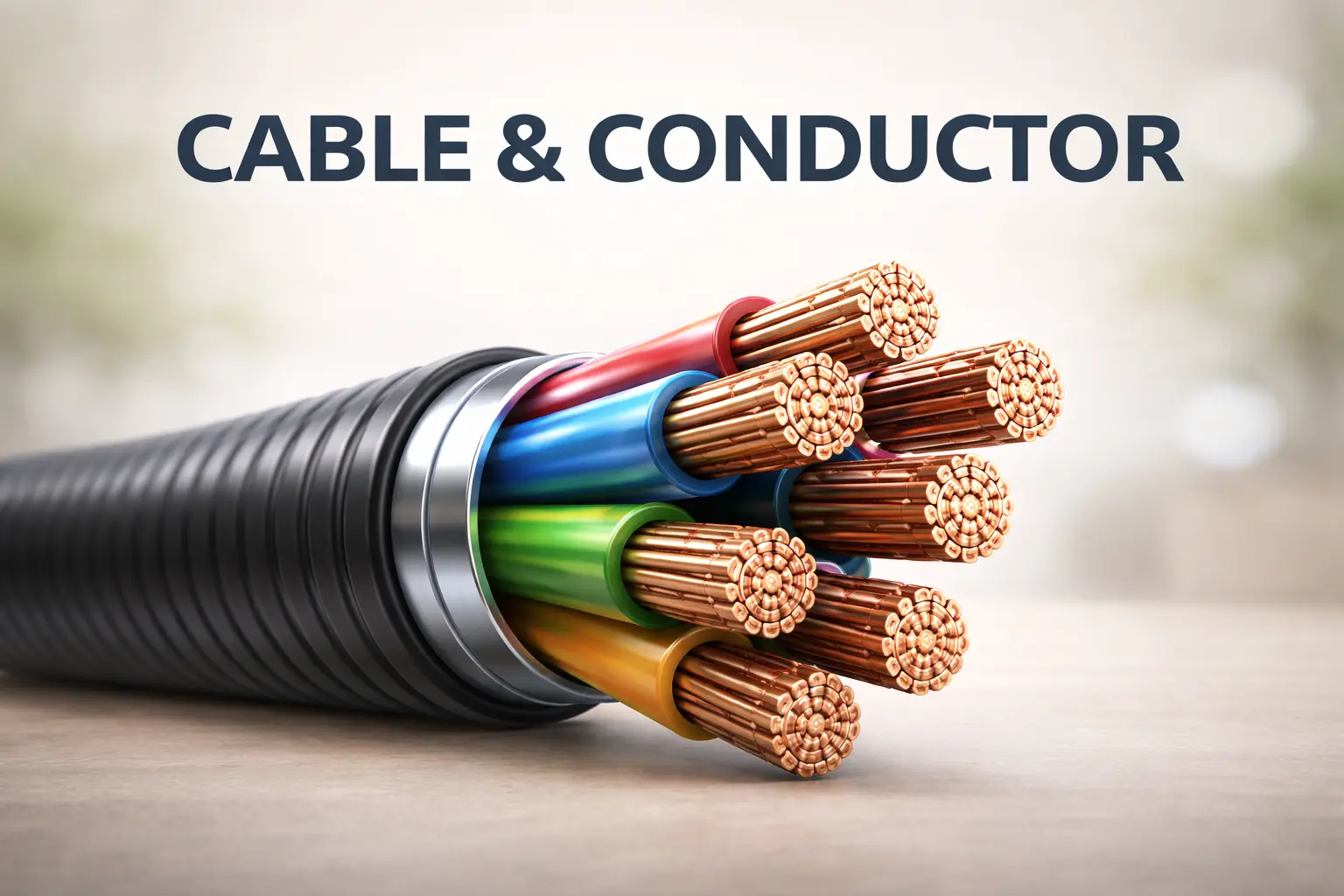
Cables and conductors are those elements in the power system which carries the current through them. Cables and conductor forms the physical backbone of the electrical power system. From the power generating stations to transmission and distribution substations, the selection, sizing and installation directly influences the system efficiency, reliability and safety.
This technical guide essentially discusses and consolidates all the fundamental and advanced aspects of the power cables, power conductors and associated accessories, covering the material used in the conductor, overhead line conductors, underground laying of the cables and conductors, thermal behaviour of the conductors, installation practices and jointing techniques. Each section below links to detailed engineering articles for deeper study.
Power conductors- Types, Design & Performance
Power conductors are the primary elements, which carries the current in overhead and underground transmission and distribution systems. Their electrical, mechanical capabilities defines the load carrying capacity of the network.
Power Conductor — It discusses the various power conductor types with the typical data sheets.
AAC conductor — This article discusses the construction details of AAC conductor, with properties, applications, types of AAC conductors along with the advantages and limitations.
AAAC Conductor — For improved strength and corrosion resistance for modern power networks.
ACSR Conductor — With hybrid construction and dominance in the transmission system.
HTLS Conductor — Advanced conductors which are often used to uprate a power network without adding any towers.
Power Clamps — Mechanical fittings used for cables and conductors for tensioning and termination in a substation.
Thermal behaviour and electrical performance of cables and conductors
The performance of conductor is strongly influenced by temperature which affects resistance, current carrying capacity and the system losses.
Effect of temperature on resistance — Relationship between temperature, resistance and losses
Knee point temperature — Critical operating temperature for modern conductors.
Conductor sizing — Engineering methodology for selection of conductor cross-section based on many variables and mechanical constraints.
Power Cable — Construction, Types & Application
Underground and industrial cabling system requires careful material and insulation selection for ensuring long service life and electrical integrity.
Cable Selection — The technical criteria for selecting the cable type, insulation, metallic screen and conductor diameter with examples.
XLPE Cable — Cross linked Polyethylene insulation and its dominance in power networks.
PVC Cable — Economical insulation for low voltage applicaton.
PILC Cable — Legacy technology which is still present in some power networks.
DC Cable — Specialized insulation for HVDC power transmission and renewable energy integration.
Control Cables — For signaling and protection circuits in substations and plants.
ABC Cable — Aerial Bundled Cable for reliability imrovement of distribution power networks.
Coaxial Cables — Communication and signal transmission fundamentals.
Fiber Optic Cable — Modern communication backbone for protection and control system.
Cable Installation and jointing systems
Correct installation and jointing practices are essential for long term performance and fault free operation of the system.
Cable Laying — Underground cable installation methods for trenching, spacing and cable protection.
Cable joints — Jointing technologies, material and stress control for prevention of failure.
Conclusion
Cables and conductors are not merely passive components of the power system but are strategic assets. The selection, design and maintenance of these cables and conductors influences the reliability, safety and expansion capability of the power system. This guide serves as a continously expanding technical knowledge base, integrating the conventional engineering principle with the emerging technologies to support the engineers, designers and operators in building the robust and future ready power network.