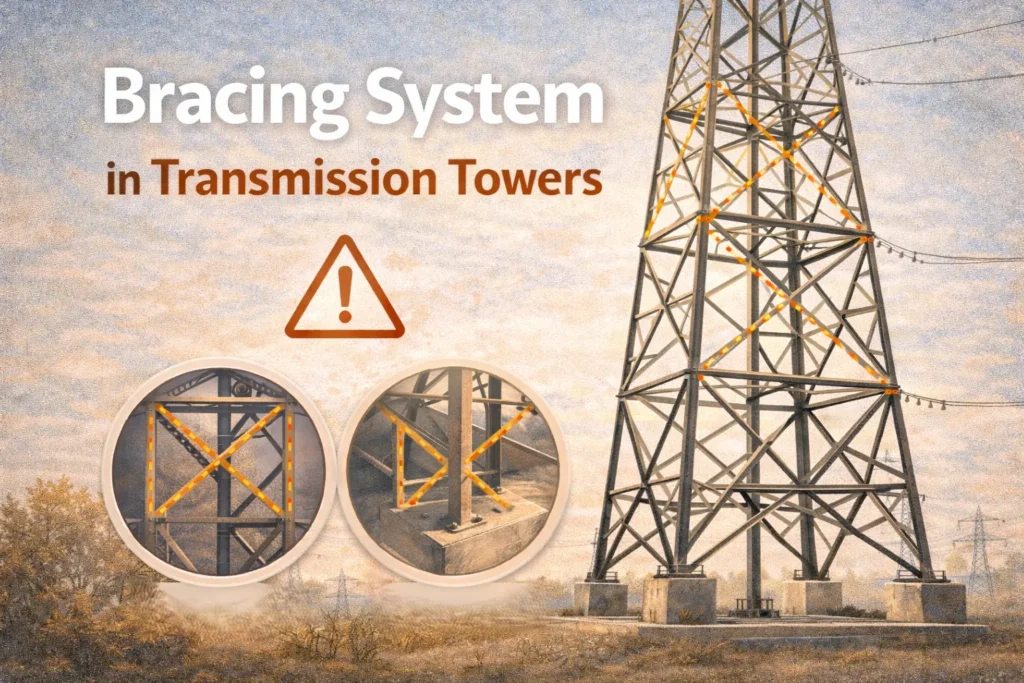
The bracing systems of transmission line tower are the arrangement of steel diagonal members and struts installed between the main tower leg and horizontal members. The members in the bracing system forms a triangular pattern in the tower body, which makes the tower stable and capable of resisting both tension and compression forces. Without the bracing system, the tower frame would be vulnerable to buckling, twisting and collapse under wind loads.
Table of Contents
Function of Bracing system
In lattice tower of the transmission lines, bracing system works by converting the flexible rectangular frames into rigid triangular load paths. The main functions of the bracing system are
Structural stability
With no bracing system, vertical legs, and horizontal members of a tower form rectangular panel. Rectangles are geometrically unstable because they can deform into parallelogram with no change in the member length. When diagonal bracing is added, the rectangular panel becomes two triangles and as triangles are geometrically stable, the forces are resisted by the axial tension or compression in the bracing members.
Wind or conductors, forces and tries to distort the tower frame. In the bracing system, one brace goes into tension while other goes into compression. This prevents the lateral distortion of the tower body as the bracing system locks the geometry of the tower.
Load distribution
Load acting on a transmission tower includes conductor tension, wind load, broken conductor condition, weight of insulator and hardware. These do not act only on one member but must be transferred via the tower structure to the foundation. The bracing system creates multiple load paths.
For example, as the wind forces the tower sideways, the load path becomes crossarm → diagonal bracing → vertical leg → stub and base plate → foundation. As the bracing members are axial, they efficiently transfers the load as tensile and compressive forces instead of bending.
Wind load resistance
Wind applies a lateral force on the tower body, conductors, and insulator strings. This produces a shear force and overturning moment. The bracing converts the tower into a vertical truss structure and as wind pushes the tower, windward brace goes into compression and leeward brace goes into tension thus resisting and redistributing the wind load through triangulated truss action.
Prevention of Buckling
The tower legs are long slender compression members. A long column fails by buckling and not by crushing. The critical buckling load is given by euler’s formula, P = π2 EI / (KL)2
Where, L= unsupported length and K = effective length factor
This shows that if the length increases then the buckling load decreases sharply. Bracing solves this by dividing the leg into shorter segments.
Example: Without bracing system, the leg length is 20 m (suppose), with bracing in every 2m, effective buckling length becomes 2m and buckling load proportional to 1/L2 increases drastically as the buckling length decreases. Thus, the slender legs remain safe, smaller steel sections can be used with reduced tower weight.
Torsional resistance
Unequal conductor tension or broken conductor causes the tower to twist. Bracing in all the panels or tower faces forms a 3-D truss which resists the twisting of the tower.
Types of bracing systems used in transmission towers
Single web system
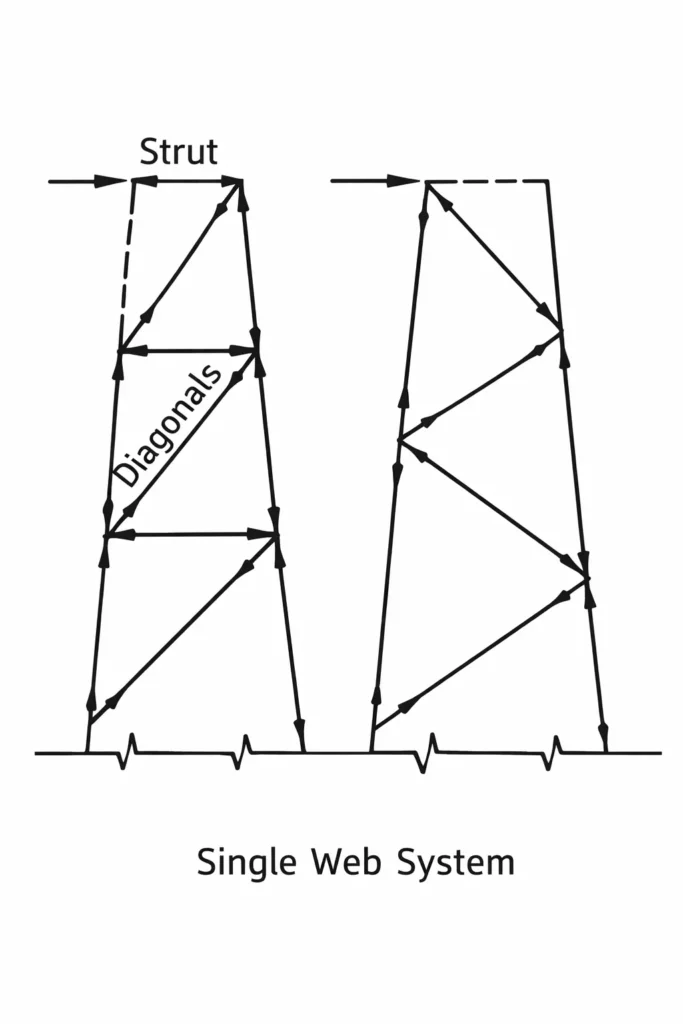
This type of bracing system comprises of diagonals and struts or of diagonals only. The struts are designed as compression members and the diagonals as tension. Whereas a system with all diagonal member are designed for both tension and compression to permit the reversal of applied external shear. This system is used for narrow based towers, crossarm girders and portal type towers.
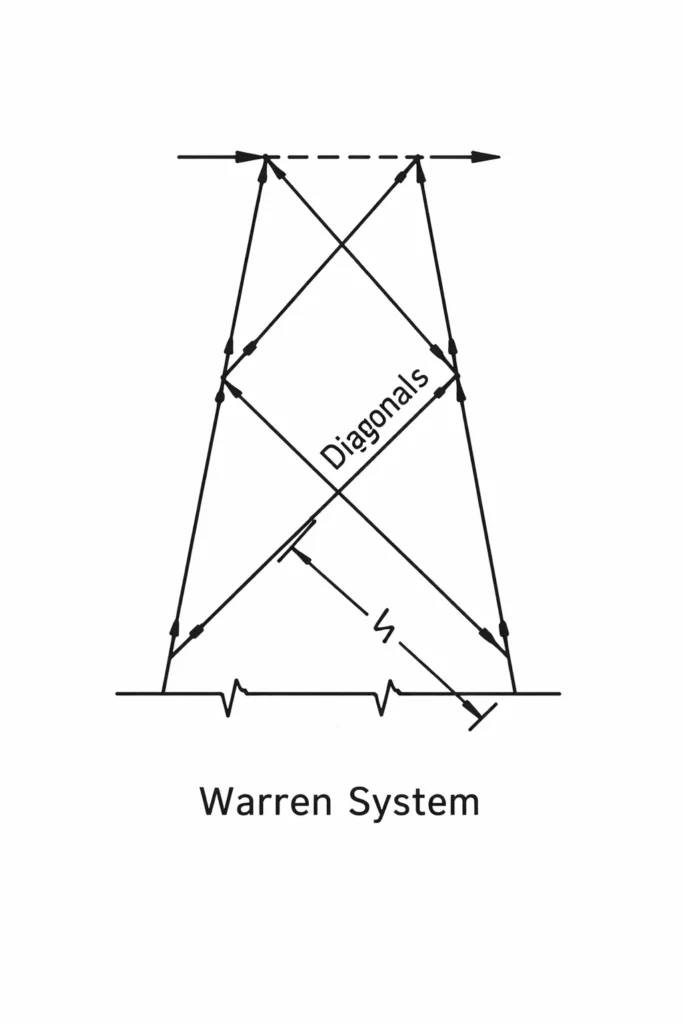
Double web or warren system
This bracing system consists of diagonal cross bracing where shear force is equally distributed between the diagonals with one in compression while the other diagonal in tension. Both diagonals are designed for both tension and compression to permit reversal of externally applied shear. The diagonal bracings are connected at the point of crossing. The diagonal with tension supports the diagonal with compression at the connection point and thus reduces the unsupported length of the bracing which results in lighter size of the bracing members. This system is adopted for both large and small tower’s body and cage.
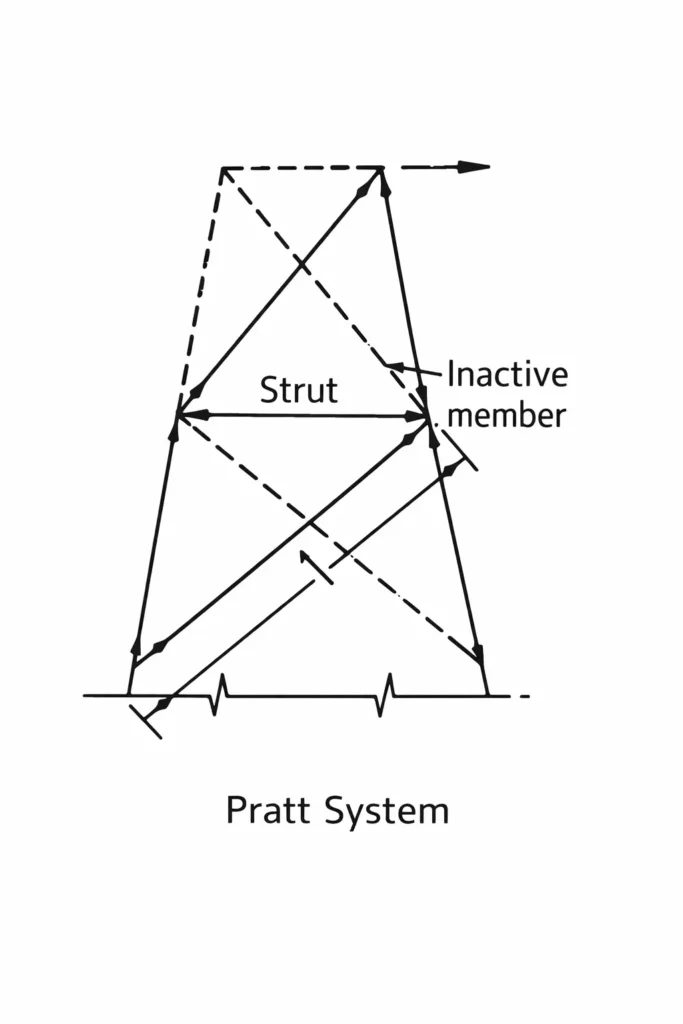
Pratt system
In this system, the shear is entirely carried by the diagonal members which are under tension. Other diagonal or horizontal strut is assumed to be carrying no stress although are necessary for the continuity of the system. This type of bracing results in large deflection of tower under heavy loading as the tension members are slenderer compared to the compression members in cross-section for similar loading. In towers with such bracing, the compression member fails in overloaded condition while the active tension member can take up the tension loads. This system imparts torsional stress to the leg members and results in unequal shear at the top of the stubs.
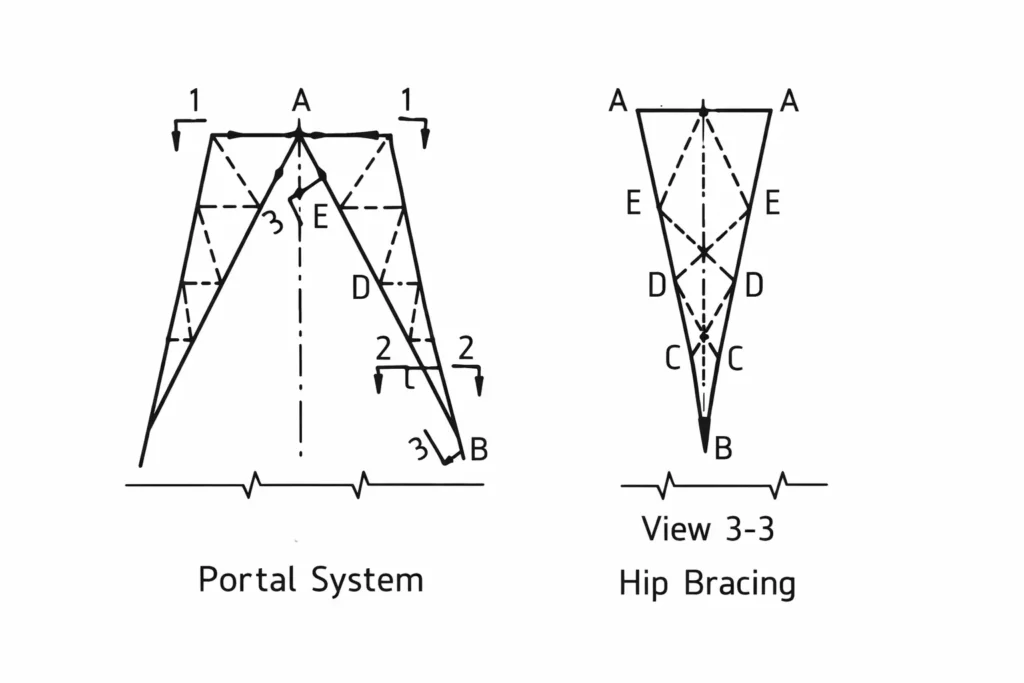
Portal system
Here the diagonal and horizontal members are designed for both tension and compression forces. The diagonals meet the horizontal members at the mid-point. Half of the horizontal member is in compression and the other half is in tension. It has been seen that the portal bracing system is advantageous for bottom panels, extensions and river crossing towers, where rigidity is the primary consideration. Portal bracings are also popular for corner extension and hill side locations because it can accommodate structural adjustments.
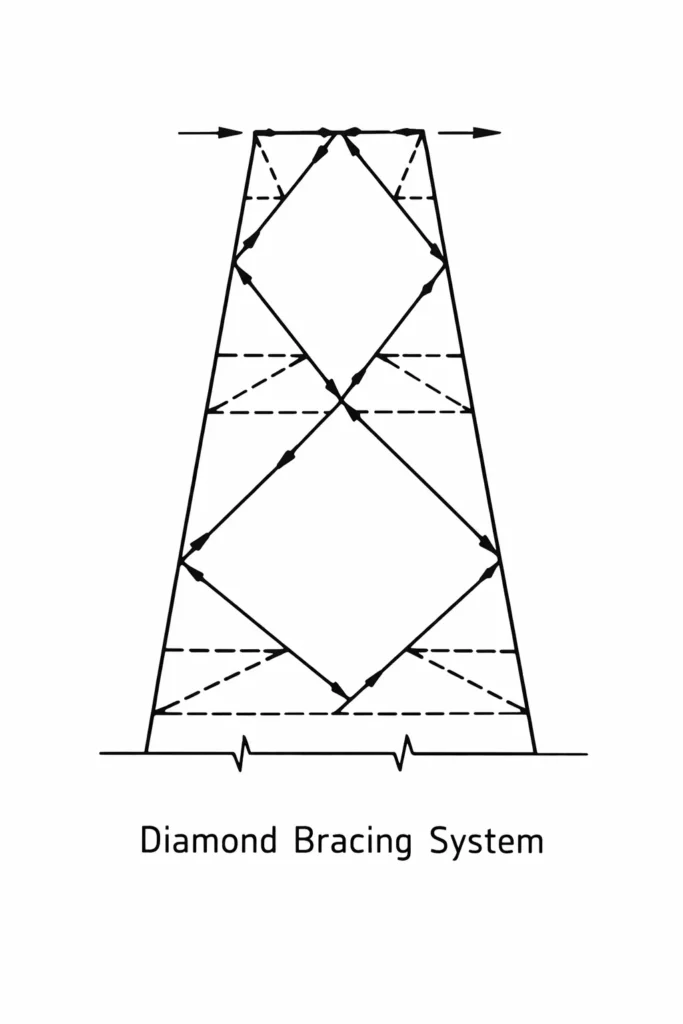
Dimond bracing system
This system is somewhat similar to double web system. The bracing arrangement can also be derived from portal system by inverting every second panel. All diagonals are designed for tension and compression. This system is applicable to panel of approximately same size as that of Pratt and portal system. Here, the horizontal members carry no primary load and are designed as redundant members.
Multiple bracing system
In towers where torsional load is high, the cage width is kept large to counter the torsion. Standard warren system here results in long unsupported length of legs and bracing which increases the weight of the tower disproportionately. For such towers’, multiple bracing system is used. The main advantage of this system is that it reduces the forces on the bracing and unsupported length of legs and bracing is also reduced as length of compression members gets shorter, which increases the strength of the members with reduced size. The buckling tendency also reduces with the shorter sized members and as a result, lighter sections can be used to maintain adequate strength.
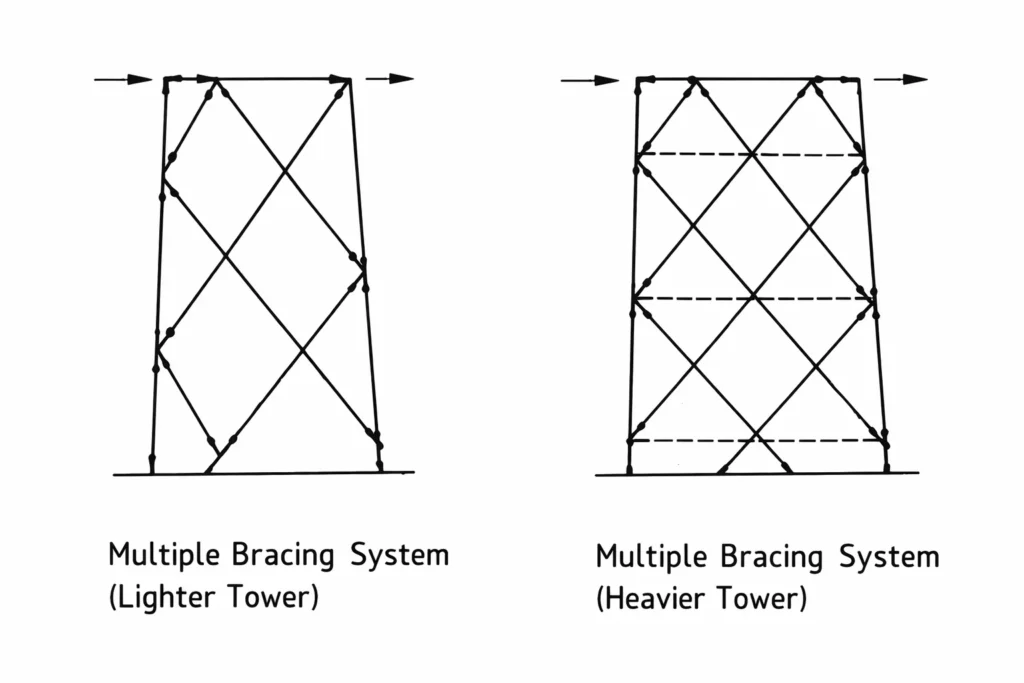
The bracing on the transverse and longitudinal faces may be staggered to achieve weight reduction. However, this is only preferable for suspension and medium tension towers. In heavy angle towers or dead-end towers, which have more rigidity needs, bracing on transverse and longitudinal faces should not be staggered.
Staggering means to arrange the bracing at a different panel level on opposite faces of the tower. If the bracings are arranged at the same level on the opposite faces of the tower, this arrangement is called aligned bracing.
This article is a part of the Transmission line page, where other articles related to topic are discussed in details.