
The temperature rise test verifies the transformer’s thermal performance under rated load conditions. A transformer can pass all electrical test and still fail prematurely if its thermal design is weak. The life of the transformer depends on the insulation temperature. Every 6-8 degree rise in operating temperature beyond the rated halves the insulation life. During the temperature rise test, rated current is circulated through the windings until thermal equilibrium is reached, the rise in the top transformer oil temperature and winding temperature above ambient is measured using thermometers and resistance methods. The results are then compared with specified standards.
The temperature rise test of transformer also validates the cooling design of the transformers, heat losses and heat dissipation capability.
Table of Contents
Principle of the Temperature rise test
In a transformer, heating results as a function of copper losses (I2R) in the windings of the transformer, when the load current flows and core losses in the magnetic core of the transformer under excitation.
The temperature rise test can be conducted in two different ways:
Direct loading method
In this method of temperature rise test, the LV winding of the transformer is short circuited and reduced voltage is applied to the HV side of the transformer so that the rated current flows in the winding. During this the voltage is low (5-10% of the rated), current is the rated current of the transformer, copper loss (I2R) is produced corresponding to full load and the core loss is negligible. To simulate the total full load loss, therefore, separate core loss power is injected or equivalent power for total loss is maintained.
Back-to-Back method (Sumpner’s Test)
In this method of temperature rise test, two identical transformers are used, whose primaries are connected in parallel and the secondaries are connected in series. To generate copper loss heating, a voltage difference is created in the secondary by adjusting tap of one transformer and thus producing the circulating current. Here, the core sees the rated voltage contributing to full core loss, secondary loop sees the controlled circulating current contributing to full copper loss and hence no external loading is needed.
The direct loading method of temperature rise test is used for power transformers with high MVA rating while the back-to-back method is used for medium to low voltage transformers.
Test Arrangement
Electrical connection
The temperature rise test of transformer is basically done in the factory, where one winding usually the LV winding is short-circuited (R-Y-B LV terminals are connected phase to phase). It is to be noted that the shorting link must be rated for the full load current. The purpose of this is to create a low impedance loop so that the rated current can circulate.
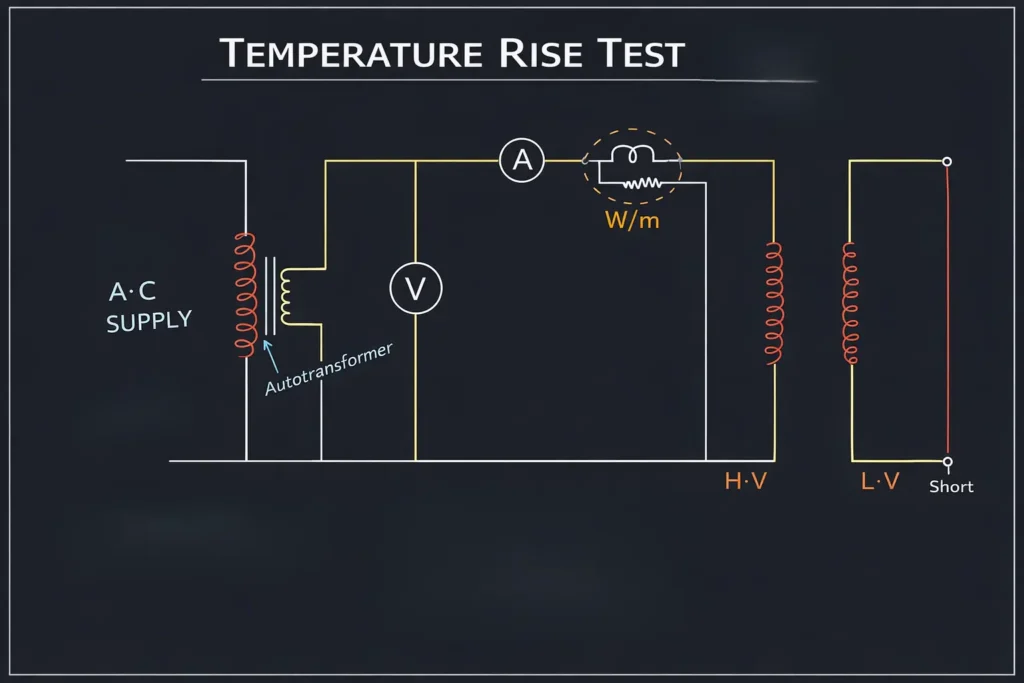
Reduced 3-phase voltage is applied to the HV winding of the transformer. The required voltage injection is usually 5-15% of the rated voltage.
This is because V Short circuit = %Z x V rated
This produces the full load copper loss (I2R). During this condition, flux at the core is very low and hence the core loss is negligible. To counter this, a open circuit test is performed separately on the transformer and equivalent loss power is added during the short circuit or direct loading, such that P Total = P Core + PCopper.
Instruments used in temperature rise test
Ammeter: For measuring the injected current and must confirm the rated current is circulating via current transformers.
Voltmeter: For measuring the short circuit voltage injected via auto transformer to the HV terminals via Potential transformers.
Power analyzer or wattmeter: For ensuring actual input power and ensure the total full load loss.
Oil Temperature indicator (OTI): It can be measured by using top oil thermometer or RTD based unit.
Resistance measuring kit: Used for measuring the winding resistance test before the test and immediately after the test or power is turned off.
Ambient temperature sensors: Usually 4 in number placed away from the tank 1-2 meters apart, shielded from radiations and average reading is taken as the ambient temperature for the test.
Temperature Rise Test procedure
Step 1: Check the transformer oil level, ensure normal.
Step 2: Check the cooling system is operational.
Step 3: Ensure the tap changer is at normal position.
Step 4: Record the ambient temperature.
Step 5: Record the winding resistance at ambient temperature.
Step 6: Short the LV side terminals.
Step 7: Connect the HV side terminals to 3 phase supply via auto transformer.
Step 8: Increase the current to the HV side of the transformer gradually to the rated current and check the ammeter. Note that current ratings are different for different cooling conditions. Current rating is lower for ONAN than ONAF.
Step 9: Maintain the current continuously and monitor the oil and winding temperature at regular intervals (hourly).
Step 10: Continue holding rated current till the equilibrium is reached, attaining a condition where the oil temperature rise is less than 1°C per hour. This may take hours from the initiation of the test depending upon the rating.
Step 11: Record the maximum top oil temperature. And calculate the rise in temperature
ΔT Oil = TMax Top oil – TAmbient
Step 12: Shutdown the power supply and measure the winding resistance immediately, or measure the winding resistance by superimposing a low value DC current injection into the winding. Then, calculate the winding temperature T2 = (R2/R1)(235+T1)-235, where
- T1= Temperature at ambient condition.
- T2= Temperature at final condition.
- R1= Resistance of the winding at ambient temperature.
- R2= Resistance of the winding at temperature T2.
- And the co-efficient of temperature for copper is 235 /°C.
Permissible temperature limits
Considering ambient temperature of 30°C, the typical temperature rise is tabulated as:
| Temperature rise limits | As per IEC 60076-2 | As per IEEE C57.12.00 |
| Top insulating oil | 60 | 65 |
| Winding temperature ON/OF OD cooling system | 65 70 | 65 |
| Hotspot in winding | 78 | 80 |
NB: For naturally cooled transformer AN group,the limits of top oil temperature rise, winding temperature rise and hot spot temperature must be reduced by 1°C every 400m when installation altitude exceeds 1000m.
For forced cooled transformer AF group, the reduction shall be 1°C for every 250 m exceeding 1000m.
Maximum permissible temperature limit applicable beyond nameplate rating (IEC-60076-7)
| Loading Type | Parameter | Small Transformers (°C) | Medium & Large Power Transformers (°C) |
| Normal Cyclic Loading | Winding hot-spot & metallic parts in contact with cellulosic insulation | 120 | 120 |
| Other metallic hot-spot (in contact with oil, aramid paper, glass fibre materials) | 140 | 140 | |
| Inner core hot-spot | 130 | 130 | |
| Top-oil temperature (in tank) | 105 | 105 | |
| Long-Time Emergency Loading | Winding hot-spot & metallic parts in contact with cellulosic insulation | 140 | 140 |
| Other metallic hot-spot (in contact with oil, aramid paper, glass fibre materials) | 160 | 160 | |
| Inner core hot-spot | 140 | 140 | |
| Top-oil temperature (in tank) | 115 | 115 | |
| Short-Time Emergency Loading | Winding hot-spot & metallic parts in contact with cellulosic insulation | — | 160 |
| Other metallic hot-spot (in contact with oil, aramid paper, glass fibre materials) | — | 180 | |
| Inner core hot-spot | — | 160 | |
| Top-oil temperature (in tank) | — | 115 |
This article is a part of the Testing and commissioning page, where other articles related to topic are discussed in details.