
A TOD meter or Time of Day meter is a type of energy meter that not only records the energy consumption but also records the time of consumption. Other than displaying the total KWh consumed, the TOD meter splits the energy usage into different time blocks such as peak, off peak, and normal hours. Each time block has a different tariff and the consumer is billed accordingly. The electricity becomes costlier during high demand and is cheaper when the grid load is light.
Table of Contents
Why TOD meters are needed?
The Time of Day meters were introduced because the traditional flat tariff system could not solve the growing peak hour demand challenges. TOD meter provides a transparent and smarter way to manage the load, cost control and operation planning of the grid. The need of the TOD meter arises from three perspective and are listed as:
Grid perspective: It is seen that electricity demand shoots up steeply during the peak hours 6-10 AM and 5-9 PM. The domestic lighting, commercial appliances and increased air conditioning load sharply increases the demand. In order to meet this peak load demand, utility buys short term expensive power from the exchange or run the old, less efficient generating units and overload the transformer, feeders and substations.
This increases the cost of supply for the utilities and pressurises the grid infrastructure. Time of Day meter imposes higher tariffs on the peak time power usage and lower during the off peak period. This higher tariff motivates the consumers to shift non essential load to the night time, reducing the peak hour load and flattening the load curve. By lowering the peak stress, the utilities save money as they do not have to purchase short term expensive power from the exchange, improve system reliability and avoid costly system upgrade.
Consumer perspective: The industrial and commercial consumers receive the discounted tariffs for usage during the off peak hours. This allows the textile mills, cold storage, foundries, EV charging stations, etc run more cheaply during low demand periods. By shifting even, a part of the operations away towards the off-peak hours, significantly reduces the monthly electricity bills, while optimizing machine operation schedules. TOD meters naturally push the user towards identifying inefficient equipment, staggering load startup and integration of smart automated controls.
Regulatory perspective: The state commission for electricity regulation across the world mandates the TOD metering for consumers above a specific connected load commonly above 20 KW or 40 KVA, consumers under HT industrial and commercial categories, and consumers with demand-based tariffs. TOD metering enables the utility for real time pricing of power, lays foundation for demand response program and enables smart metering frameworks.
How a Time of day meter (TOD meter) works?
The TOD meter works just like a normal digital energy meter but it has an added intelligence to it. The meter keeps the time and separate registers for each time zone, defined by the utility. The overall operation of the TOD meter is cited as following:
Internal Clock: The internal clock or RTC, real time clock is the brain clock of the meter, which maintains accurate time and date continuously. It automatically syncs with the utility time source whenever the meter is read. The meter is equipped with a backup battery for the RTC to function even during the power cuts so that the time never shifts. The RTC ensures that every energy unit is recorded in the correct time slot (peak, off peak, normal).
TOD time zones or slots: The utility divides the day into 4 to 8 time zones. Common example of which are Peak hours, Off peak hours, Normal Hours, Night hours. The peak being the most expensive, off peak being cheaper, normal hours with normal tariff and night hours with discounted rates for industries.
Inside each time zones, separate registers are integrated to record the active energy KWh, apparent energy KVAh, reactive energy in KVArh and maximum demand for that time slot.
DSP Engine: The digital signal processor inside the meter performs all electrical calculations by continuously sampling the voltage and current inputs from the ADC like active power, reactive power, apparent power, and power factor. The DSP separately records the total KWh, KVAh, Maximum demand and load profile for each time zones and automatically switches the register as the time zone changes. It basically computes the energy and allocates precisely to the correct time blocks.
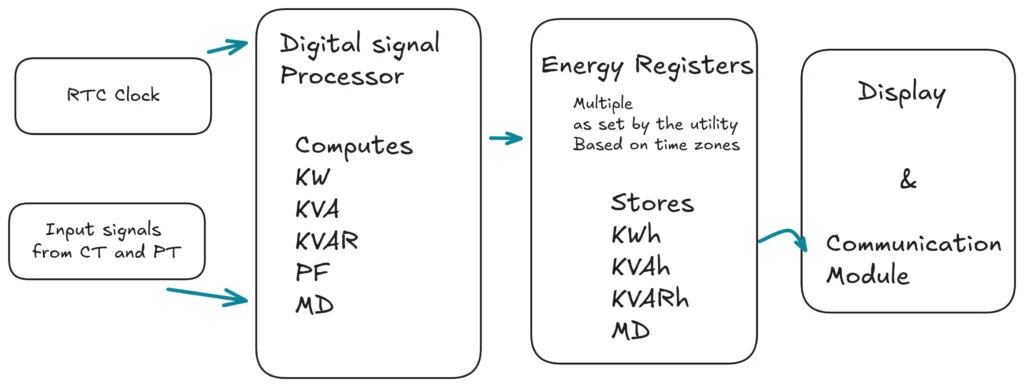
Tariff Application: The meter stores the energy consumption and demand values in various registers; time tagged and is cumulated at the end of every billing cycle. The utility collects the cumulated data from the meter via the communication port. The billing software computes the total bill as cumulated energy of each registers multiplied by the tariffs of the time slots.
TOD Meter’s parameters
KWh registers: These are time separated energy buckets. The TOD meter stores energy into number of registers as defined by the utility. Every unit of energy computed by the DSP is time tagged into the correct register based on the RTC clock.
Maximum Demand: Maximum demand is the highest average load drawn in a integration window of 15 or 30 minutes. The TOD meter also records the maximum demands into registers which are time tagged. The MD values are in KW or KVA. The recording in the separate registers helps the utility contract demand violation and levy sanction on the consumer drawing excess power during the peak hours, standard penalty during normal hours and no penalty or reduced penalty during off peak hours.
Load profile: The load profile is the most powerful feature of the TOD meters. The meter logs the instantaneous KW, KVA, voltage, current, PF, Wh or VAh consumption, MD in every 15 to 30 minutes block. The load profile helps the utility to understand how load rises and falls during the day, identify peak spikes, helps in tariff planning and peak demand management. The load profile also helps the utility in better grid planning, transformer loading studies, and feeder load forecasting.
Among the important requirements, the RTC of the TOD meter must be synchronized with the grid time during the installation.
While Time of Day meters can be very useful for application in various large industries, commercial buildings, EV charging stations but is not suitable for domestic consumers and commercial consumers which cannot shift load timings like hospitals, etc
This article is a part of the Metering page, where other articles related to the topic are discussed in details.