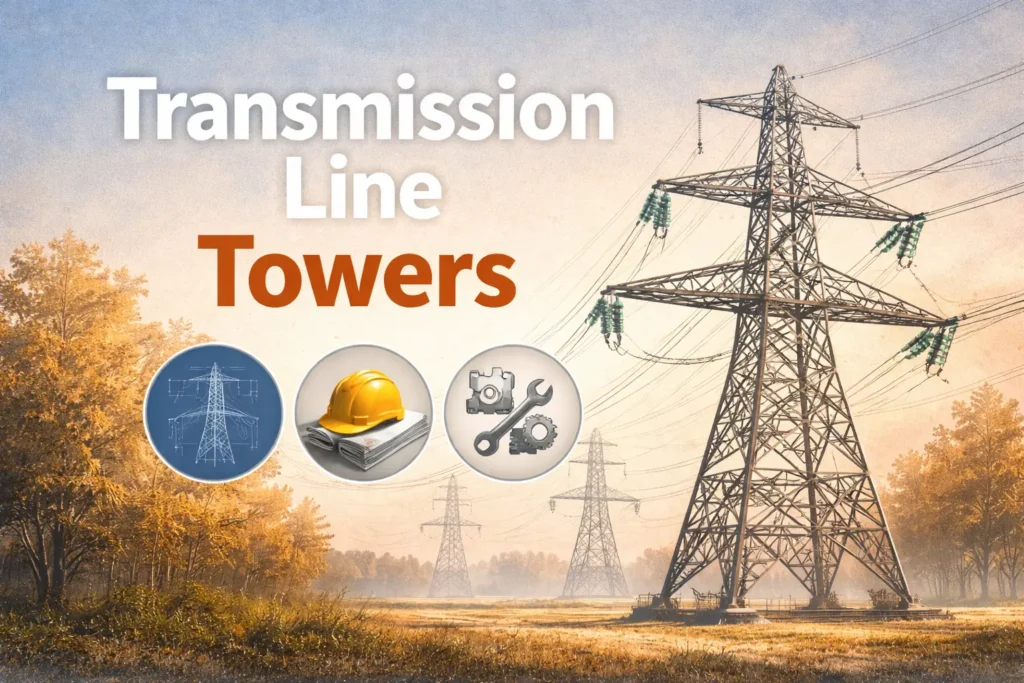
Transmission line towers are overhead line support steel structures which are designed to support phase conductors, earth wire and associated hardware fittings. These lattice or tubular structure forms the backbone of high-voltage transmission networks, ensuring mechanical stability under wind, ice and seismic loads. Their primary function is to maintain sufficient electrical clearances between conductor-ground and conductor to conductor as well to prevent flashover and ensuring system reliability. A proper design of tower considers span length, conductor sag, terrain profile and loading conditions to achieve safe power transfer across long distances while complying with safety and grid standards.
Table of Contents
Purpose of Transmission line towers
A transmission line tower must
- Carry vertical loads which are weight of conductor, insulator, hardware
- Resist the transverse loads such as wind pressure on the conductor and the structure itself.
- Resist the longitudinal loads like uneven span, broken wire condition.
- Transfer load safely to the foundation
- Maintain electrical clearances.
Classification of transmission line towers
Based on Line function
Line function basically refers to the operational role and performance of a transmission line tower along the route alignment of an overhead transmission lines. It defines how well the tower handles the mechanical loading such as vertical, transverse and longitudinal loads due to tension or broken wire condition. Based on this line function, transmission line towers are classified as
Suspension tower
Suspension towers or tangent towers are used for straight line alignments where the deviation angle of the transmission line is typically between 0° to 2°. In this type of towers, the conductors are supported using suspension insulator strings. These towers are designed to carry vertical loads and transverse wind loads only. They are not intended to withstand the full longitudinal tension. Because of the lighter design, suspension towers are the most economical and commonly used structures in a transmission line.
Angle tower
Angle tower or tension tower are installed where the transmission line changes the direction. Depending upon the deviation angle the angle or tension towers are categorized. These structures uses strain insulator strings and are designed to resist significant longitudinal and transverse forces. They are heavier and structurally stronger than the suspension towers.
| Transmission Line Tower types | Angle of deviation |
| A (Suspension) | 0° to 2° |
| B (Tenison) | 2° to 15° |
| C (Tenison) | 15° to 30° |
| D (Tenison) | 30° to 60° |
Dead end Tower
These towers are provided at the line termination points such as entry to substation, river crossing or sectionalizing locations. These towers withstands the full conductor tension from one side and therefore are among the strongest tower types in the transmission system.
Transposition tower
These towers are used in long extra high voltage transmission lines to interchange phase positions as doing this improves the system balance and reduces the inductive interference and mutual coupling effects.
Classification based on structural configuration
Lattice tower
Lattice towers are fabricated from steel angle sections, assembled with bolted connections. It offers high strength to weight ratio and are widely used for voltage levels of and above 132 KV voltage level. The open structure of lattice tower reduces wind pressure and makes them suitable for long span and heavy loading condition.
Monopole tower
Monopole towers consist of a single tubular steel pole and thus have a smaller footprint and are preferred in urban corridors where right of way is limited. Although aesthetically it is superior, it is generally costlier than lattice towers.
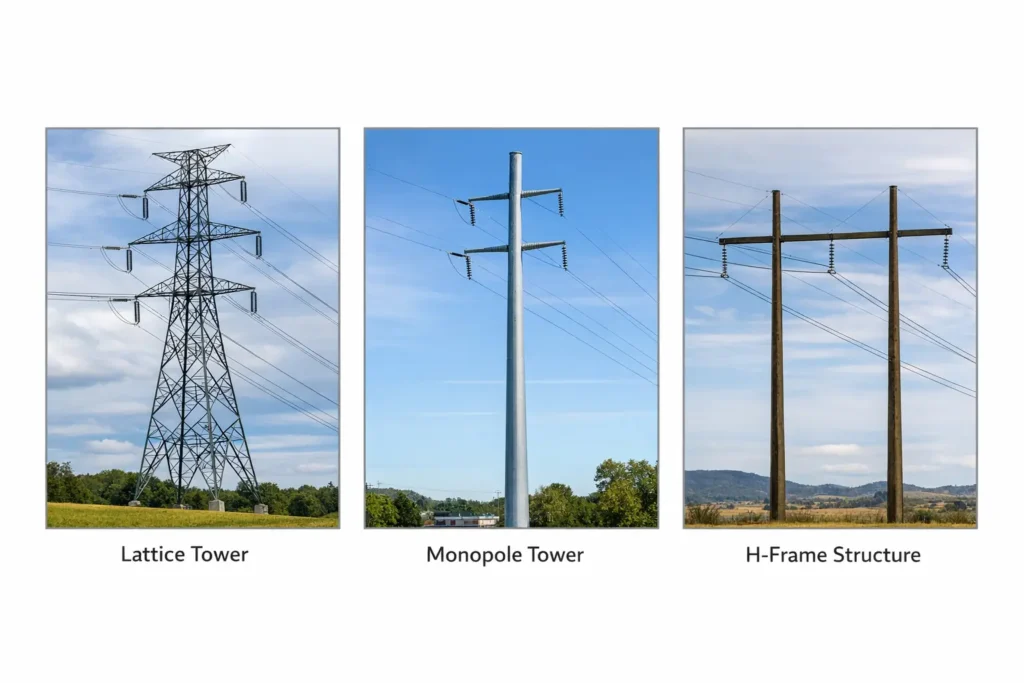
H-frame structure
H-frame structures uses two vertical poles connected by cross-arm. These type of structures are commonly used for 33KV and 66 KV lines specially in rural areas with shorter span requirements.
Classification based on circuit arrangement
Transmission line towers can also be classified based on circuit arrangements as
Single circuit tower: These towers are designed to carry only three phases of a single circuit.
Double circuit tower: These towers are designed to carry six phases or two independent circuits of three phase system.
Multi circuit towers: These towers are used in congested transmission corridors and are designed to carry multiple independent circuits. Higher circuit configuration increases the tower loading and height.
Classification based on conductor configuration
Horizontal configuration: Transmission towers with horizontal configuration has phases laid side by side and requires a wider right of way with shorter tower height.
Vertical configuration: The towers with vertical configuration of towers have phases one above the other with adequate clearances. These towers have reduced corridor but increased tower height.
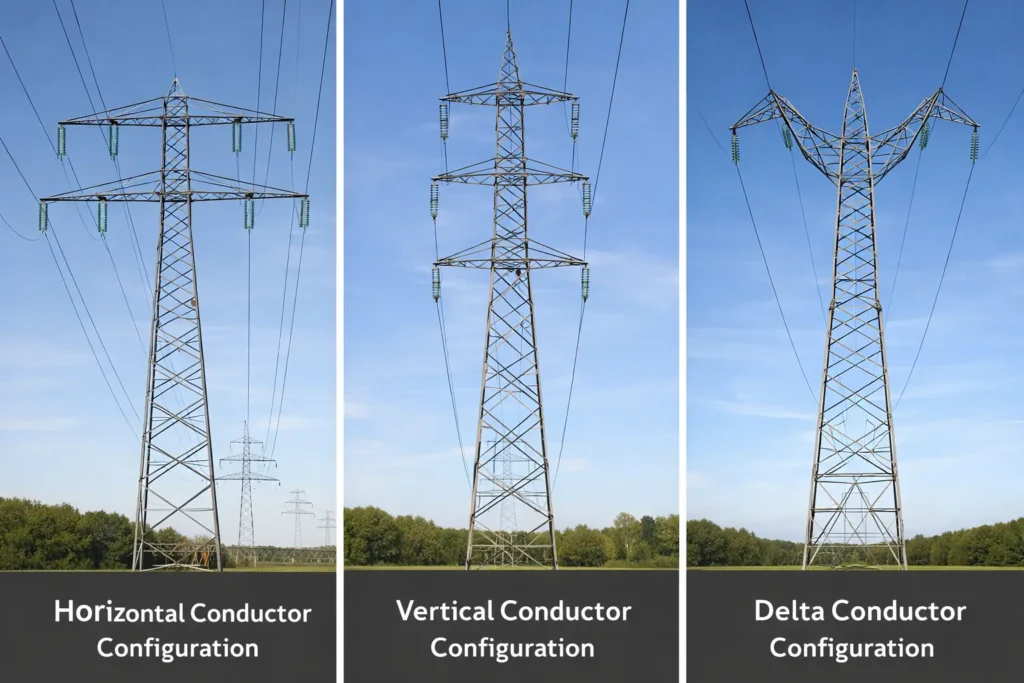
Delta configuration: Towers with delta configuration have phases arranged in triangular form offering good electrical symmetry and commonly used in EHV systems.
Voltage wise typical tower configurations
| Voltage Level | Common Structure |
| 33 kV | H-frame / pole. |
| 66 kV | Light lattice. |
| 132 kV | Lattice single circuit or double circuit. |
| 220 kV | Lattice double circuit. |
| 400 kV | Heavy lattice with bundle conductor. |
| 765 kV | Large EHV lattice structure. |
This article is a part of the Transmission line page, where other articles related to topic are discussed in details.