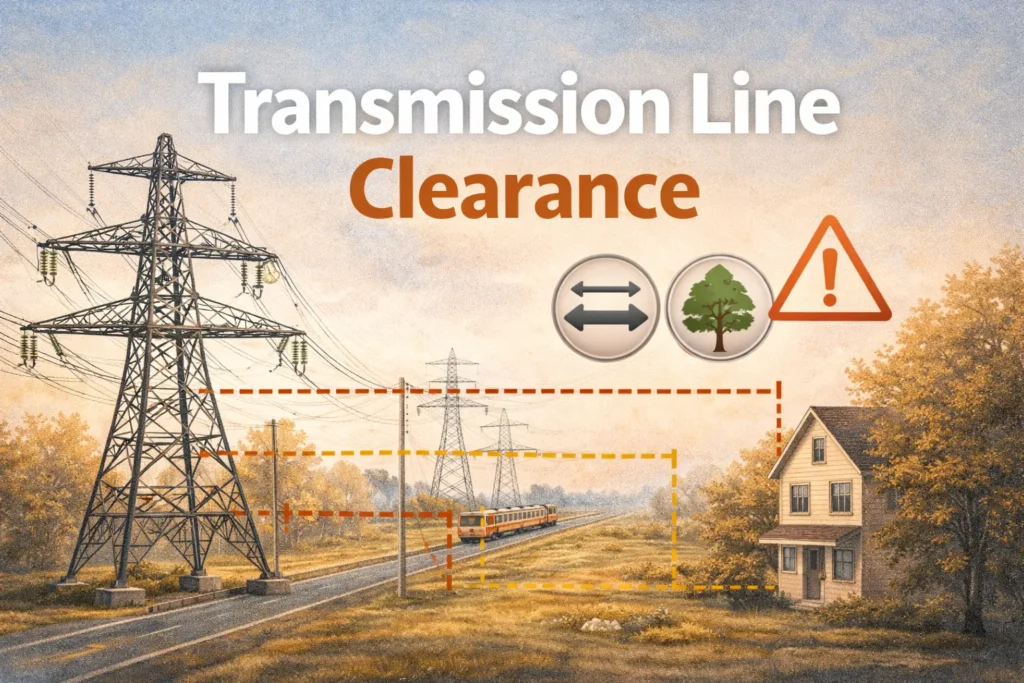
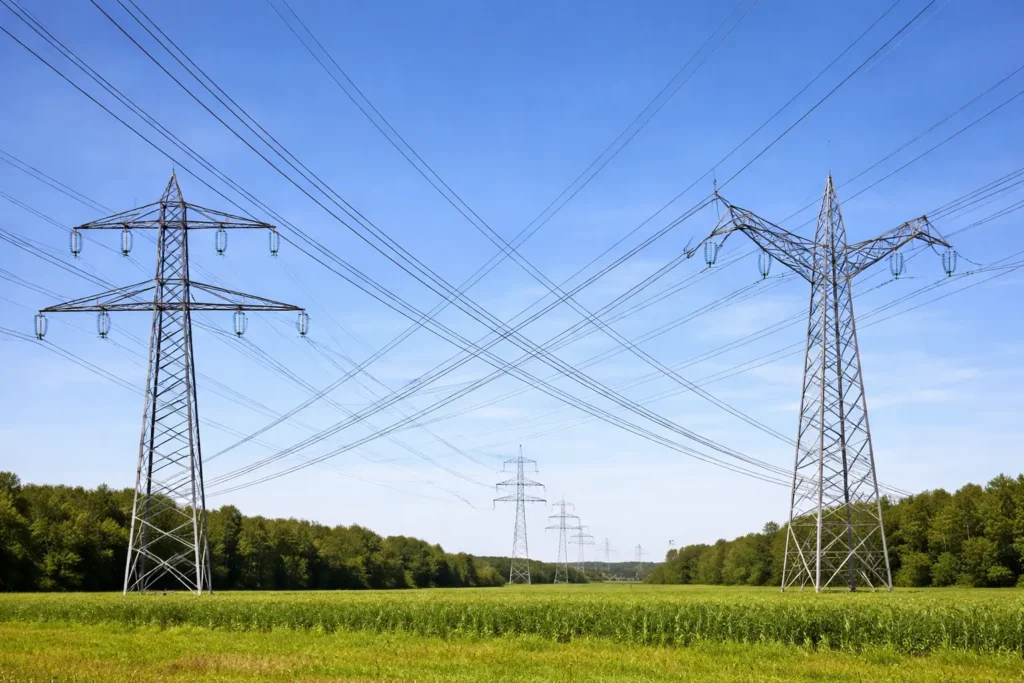
Transmission line clearances refer to the minimum safe distance that is to be maintained between energized conductors and surrounding objects such as ground, buildings, trees and other phase conductors. The transmission line clearances are essential to prevent electrical flashover between line and grounded objects, ensure safety of people and equipment, maintain reliable system operation with minimum ground faults or phase-phase electrical faults, and comply with statutory regulations during the power frequency steady state voltage and also during power frequency over voltages, lightning and switching etc. The transmission line clearance is largely determined based on voltage level of the line.
Table of Contents
Types of transmission line clearance
Ground clearance
It is the minimum clearance to be provided above the ground based on regulation of safety for AC transmission lines which is stipulated to be 5.2 meters plus 0.3 meters for every 33KV by which the voltage of the line exceeds 33KV provided that minimum transmission line clearance (ground clearance) across any street crossing must be at least 6.1 meters.
For example: The minimum ground clearance of a 132 KV transmission line is 5.2 + 3 x 0.3 = 6.1 m ( 5.2 m for first 33KV and 0.3 is for every 33KV above the first 33KV of the line voltage)
| AC Voltage (KV) Nominal/Highest | Minimum ground clearance (meters) |
| 66/72.5 | 5.5 (6.1 along or across street) |
| 132/145 | 6.1 |
| 220/245 | 7 |
| 400/420 | 8.84 |
| 765/800 | 12.1 |
| 1150/1200 | 15.4 |
The minimum transmission line clearance above the ground for DC transmission lines are
| DC Voltage (KV) | Minimum ground clearance (meters) |
| 100 | 6.1 |
| 200 | 7.3 |
| 300 | 8.5 |
| 400 | 9.4 |
| 500 | 10.6 |
| 600 | 11.8 |
| 800 | 13.9 |
The minimum ground clearance of transmission line is also dependent upon the interference limits including electric field, audible noise, radio interference voltage RIV, television interference voltage TIV etc. for transmission line voltages above 400 KV. Electrostatic field at ground level design is another criterion that influences the ground clearance. International design practice limits the electric field strength to 5KV/m at the edge of the ROW for public exposure and 10KV/m within the ROW. To maintain these limits the conductor height and tower design must provide sufficient ground clearance.
| Voltage (KV) | Minimum ground clearance (meter) |
| 765/800 AC | 15 |
| 1150/1200 AC | 24 |
| 500 DC | 12.5 |
| 800 DC | 18 |
Phase to ground metal clearance
The live metal clearance is the minimum air gap between the energized conductor and the grounded metal part of the transmission line tower (tower structure, crossarm, hardware). This clearance must be sufficient to prevent flashover or insulation failure during different voltage stress in the transmission line. This transmission line clearance is determined using a probabilistic insulation coordination approach, balancing system voltage, considering conductor swing due to wind, environmental and economic consideration.
| DC Voltage Level (Nominal / Highest) | Conductor / Insulator Type | Clearance (m) | Swing Angle – Without Pilot String (°) | Swing Angle – With Pilot String (°) | |||
| 500 / 525 kV | Twin Lapwing (V insulator string) | 1.15 | 57 | # | |||
| 3.15 | 15 | – | |||||
| 3.75 | 0 | – | |||||
| 800 / 840 kV | Hexa Lapwing (Y insulator string) | 2.0 | 72 | # | |||
| 6.5 | 25 | – | |||||
| 7.7 | 0 | – | |||||
Phase to phase clearance
This transmission line clearance is basically dictated by the ground metal clearance. For AC transmission lines the minimum phase to phase clearance under stationary condition is given by the formula below
Vertical phase to phase clearance: (0.75 x √(FMax + IK)) + V/150
Horizontal phase to phase clearance: (0.62 x √(FMax + IK)) + V/150
Where, FMax = conductor sag in meter at max operating temperature and
IK =Vertical length of insulator string in meters
V = Line voltage in KV
| AC Voltage (kV) Nominal / Highest | Standard Lightning Impulse Withstand Voltage (kVp) | Standard Switching Impulse Withstand Voltage (kVp) | Minimum Phase–Earth Clearance (m) (Conductor–Structure / Rod Structure) | Minimum Phase–Phase Clearance (m) (Conductor–Conductor) | Minimum Phase–Phase Clearance (m) *(Rod Structure) / *(Rod–Conductor) |
| 66 / 72.5 | 325 | – | 0.63 | – | 0.63 |
| 110 / 125 & 132 / 145 | 650 | – | 1.3 | – | 1.3 |
| 220 / 245 | 1050 | – | 2.1 | – | 2.1 |
| 400 / 420 | – | 1050 / 1680 | 2.6 / 3.4 | 3.9 | 4.6 |
| 765 / 800 | – | 1550 / 2480 | 4.9 / 6.4 | 7.6 | 9.4 |
| 1150 / 1200 | *** | 1800 / 2880 | 8.0 | 10.8 | 13.8 |
For HVDC transmission lines, pole to pole clearance is determined based on interference levels to be maintained and are basically
| Voltage Level (kV) | Conductor Type | Minimum Pole-to-Pole Clearance (m) |
| 500 | ACSR BERSIMIS / ACSR LAPWING | 12.5 |
| 800 | ACSR LAPWING | 22.0 |
Clearance between conductor and ground wire / OPGW at mid span
The mid span clearance between the conductor and ground wires is kept more than the clearance at the tower to avoid flashover from ground wire to conductor during lightning strike. The usual practice is to keep the ground wire sag at 90% of that of the conductor at minimum temperature for normal span. This improves the shielding angle in the middle of the span. For UHV lines 1200 KV this clearance is dictated by the corona performance of the line.
| AC Voltage (kV) Nominal / Highest (System) | Minimum Mid-Span Clearance (m) |
| 66 / 72.5 | 3.0 |
| 110 / 125 & 132 / 145 | 6.1 |
| 220 / 245 | 8.5 |
| 400 / 420 | 9.0 |
| 765 / 800 | 9.0 |
| 1150 / 1200 | 18.0 |
| DC System Voltage (kV) | Minimum Mid-Span Clearance (m) |
| 500 | 8.5 |
| 800 | 12.0 |
Transmission line clearance above water bodies
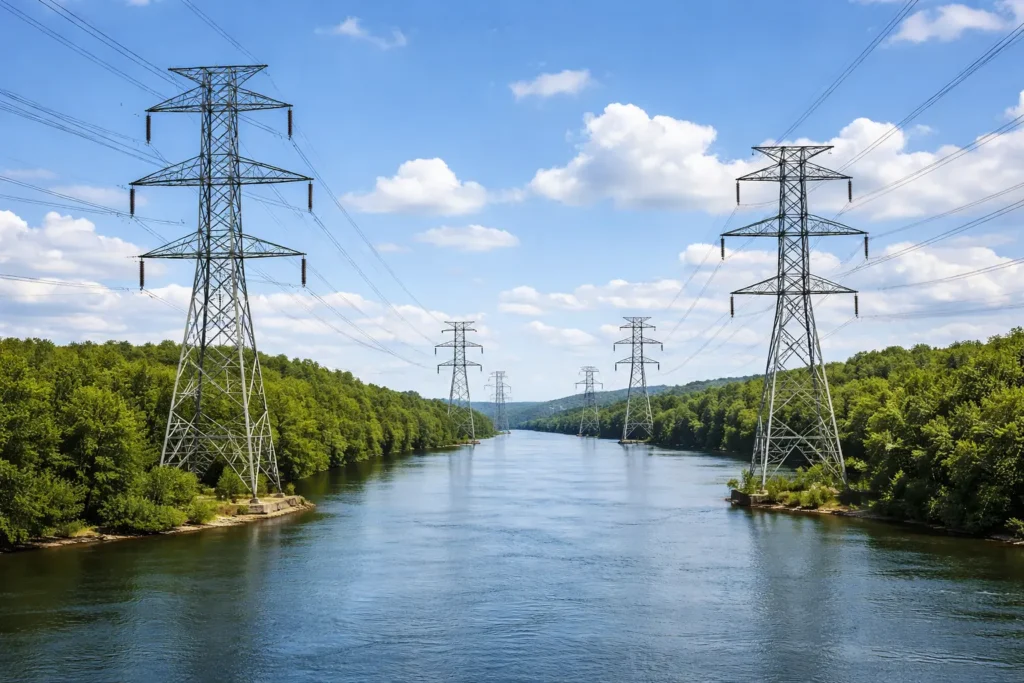
The minimum transmission line clearance above water bodies shall be fixed in consultation with the concerned navigational port authorities for navigable rivers.
Minimum clearance of power conductor over highest flood level in case of navigable rivers
| AC Voltage (kV) Nominal / Highest (System) | Minimum Clearance Above HFL (m) |
| 66 / 72.5 | 19.0 |
| 110 / 125 | 19.0 |
| 132 / 145 | 19.22 |
| 220 / 245 | 20.1 |
| 400 / 420 | 21.9 |
| 765 / 800 | 25.55 |
| 1150 / 1200 | 29.9 |
| DC Voltage (kV) | Minimum Clearance Above Highest Flood Level (m) |
| 500 | 24.03 |
| 800 | 27.7 |
Maximum clearance above highest flood level for non-navigable rivers
Considering the maximum height of an object above HFL to be 3 meters.
| System Voltage (kV) Nominal / Highest | Minimum Clearance Above HFL (m) |
| 66 / 72.5 | 3.65 |
| 110 / 125 & 132 / 145 | 4.3 |
| 220 / 245 | 5.1 |
| 400 / 420 | 6.4 |
| 765 / 800 | 9.4 |
| 1150 / 1200 | 11.0 |
| DC Voltage (kV) | Minimum Clearance Above HFL (m) |
| 500 | 6.75 |
| 800 | 11.0 |
Transmission line clearance while AC lines crossing each other
| Crossing Line Voltage (kV) ↓ / Overhead Line Voltage (kV) → | 11–66 / 12–72 | 110–132 / 121–145 | 220 / 245 | 400 / 420 | 765 / 800 | 1150 / 1200 |
| 11–66 / 12–72 | 2.44 | 3.05 | 4.58 | 5.49 | 7.94 | 10.44 |
| 110–132 / 121–145 | 3.05 | 3.05 | 4.58 | 5.49 | 7.94 | 10.44 |
| 220 / 245 | 4.58 | 4.58 | 4.58 | 5.49 | 7.94 | 10.44 |
| 400 / 420 | 5.49 | 5.49 | 5.49 | 5.49 | 7.94 | 10.44 |
| 765 / 800 | 7.94 | 7.94 | 7.94 | 7.94 | 7.94 | 10.44 |
| 1150 / 1200 | 10.44 | 10.44 | 10.44 | 10.44 | 10.44 | 10.44 |
Transmission line clearance while AC lines crossing DC lines
| Nominal System Voltage (Crossing Line) | 100 kV DC | 200 kV DC | 300 kV DC | 400 kV DC | 500 kV DC | 600 kV DC | 800 kV DC |
| Low & Medium Voltage | 3.05 | 4.71 | 5.32 | 6.04 | 6.79 | 7.54 | 9.04 |
| 11–66 / 12–72 kV AC | 3.05 | 4.71 | 5.32 | 6.04 | 6.79 | 7.54 | 9.04 |
| 110–132 / 121–145 kV AC | 3.05 | 4.71 | 5.32 | 6.04 | 6.79 | 7.54 | 9.04 |
| 220 / 245 kV AC | 4.58 | 4.71 | 5.32 | 6.04 | 6.79 | 7.54 | 9.04 |
| 200 kV DC | 4.71 | 4.71 | 5.32 | 6.04 | 6.79 | 7.54 | 9.04 |
| 300 / 330 kV AC | 5.32 | 5.32 | 5.32 | 6.04 | 6.79 | 7.54 | 9.04 |
| 400 / 420 kV AC | 5.49 | 5.49 | 5.49 | 6.04 | 6.79 | 7.54 | 9.04 |
| 400 kV DC | 6.04 | 6.04 | 6.04 | 6.04 | 6.79 | 7.54 | 9.04 |
| 500 kV DC | 6.79 | 6.79 | 6.79 | 6.79 | 6.79 | 7.54 | 9.04 |
| 600 kV DC | 7.54 | 7.54 | 7.54 | 7.54 | 7.54 | 7.54 | 9.04 |
| 765 / 800 kV AC | 7.94 | 7.94 | 7.94 | 7.94 | 7.94 | 7.94 | 9.04 |
| 800 kV DC | 7.94 | 7.94 | 7.94 | 7.94 | 7.94 | 7.94 | 9.04 |
Transmission line clearance while AC lines crossing communication lines
| Nominal Voltage / Highest Voltage (kV) | Minimum Clearance (m) |
| 66 / 72.5 | 2.44 |
| 110 / 125 & 132 / 145 | 2.75 |
| 220 / 245 | 3.05 |
| 400 / 420 | 4.48 |
| 765 / 800 | 7.90 |
| 1150 / 1200 | 10.00 |
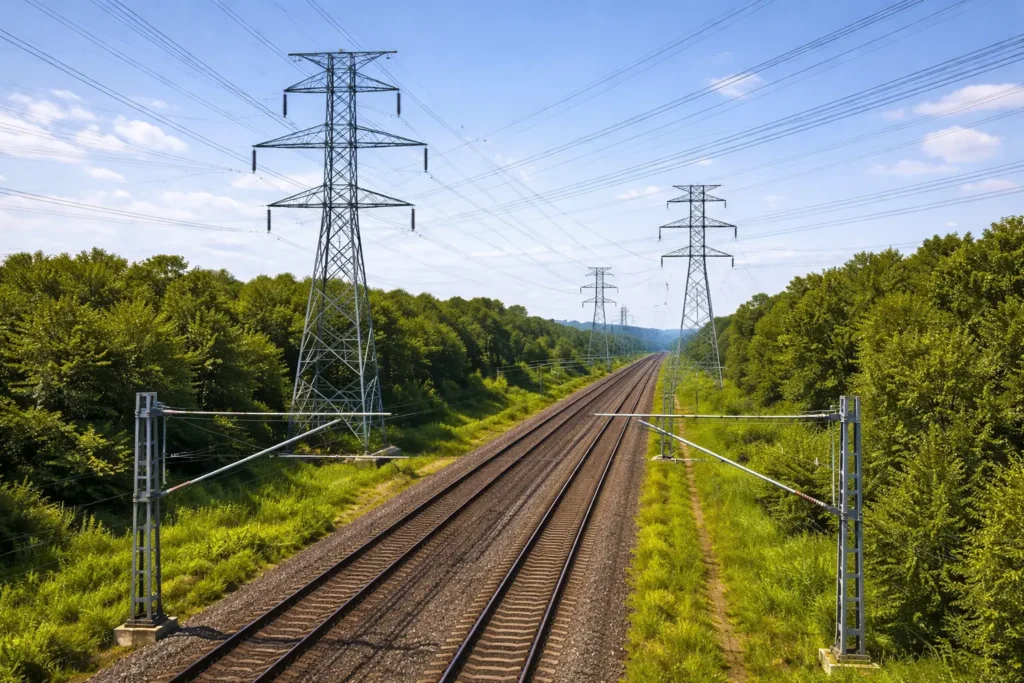
Minimum transmission line clearance while crossing electrified railway sections
The clearances are in meters from the rail level
| Sl. No. | Overhead Crossing Voltage (kV) | Clearance at OHE Structures (m) | Clearance at Mid OHE Span (m) |
| 1 | Above 33 / 36 kV & up to 66 / 72 kV | 14.96 | 12.38 |
| 2 | Above 66 / 72 kV & up to 132 / 145 kV | 15.56 | 12.99 |
| 3 | Above 132 / 145 kV & up to 220 / 245 kV | 16.46 | 14.52 |
| 4 | Above 220 / 245 kV & up to 400 / 420 kV | 18.26 | 15.43 |
| 5 | Above 400 / 420 kV & up to 500 / 550 kV | 19.16 | 17.88 |
| 6 | Above 500 / 550 kV & up to 765 / 800 kV | 21.86 | 17.88 |
Reference
Design of Transmission Line Crossing Scheme
UHV AC transmission systems – Part 202
This article is a part of the Transmission line page, where other articles related to topic are discussed in details.