
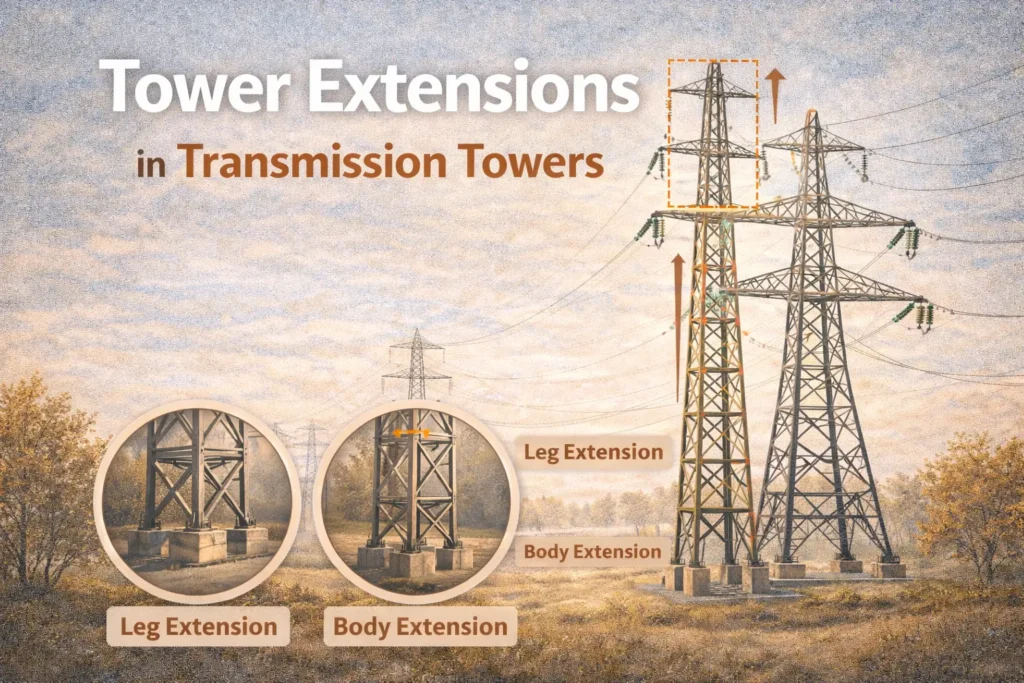
Tower extensions in transmission line tower are needed when the standard height tower is unable to meet the required transmission line clearance. In terrain variations, river crossing, road crossing and other site conditions, standard towers fall short to provide the required clearances and hence taller structure is required. Thus, in order to achieve the additional height, without redesigning the entire tower, tower extensions are used to increase the tower height, while maintaining the structural integrity of the tower.
Tower extensions are additional structural sections installed between the tower body and the foundation to increase the overall height of the tower. The tower extension raise the tower above the ground level, allowing the conductors to maintain proper ground clearance and clear obstacles.
Table of Contents
Purpose of tower extensions
Tower extensions are used in transmission line’s construction for various reasons
Maintaining the ground clearance
Tower extensions are commonly used to maintain the required minimum ground clearance between conductor and earth surface. In areas, the ground level rises because of hills, embankments or terrain changes, the effective ground clearance reduces. In such cases, the extension increases the tower height helping the conductor to maintain statutory clearance requirements.
Crossing obstacles
Transmission lines often has to cross rivers, roads, canals, railway tracks, other transmission line corridors. This requires additional vertical clearance to ensure safe operation of the transmission line. The extension provides the extra vertical height so that the conductors can maintain the prescribed crossing clearances. This prevents electrical hazards, ensure safety of traffic and complies with regulatory standards.
Uneven terrain
In hilly or uneven terrain, ground levels are often at different levels for same tower locations and requires benching and cutting. Tower extension compensate this variation by increasing the height of legs where required. This ensures the conductor profile remains smooth and required clearances are maintained when foundations are at different levels.
Alignment adjustment
Extensions are also used to maintain proper conductor sag and tension between adjacent spans. If there is a difference in elevation between towers or a need to modify the conductor profile, extension helps to adjust the effective attachment height, which allows the transmission line to maintain optimal mechanical performance.
Types of tower extensions
These extensions are basically classified based on the structural configuration.
Leg extensions
The leg extension increases the tower height by extending the main tower legs above the foundation level. These are used between the tower base and foundation with one leg or combination of legs, where footings of the tower are at different levels, typically used when moderate height increase is required. The alignment of the leg extension is done with first section of the tower and its installation requires high degree of expertise in tower erection.

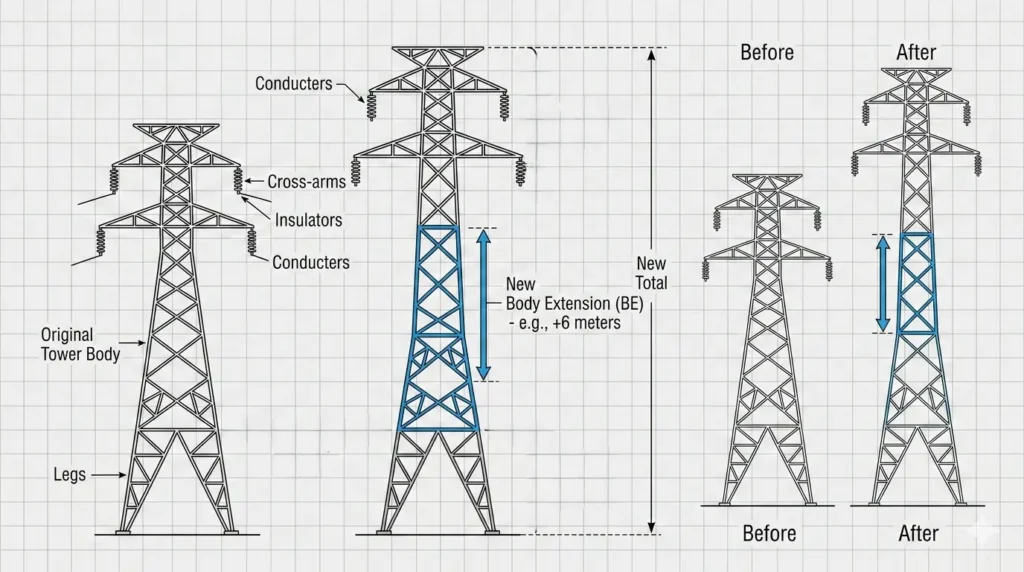
Body extension
Body extensions are basically additional lattice section inserted into the main tower body. Body extension is used to increase the height of the tower to obtain the required ground clearance over road, river crossings and avoid ground obstacles. Body extension up to 9m height are used normally in steps of 1.5 m. for body extensions with height greater than 9m (say 12,15,18,21,25 m, etc.), the suitability of loading of standard tower must be checked by reducing the span length or angle of deviation. In hilly regions, negative body extension is used in tension towers considering the economy. Negative body extension generally means to truncate a portion of the tower body.
Structural design consideration
Since the tower height increases with the use of extensions, the bending moment at the base increases because the wind load at the tower body, conductors and insulators acts as a lever arm. To allow the same standard tower design to be used, special structural provisions are adopted.
Strengthened extension members
The extension panel uses heavier angle sections, additional bracing and stronger gusset plates. This allows the extension to transfer loads safely to the foundation.
Foundation design adjustment
Since the height increases the overturning moment, the foundation is usually strengthen by increasing the footing size, increasing embedment depth and providing larger stub angles.
Limiting extension height
Utilities typically limit the extension height to about 9 m. Beyond this, taller tower type is designed instead. This is because the increased length of the leg causes the slenderness ratio to increase beyond 180 which is the limit for compression members of the transmission tower.
For a stable lattice tower geometry, the base width of the tower has to be 1/6th to 1/8th of the height of the tower. When the height of the extension exceeds 9m, the height of the tower increases without increasing the base making the tower structurally inefficient.
For fabrication and erection, typical panel height is 3-4 m, a 9m extension already requires 3 additional panels and beyond this, extension becomes structurally similar to designing a new tower body section.
This article is a part of the Transmission line page, where other articles related to topic are discussed in details.