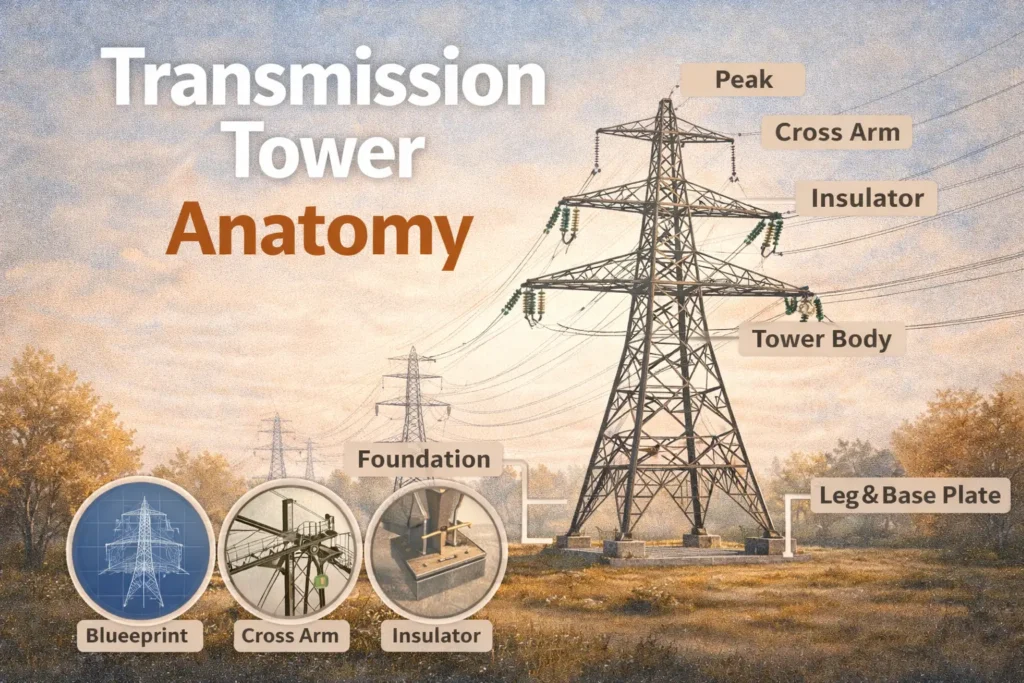
Tower anatomy refers to the structural components and arrangement that makes up a transmission tower used in overhead transmission lines. A transmission line tower is designed to support the power conductors and to maintain the required transmission line clearance and mechanical stability. Each part of the tower such as peak, corss arm, cage, body, foundation etc performs very specific functions in carrying the mechanical loads and maintaining the phase spacing. The transmission line tower must withstand environmental forces such as wind, conductor tension and at times ice loading.
Thus, understanding the tower anatomy helps engineers in proper designing, structural analysis, inspection and maintenance, ensuring reliability and long-term safety of the high voltage transmission lines.
Table of Contents
Tower anatomy
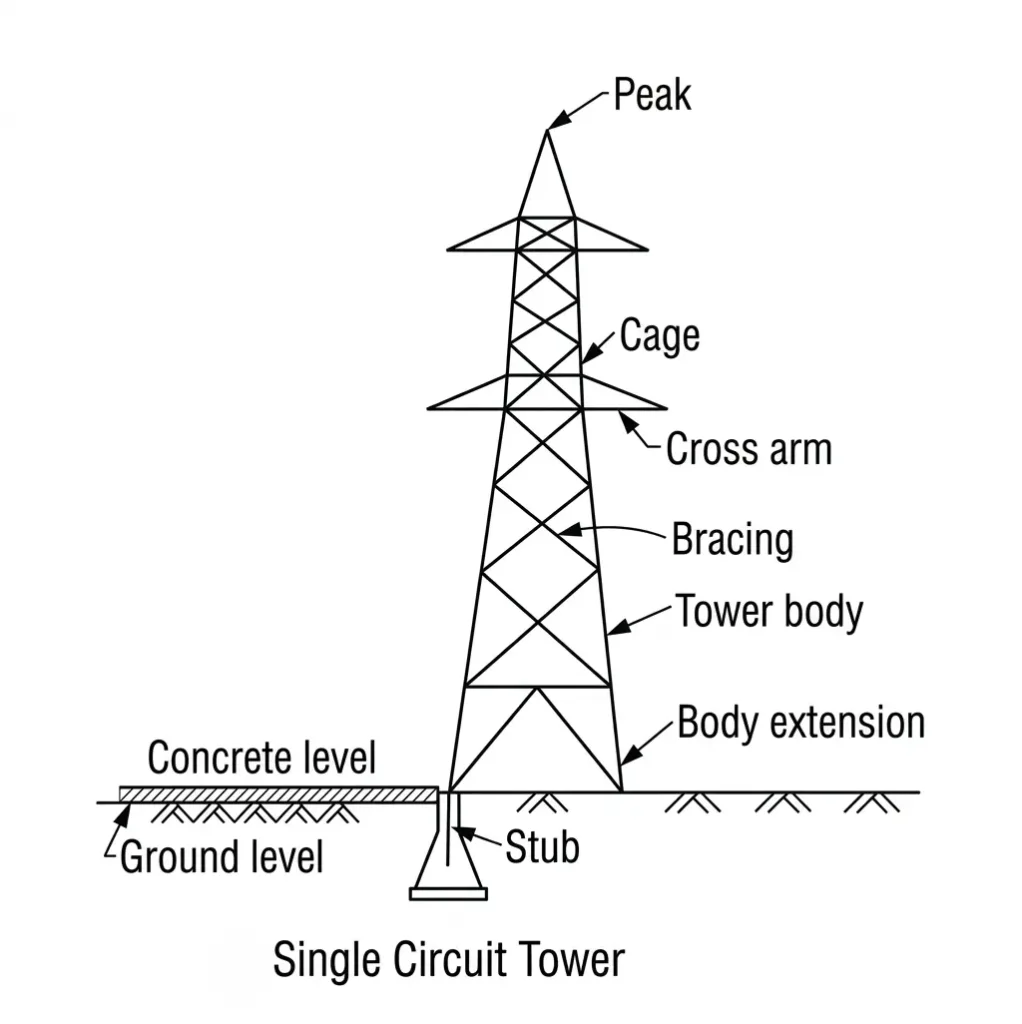
A transmission tower is composed of several structural components that work together to support the conductors, maintain electrical clearances and transfer the loads to the foundation. The components are discussed below
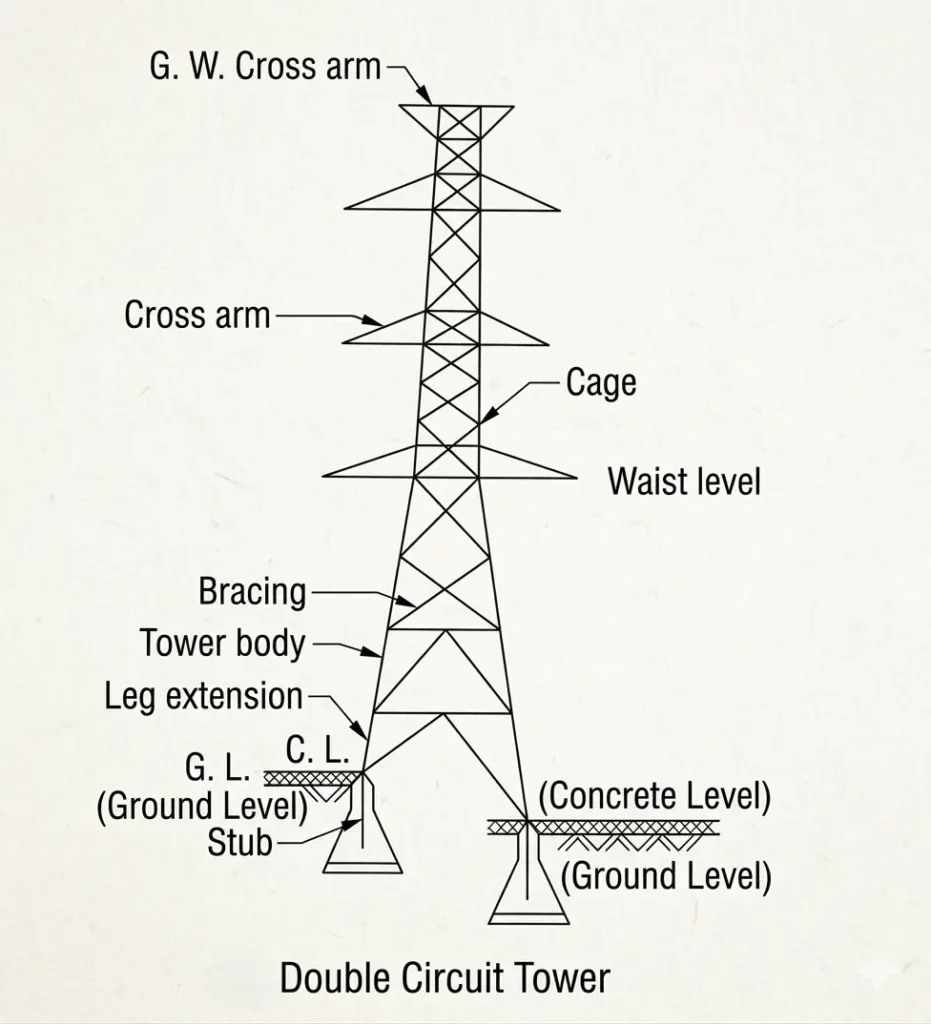
Peak (Tower top)
The peak of the tower is the portion which is above the top cross arm in case of vertical configuration tower and it is above the boom in case of horizontal configuration tower. The main function of the peak is to support the ground wire or OPGW in suspension and tension clamps at suspension and tension tower locations respectively. The height of the peak depends upon the specified angle of shield and clearance between phase and ground conductors at the mid span.
Cage
Cage is the portion of the tower which is in between the peak and tower body in vertical configuration towers. The cross-section of the cage is generally square but it can also be uniform or tapered throughout its height depending upon load. The cage basically comprises of tower legs, interconnected by bracing, used in the panel of the cage where the cross arms are connected. The slope of the cage changes for proper distribution of the torsion.
Cross arm
In tower anatomy, function of the cross arm in case of vertical configuration tower is to support the conductor or ground wire / OPGW (mostly in double circuit towers). The number of cross arms depends upon the number of circuits, tower configuration, and conductor arrangement. The cross arm of ground wire/ OPGW consists of fabricated steel work and for conductor consists of fabricated steel works along with insulator strings, which keeps the cross arm insulated from phase conductors.
The dimension of the cross arm depends upon line voltage, type and configuration of insulator strings, minimum framing angle for mechanical stress distribution etc. For large angle deviation, rectangular or trapezoidal cross arm with pilot string are used on the outer side to maintain ground metal clearance. The lower members of the cross arm are called as main members while the upper members are called tie members or compression members.
Boom
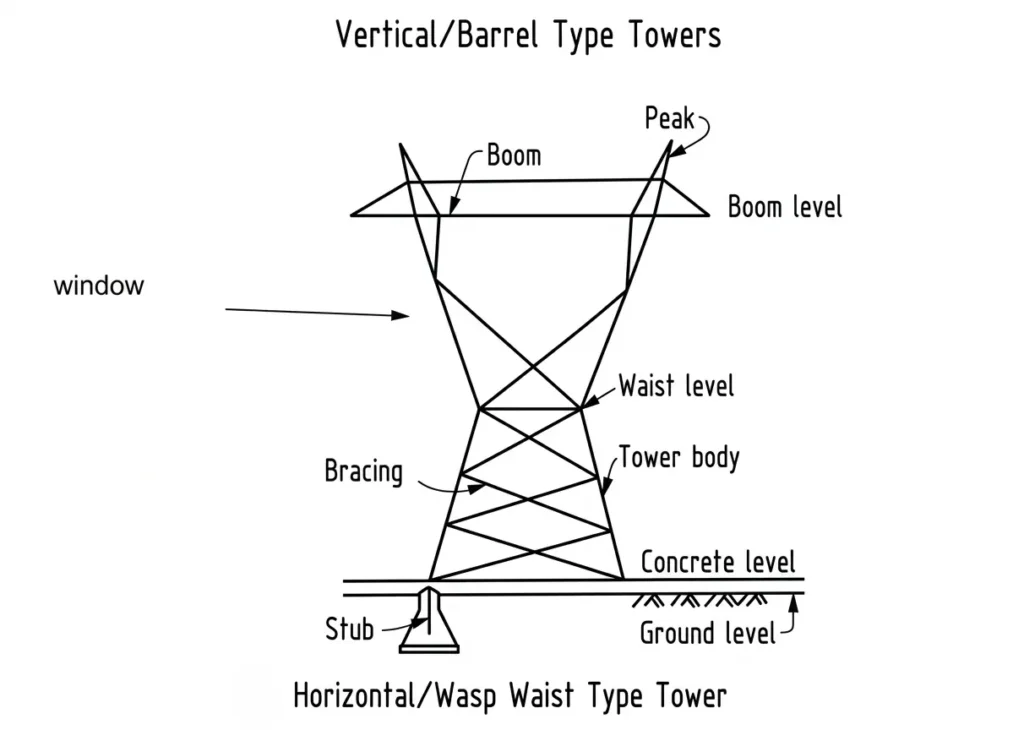
For a horizontal configuration tower anatomy, boom is the rectangular beam of uniform cross-section or tapered towards middle of the beam. It is attached to the tower body and supports the power conductors.
K-frame
For horizontal configuration tower anatomy, K-frame, two in number are usually provided on the transverse face of the tower placed between waist and boom level, is a structural bracing arrangement. The window that forms in the center is utilized to pass the middle phase conductor.
Tower body
The tower body is the main portion of the tower anatomy which connects the cage or k-frame to the tower foundation or body extension or leg extension. The tower body consists of tower legs interconnected by bracing and redundant members. The tower body is generally square or rectangle depending upon the economics of the tower.
Bracing members
These are diagonal members forming triangular patterns which increases the structural rigidity and strength of the tower. It helps to prevent deformation and distribute the mechanical loads evenly.
Leg members
In the tower anatomy, leg members are the four main vertical supports of the tower that carries the entire load of the structure and conductors and passes it to the foundation via stubs. These are among the heaviest members of the tower designed to resist compression and bending load.
Base plate and stub
The base plate and stub assembly connects the tower body / body extension or leg extension to the foundation. Cleats are provided on the stubs, which offers resistance against uprooting of the stub from the foundation. A stub set consists of 4 members and number of anchor bolt depends upon uplift and shear on the bolts.
This article is a part of the Transmission line page, where other articles related to topic are discussed in details.