

The CT polarity test is among the most important tests that is done during the commissioning of a new current transformer in the substation. It is because the correct polarity is very essential for the differential protection, directional overcurrent protection and metering accuracy. Wrong CT polarity can cause maloperation in the system and introduce false tripping.
Table of Contents
Objective of CT polarity Test
The objective of CT polarity test is to test and verify correct primary and secondary relationship with instantaneous current direction. The CT polarity test confirms that the polarity markings in the primary side P1 and P2 corresponds to the secondary terminals S1 and S2. In simple terms, current enters the primary winding via P1 and leave via P2, then in the secondary, current enters via S2 and leaves via S1.
Methods of CT polarity test
There are three practical methods of CT polarity testing and these are discussed below
Battery kick test
The battery kick test is a simple method which is used to verify the polarity of the current transformers (CT). In this test, the relationship between (P1-P2) and (S1-S2) is verified using a DC source and an analog voltmeter.
A small DC battery 1.5 to 9 V is momentarily connected across the CT primary winding and an analog voltmeter is connected across the secondary terminals. It may be noted that parallel connection of voltmeter with the shorted secondary will result in no kicks. The CT secondary has to be open and then connected to the analog voltmeter. When the battery is closed, a sudden rise in current in the primary produces a transient magnetic flux in the core. This change in flux causes a momentary voltage in the secondary winding.
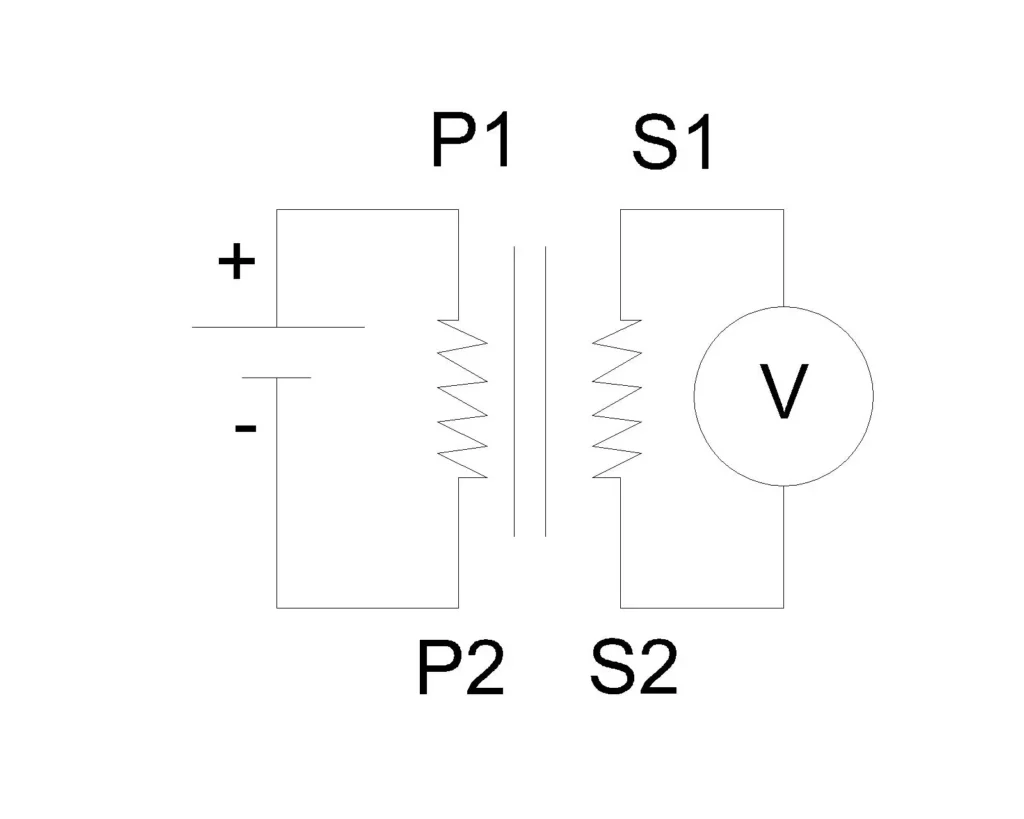
The pointer of the voltmeter kicks either in positive or negative direction. The direction of deflection determines the polarity. If the battery’s positive is connected to P1 and the meter shows a positive kick when connected between S1-S2, then the polarity is correct as P1 corresponds to S1. If in the same setup, the voltmeter shows a negative kick, then it is to be interpreted that polarity at secondary is reversed. It may be noted that when the battery circuit is opened, the pointer deflects in the opposite direction because of collapsing flux.
Application of DC causes a transient flux change in the CT core and polarity is only observed during the make and break of connection. A continuous DC does not produce a steady secondary voltage. This test verifies the instantaneous polarity of the CT but it does not check the ratio accuracy or burden capability. It is widely used to test current transformer polarity.
AC voltmeter method
This method is used when the battery kick test is not possible because of unavailability of DC source or the analog meter is not available.
In this alternative method, low voltage AC is applied to primary of the CT (P1-P2) and check the secondary voltage Vs. Then one primary terminal is shorted to one secondary terminal (P1-S1) to form a series connection. Then we measure the voltage between the free primary and secondary terminals (P2-S2) using an AC voltmeter.
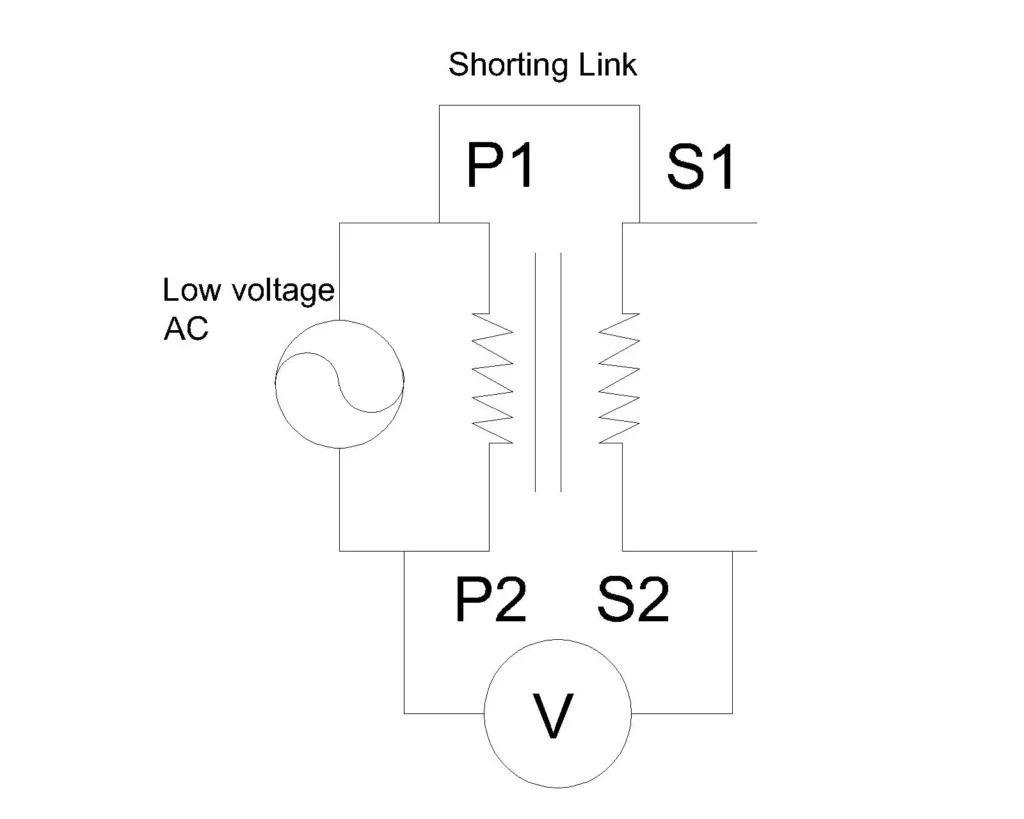
If the measured voltage is equal to sum of primary and secondary voltages, it refers to additive polarity and if the measured voltage is equal to difference of the primary and secondary voltages, it refers to subtractive polarity.
When P1 corresponds to S1, correct polarity, the connected terminals (1 primary and 1 secondary) will have opposite instantaneous polarity, measured voltages will be in phase and add up.
V measured = V p + V s
It may also be noted that the secondary and the primary winding of the CT forms a closed loop via the primary circuit. P2-P1 forms primary, P1-S2 forms secondary and via voltmeter back to P2 makes a closed circuit and should not be confused with S1-S2 open circuited.
This method is rarely used in commissioning as it requires careful handling of energized connections.
Primary injection method
In the primary injection method, actual current is passed through the CT primary conductor and corresponding secondary response is then observed. The primary injection test kit supplies high current simulating real operating condition. During the test current is injected through the primary P1-P2 and measured across secondary S1-S2. The phase relation and instantaneous polarity is verified by the kit, relay operation and wiring correctness can also be checked. If current entering P1 produces secondary current leaving S1, the polarity of the CT under test is correct.
This method is widely used during protection commissioning because it verifies the CT polarity, ratio accuracy, secondary wiring and relay functionality.
Safety precaution
During CT polarity test, ensure that the CT primary is isolated before the test and make sure to short the CT secondary after test.
This article is a part of the Testing and commissioning page, where other articles related to topic are discussed in details.