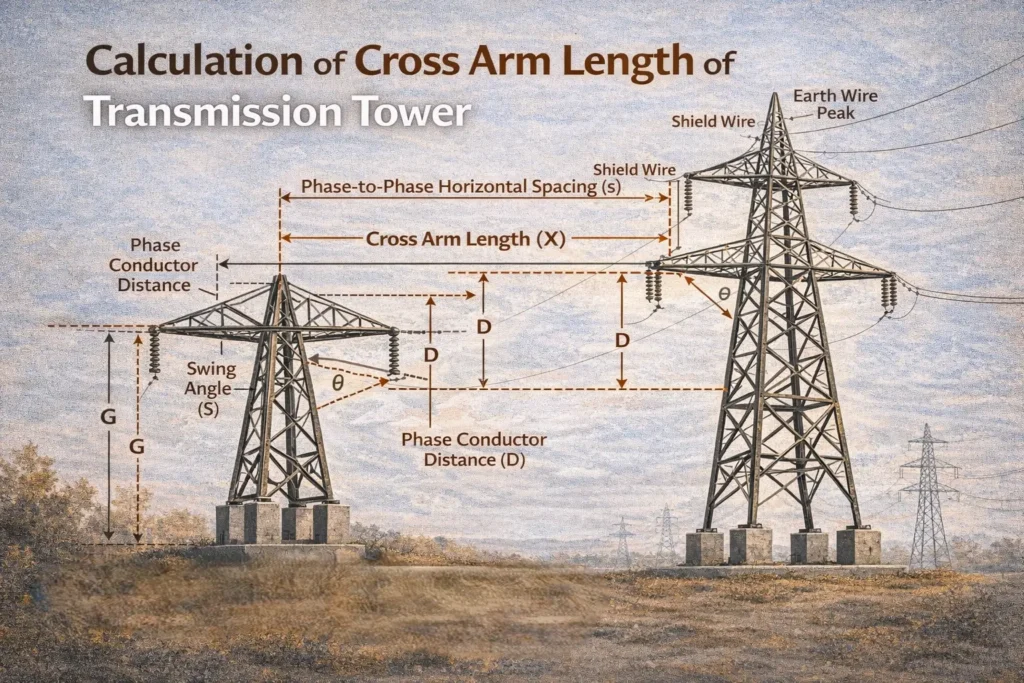
Length of cross arm for suspension type tower
The length of the cross arm is determined corresponding to the swing angles and transmission line clearance for the lightning impulse withstand voltage or switching impulse and power frequency dynamic over voltage. The medium swing angle corresponds to the switching or lightning impulse voltage as lightning and switching surges are less probable and hence combined with maximum air gap length.
The maximum swing angle corresponds to the power frequency dynamic overvoltage as the power frequency overvoltage is permanent with probability = 01. Hence it is combined with least probable event i.e, the maximum swing of the insulator string, where the air gap or the insulation level drops to minimum level.
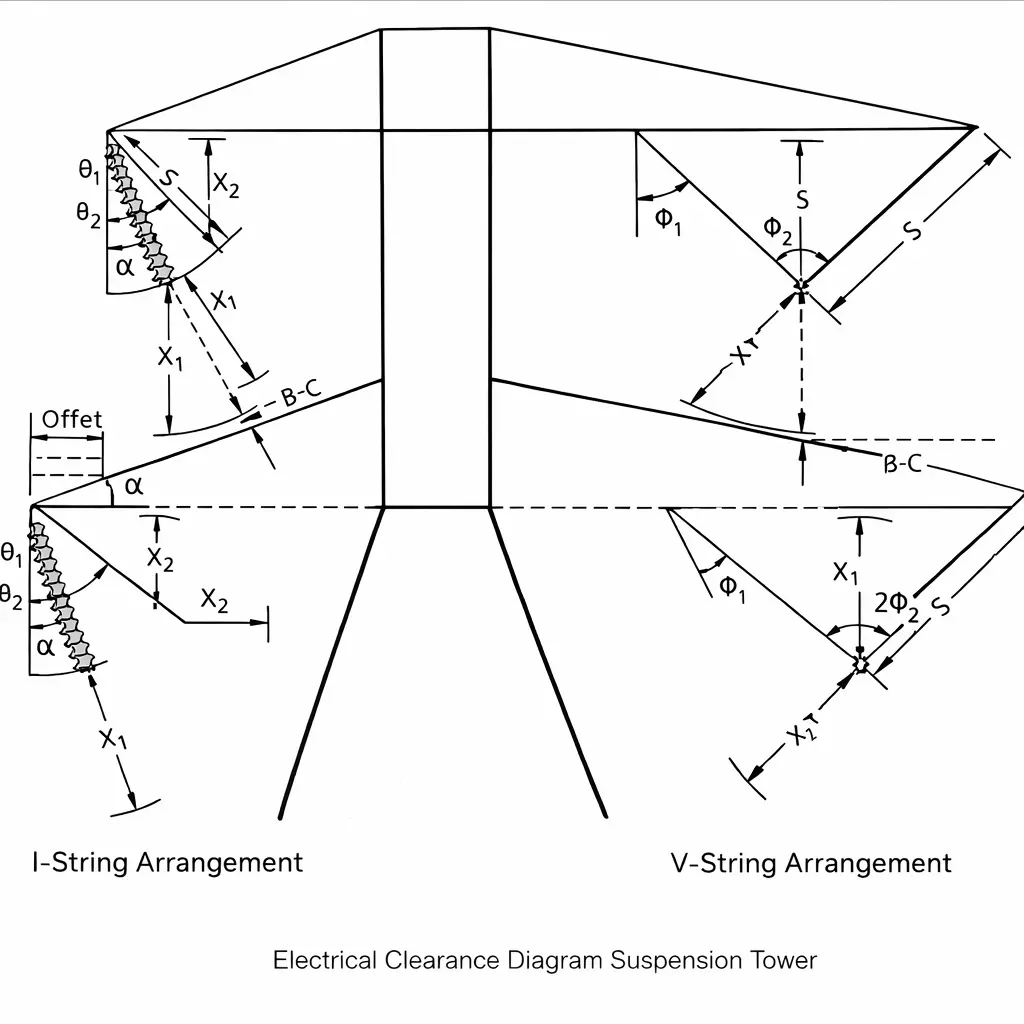
Here, C is the distance of center of gravity of the main angle section,
B is the flange width of the nearest projecting angle section connected to the main angle members.
S is the length of the insulator string.
Θ1 is the swing angle of the suspension insulator string.
Θ2 is the maximum swing angle of the insulator string.
X1 is the electrical clearance corresponding to the lightning / switching surge
X2 is the electrical clearance corresponding to the dynamic power frequency over voltage.
Φ2 is the maximum swing angle of the v-string insulator.
Therefore, the length of the cross arm for I string is S sin Θ1+X1+B+C or S sin Θ2+X2+B+C. and the length of cross arm for V string insulator is S sin Φ2+X1+B+C.
Length of cross arm for tension tower
The tension tower without the pilot string, the length of cross arm is determined corresponding to the nil swing and swing angles specified for the jumper with applicable electrical clearances. Considering the length of the tension insulator string, jumper swing angle, electrical clearances and angle of deviation, the length of cross arm can also be derived at.
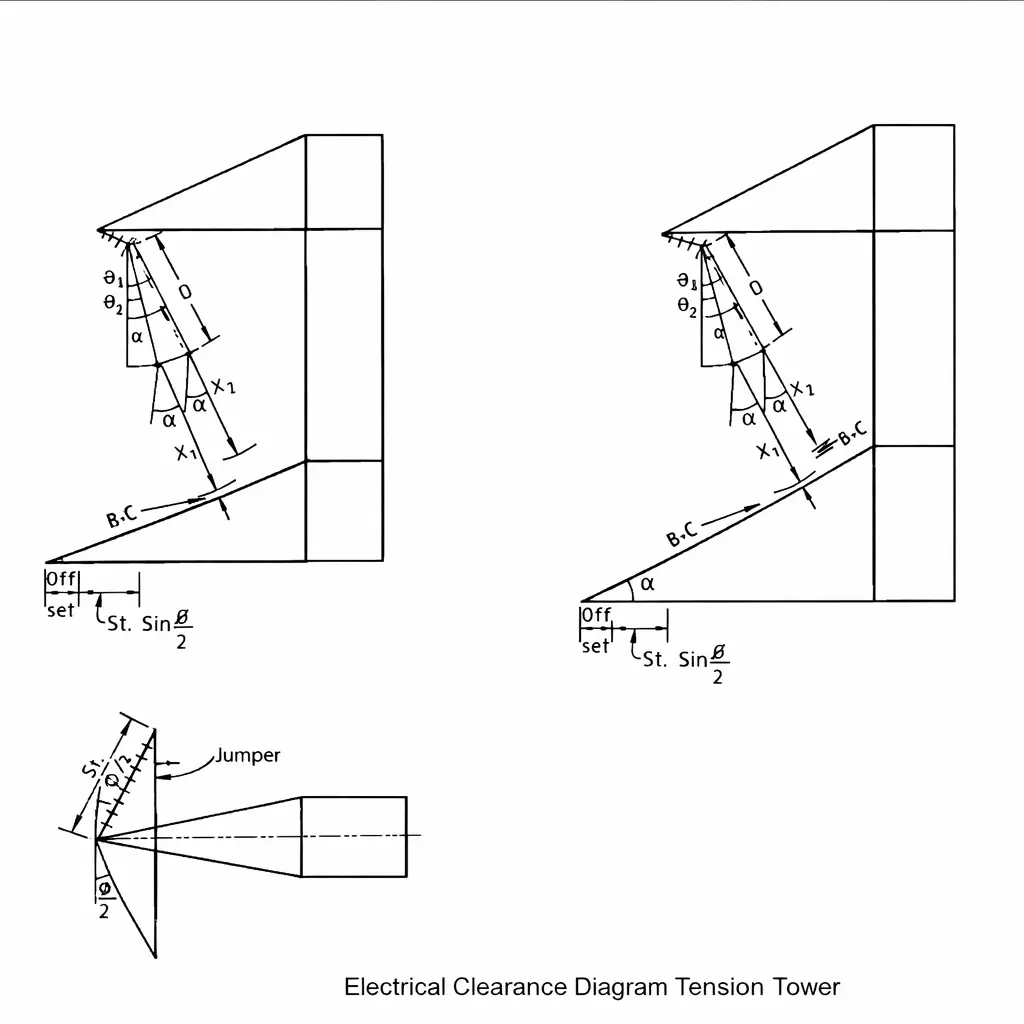
C is the distance of center of gravity of the main angle section,
B is the flange width of the nearest projecting angle section connected to the main angle members.
St is the length of the tension insulator string.
Θ3 is the jumper swing angle of the tension insulator string.
Θ4 is the maximum jumper swing angle of the insulator string.
X1 is the electrical clearance corresponding to the lightning / switching surge
X2 is the electrical clearance corresponding to the dynamic power frequency over voltage.
D is the depth of jumper which is equal to 1.03 to 1.05 of maximum electrical clearance corresponding to the lightning or switching impulse level.
Φ is the angle of line deviation.
And the length of cross arm is St sin (Φ/2) + D Sin Θ3+X1+B+C or
St sin (Φ/2) + D Sin Θ4+X2+B+C.
For large angle tower or dead end towers, provision of unequal cross arm, trapezoidal or rectangular section with a pilot string is usually considered.
This article is a part of the Transmission line page, where other articles related to topic are discussed in details.