
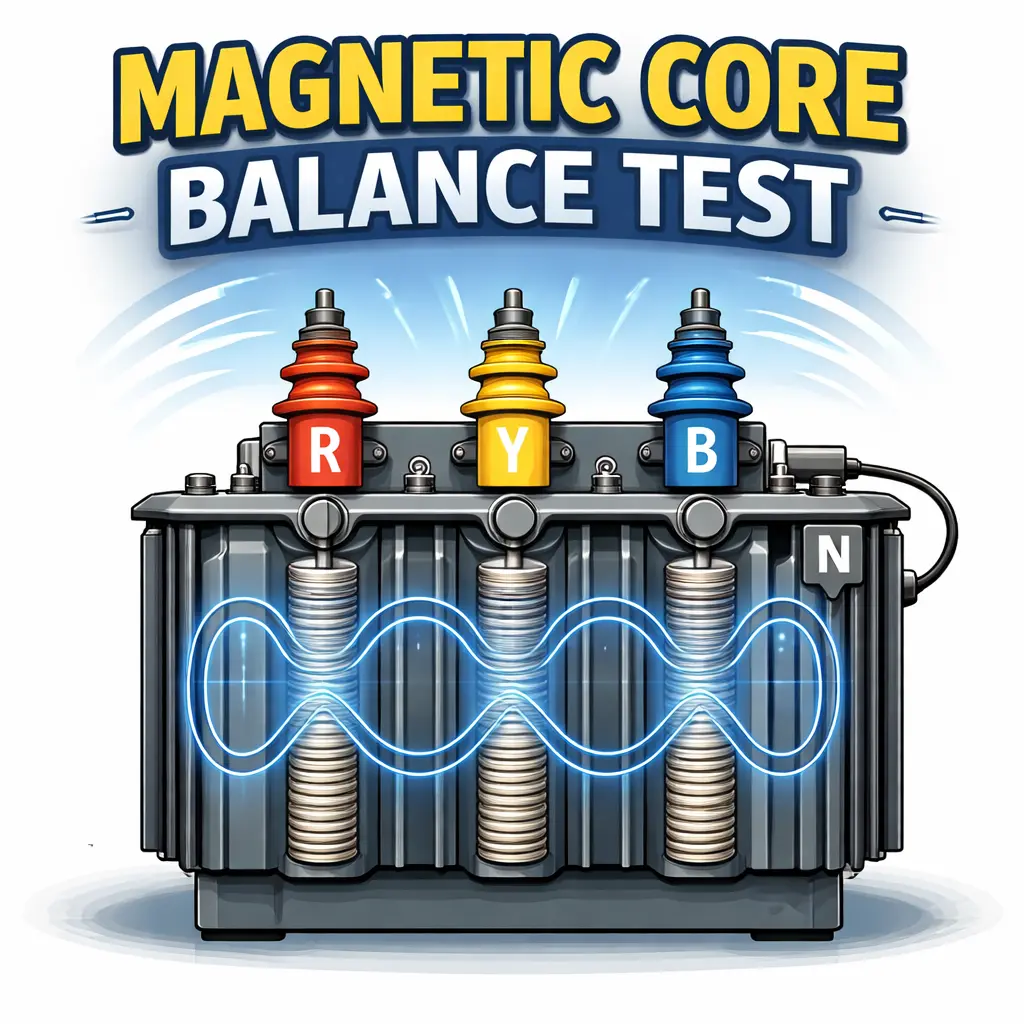
The magnetic core balance test is performed in a three phase transformer to check the symmetry of the magnetic path in the core and detect interturn faults in the power transformer. This test is basically based on the principle of flux linkage and it is expected that since the windings of the transformer are mounted on separate limbs of common core, the resulting flux from an applied voltage in one limb will be distributed across three limbs of the transformer’s core.
Table of Contents
Principle of magnetic core balance test
The magnetic core balance test is performed by the application of single phase voltage to individual limb and the voltage induced in the other two limbs are measured. The distribution of flux depends on the magnetic reluctance of the return path and the ideal condition upon application of test voltage are:
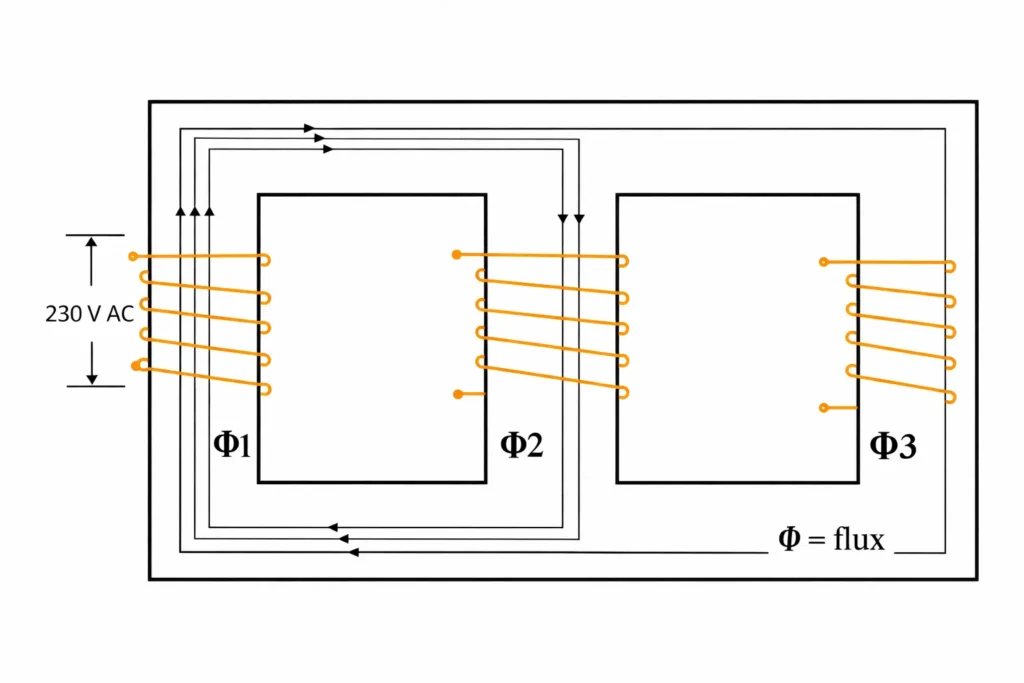
Voltage applied to U phase, Φ1 = Φ2 + Φ3, where, Φ2 = 60 – 90% of the flux links to the adjacent limb (V phase) & Φ3 = 40 – 10 % of flux flows through the extreme limb (W phase). This occurs because the adjacent limb provides the lower reluctance path.
Voltage is applied to V phase, Φ2 = Φ1 + Φ3, since both U and W phases or limbs are equidistant, the flux divides approximately equally. Hence, Φ1 ≈ Φ3 ≈ 50%.
Voltage is applied to W phase, Φ3 = Φ1 + Φ2, 60-90% flux links to the adjacent limb that is V phase and 40-10% flux flows through the extreme limb that is U phase.
This happens because flux prefers path of least reluctance. Adjacent limbs have shorter magnetic path, lower reluctance, and thus higher flux share.
Test Equipment
Magnetic core balance test needs a low voltage AC supply typically 230V single phase supply is commonly used in transformers windings for excitation. RMS voltmeter and ammeter is needed to accurately measure the induced voltages in the non-energized phases and the magnetizing current respectively. Properly insulated test leads are used for safe and reliable connection between the kit and transformer terminals. An autotransformer or variac is also used for a gradual and controlled voltage application, preventing sudden inrush and avoiding core saturation.
Test procedure of magnetic core balance test
Step 1: Disconnect the transformer and isolate it from the grid.
Step 2: Remove the transformer neutral connection from the ground.
Step 3: Remove the terminal connections of the transformer.
Step 4: Connect the single phase AC supply from the test kit to the transformer’s terminal u-n in star connected winding or u-v in delta connected winding. The supply is given commonly to LV side terminals as HV side has a greater number of turns and thus connection to the HV terminal results in poor flux development.
Step 5: Connect the measuring leads to the remaining terminals v and w and the magnetic core balance test equipment.
Step 6: Start the test and record the measured voltage and magnetizing current.
Step 7: Repeat for other phases and record the readings.
Typical result of magnetic core balance test
| Measured voltage (V) | Total voltage induced in other 2 phases | Magnetizing current | |||
| 2U-2N | 2V-2N | 2W-2N | Phase | ||
| 226 (100%) | 174 (76.9%) | 55 (24.3%) | 101.3% | U | 135 mA |
| 115 (50.8%) | 226 (100%) | 111 (49.1%) | 100.0% | V | 99 mA |
| 56.7 (25.1%) | 172.6 (76.3%) | 226 (100%) | 101.4% | W | 136 mA |
Acceptance criteria
In most healthy transformer the magnetizing current if U and W windings are almost same and both are greater than the magnetizing current of V winding. There must exist a symmetry between the two extreme limbs and the middle must be moderately lower. However, if the magnetizing current of the middle winding is extremely low and there is a large deviation 40-50% from the extreme winding’s value, it can suggest lamination short in the core, residual magnetism, or core bolt insulation failure.
When voltage is applied to the extreme winding of the transformer, the measured voltage in the other two winding must not cross 90% or below 10% of the applied voltage for an healthy transformer.
This article is a part of the Testing and commissioning page, where other articles related to topic are discussed in details.