
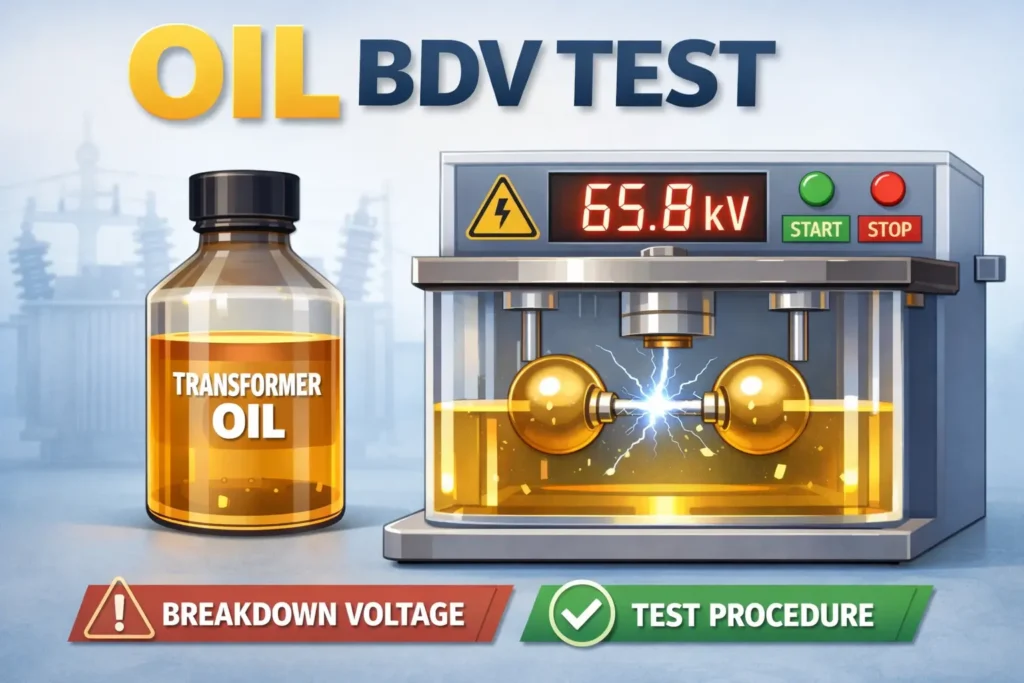
The BDV test or break down voltage test of insulating oil is a diagnostic test performed to determine the dielectric strength of the oil. It is basically the voltage at which the oil fails to provide insulation and a spark is passed between two electrodes at a standard gap of 2.5mm under controlled conditions. The test is conducted in a BDV test kit where the voltage between the electrodes is gradually increased until breakdown. The result of the BDV test is expressed in kilovolts (KV) which is proportional to the dialectic strength of the oil (KV/mm).
Low value of BDV test indicates that the oil is contaminated by moisture, dirt and other byproducts. This test is very much important to ascertain the insulation health of the transformer and enable its reliable operation.
Table of Contents
Principle of the BDV Test
The breakdown voltage, BDV test is based on the principle of dielectric break down of the insulating liquid under high electric stress. As the increasing AC voltage is supplied across two standard electrodes, immersed in transformer oil at a fixed gap of 2.5mm as per IEC 60156, an electric field emerges between them. At a critical voltage, ionization occurs forming a conductive path and resulting in an electrical arc. Pure and moisture free oil withstands this high voltage but presence of moisture, dissolved gases, suspended particles, weakens the insulation strength.
BDV Test kit
A BDV test kit is a portable setup which takes a single-phase input and includes a variac in the input side for smooth voltage control, the main HV unit is a step-up dedicated test transformer which terminates to two mushroom shaped electrodes set fixed at a gap of 2.5mm inside the test chamber which shall be filled with the oil to be tested. The unit also houses a control panel to start the test and digital display which records the breakdown voltage of the oil in kilovolts.
Electrode configuration
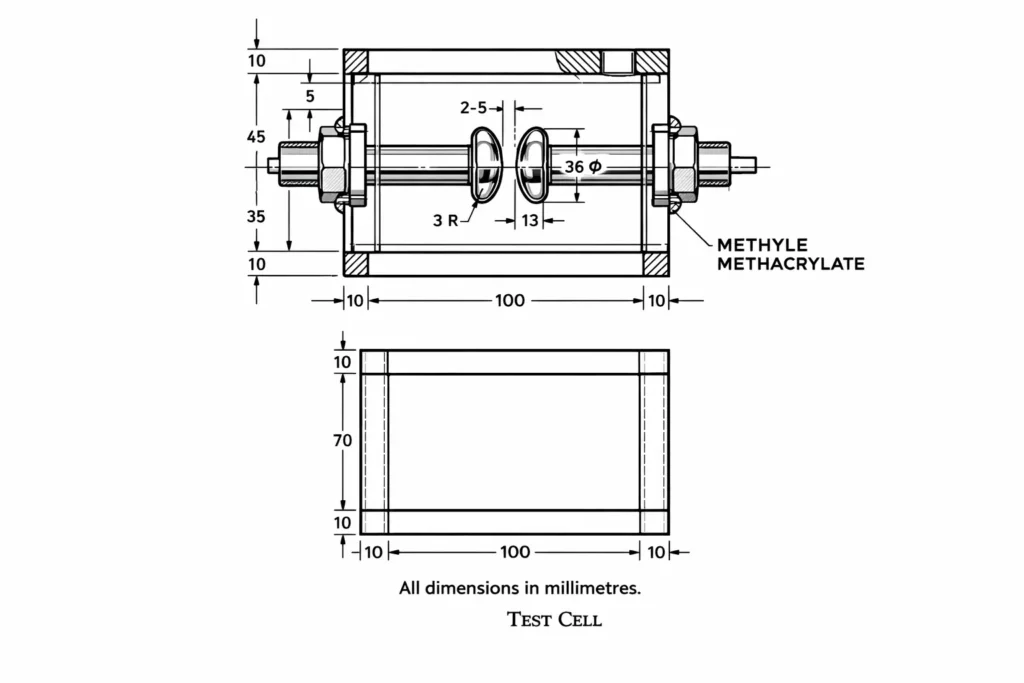
In the BDV test of the insulating oil, two mushroom shaped electrodes are used for ensuring uniform electric field distribution. The standard gap between them is 2.5mm as this gap is high enough to reflect the oil quality and low enough to be produced by the portable BDV test kits. The gap is small enough to detect suspended particles and large enough to avoid premature flashover in the surface. The electrodes must be polished and free from carbon deposits as contamination distorts the electric field and lowers the measured breakdown voltage.

Oil sample collection procedure
Proper sampling directly determines the reliability of BDV results. While the improper sampling is the biggest cause of false low measurements.
Always use a clean, dry sampling bottle made of glass or approved polymer. Ensure it is free from moisture and detergent residue. Never wipe the inside with cloth.
Make sure to drain the oil sampling valve typically 1-2 liters as this removes the stagnant oil and contaminants from the valve pockets.
Always collect the sample from the bottom valve of the transformer main tank. Because the moisture and heavier contaminants settles at the bottom, thus making the detection accurate.
Make sure to not form any air bubble during the procedure by allowing the oil to flow along the bottle wall. Do not splash or shake as air bubbles reduces the dielectric strength artificially.
Rinse the test cup three times with the sample oil. Check the gap between the electrode with a go no-go gauge and make sure the oil is filled in the test cup at least 10mm above the electrodes, then cover it with glass plate.
Test procedure
Step 1: Collect the sample oil.
Step 2: Check and set the electrode gap using the go-no-go gauge to 2.5mm.
Step 3: Fill the oil into the test cell slowly to avoid air bubble.
Step 4: Allow the sample to settle at 27 °C ± 3 °C or 5 minutes.
Step 5: Start the test and apply voltage at 2KV/s as per standard. Modern test kits does it automatically.
Step 6: Note the breakdown voltage.
Step 7: Repeat 5-6 times.
Step 8: Calculate the average breakdown voltage.
Acceptance criteria
The BDV test value of oil above 60 KV is considered very good condition oil. The test value in the range of 40-60 KV is also good and in the range of 30-40 KV is considered poor and requires filtration. The BDV test value of oil below 30 KV is critical for use and requires immediate replacement.
| BDV Test Value | Interpretation | Remarks |
| Above 60 KV | Excellent | Normal monitoring |
| 40-60 KV | Good | Routine Check |
| 30-40 KV | Fair | Requires Filtration |
| Below 30 KV | Poor | Immediate replacement |
Example
132/33 40 MVA Transformer with oil BDV test readings of 52, 55, 56, 54, 58, 65 KV with average BDV test value of 56.6 KV. The interpretation of this test result is that the average value is acceptable and requires routine check. Filtration is advisable if the trend is declining.
This article is a part of the Testing and commissioning page, where other articles related to topic are discussed in details.