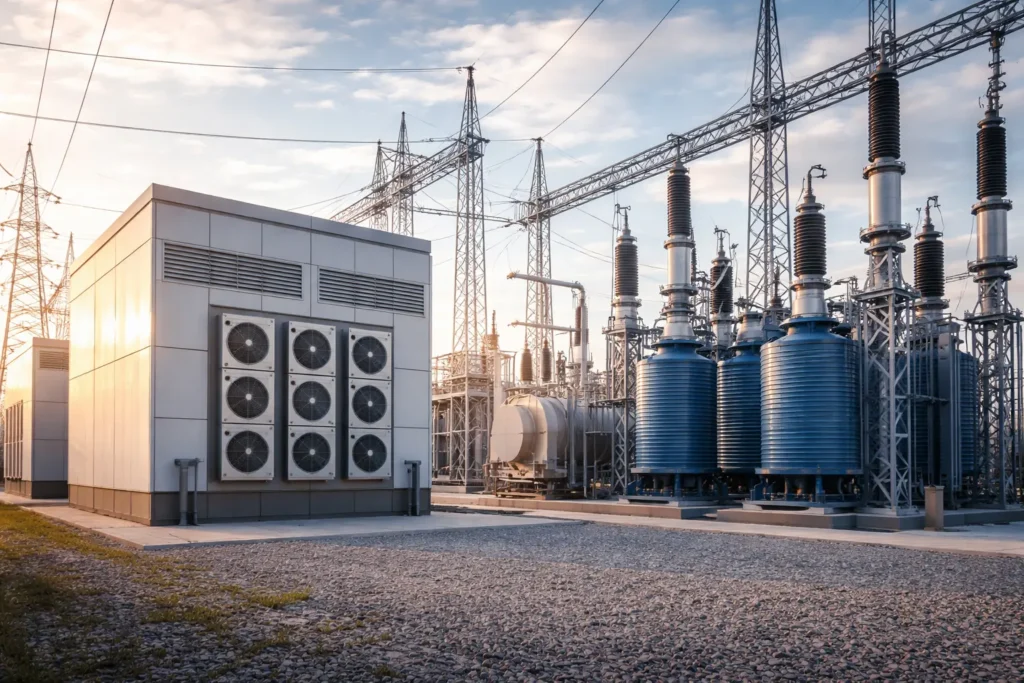
A STATCOM or static Synchronous Compensator is a fast acting device used in power system, which regulates the voltage, provides control over reactive power and enhances the stability of the grid. STATCOM employs a voltage source converter with solid state switches to generate or absorb the reactive power independent of the system voltage. This makes the STATCOM highly effective in weak grid conditions, during electrical fault and during dynamic load changes. STATCOMs are very essential for transmission networks, renewable energy integration and industrial power system where precise voltage control, flicker mitigation and transient stability improvement is critical to reliable operation.
Table of Contents
Core hardware architecture of STATCOMs
Converter system
Modern STATCOM primarily employs Modular Multilevel Converter (MMC) topologies which is a voltage source converter built from a large number of low voltage power submodules connected in series to form each phase leg. By switching these submodules in a controlled sequence, the MMC synthesizes a nearly sinusoidal AC voltage with extremely low harmonic distortion. Each phase consists of two arm, upper and lower. Each arm consists of many submodules and arm inductors for current control.
Each submodule is usually a half bridge or full bridge circuit with IGBTs, capacitors and protection circuits. By selectively inserting or bypassing the submodules, the controller creates a staircase voltage waveform which is very close to sine wave. The IGBTs are selected based on voltage class (3.3 to 6.5 KV), current rating, switching losses and junction temperature limits. The thermal margins are conservatively designed to ensure long service life of the device under continuous reactive operation.
Coupling transformer
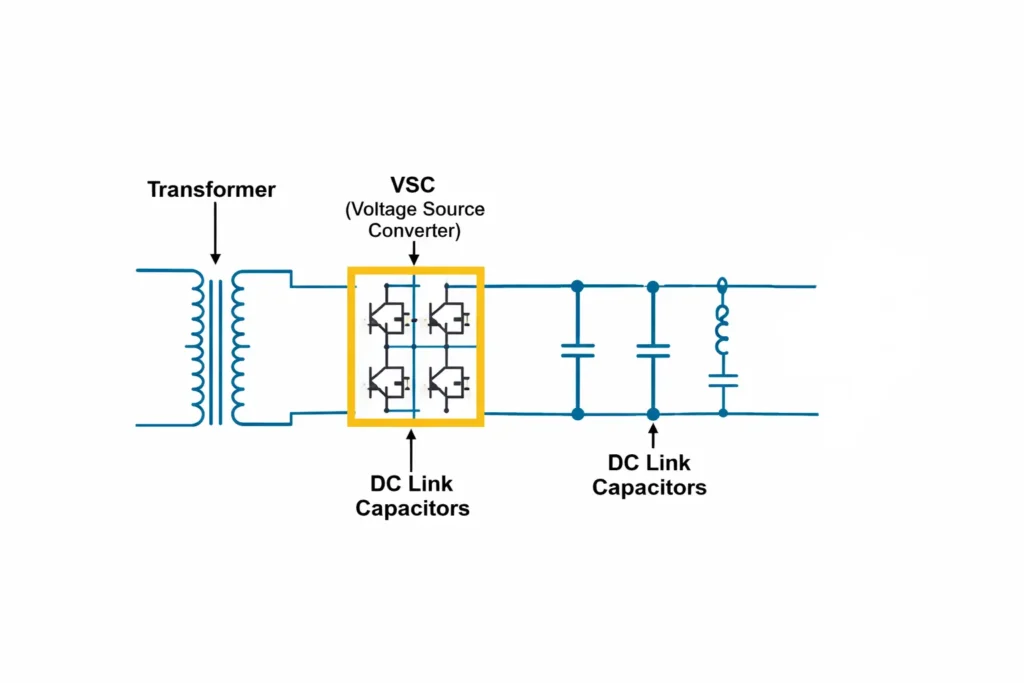
The coupling transformer is designed carefully so that its leakage impedance balances the dynamic response and fault current limitation. Lower the impedance is, higher is the voltage regulation speed, while higher impedance enhances the protection and system stability. The STATCOM converter operates at a lower internal DC and AC voltage level, the coupling transformer steps down the transmission voltage to converter’s operating range. The transformer provides inherent impedance to the high frequency harmonic propagation generated by the converter.
DC link and Energy storage
The DC link is the primary energy buffer of the STATCOM and it is the foundation of the device’s fast and dynamic performance. It connects the voltage source converter to its internal energy storage and provides a stable DC voltage from which the STATCOM synthesizes controllable AC output. The DC link stores the energy to support the rapid changes in reactive current without depending on instantaneous grid conditions. During the transients such as faults or sudden load change, the DC link absorbs or supplies energy to maintain the stability of the converter.
The DC link contains high capacitance DC capacitors, voltage sensors, pre charge and discharge circuits and protection devices like surge arrester, fuses and discharge resistors.
Harmonic filtering and Electromagnetic compatibility control
Harmonic filtering and EMC are the essential design function of a STATCOM, which ensures high frequency switching operation of the voltage source converter do not degrade the power quality or interfere with the surrounding equipment.
The STATCOMs IGBT or power semiconductors switch at a high frequency to synthesize the AC waveform and this generates the switching harmonics, inter harmonic and high frequency electromagnetic noise. Without proper mitigation of these harmonics, it can propagate into the grid causing overheating, faulty operation of protection system and communication interference.
The STATCOM employs coordinated filtering system Viz
AC side filter: It is a tuned LC circuit and high pass filter which absorbs the characteristics harmonics before it reaches the network.
Converter output filter: LCL or multi stage filter which smooths the converter’s output waveform and reduce the high frequency ripples.
Coupling transformer’s impedance: The transformer provides natural attenuation for high frequency components, acting as an additional harmonic barrier.
To control the electromagnetic interference, STATCOM design basically incorporates shielded enclosure and cabling, grounding and bonding networks, common mode chokes and EMI suppressors.
Working principle of STATCOM
The STATCOM is a power electronics-based device which is connected in shunt and is used for fast and precise reactive power control. Its fundamental operating principle is based on a voltage source converter, that generates a controllable AC voltage, which is connected to the main system through a coupling transformer with inherent leakage reactance.
The STATCOM continuously measures the bus voltage and compares it to the set reference value by the operator or automatic voltage regulator. Based on this comparison, the control system of the STATCOM commands the voltage source converter to adjust the magnitude and phase angle of its internally generated AC voltage.
When the converter’s output voltage is higher than the system voltage, reactive current flows from the STATCOM into the grid and the STATCOM operates in capacitive mode, which raises the system voltage. When the converter’s voltage is lower than the system voltage, reactive current flows from the grid to the STATCOM making it operate in inductive mode, thereby reducing the system voltage. Because this reactive current is controlled by the converter’s voltage rather than the system voltage, the STATCOM can deliver full reactive current even during severe voltage depressions. It makes the STATCOM highly effective under weak grid conditions and fault events.
The DC link capacitor maintains the converter’s internal voltage and provides energy buffer which is required for stable operation and rapid control action. High speed digital controller regulates the converter’s switching within milli seconds, enabling the device to respond to system disturbance within one power cycle.
Control and protection architecture
The control and protection architecture of a STATCOM forms a intelligence backbone which enables stable, fast and grid compliant operation under all network condition.
The primary control layer manages the converter switching, current regulation, DC link’s voltage stabilization and harmonic suppression. The secondary layer regulates the system voltage, reactive power, and power factor that enables coordinated operation with other voltage control equipment.
The protection architecture continuously monitors the converter’s current, voltage, transformer’s health, DC link’s condition, and other auxiliaries. It coordinates with the substation relays to ensure selective fault isolation, while maintaining grid support whenever possible.
Advanced fault ride through logic allows the STATCOM to remain connected during voltage disturbances, injecting maximum reactive current to support the grid recovery.
This article is a part of the Energy storage and reactive power compensation page, where other articles related to the topic are discussed in details.