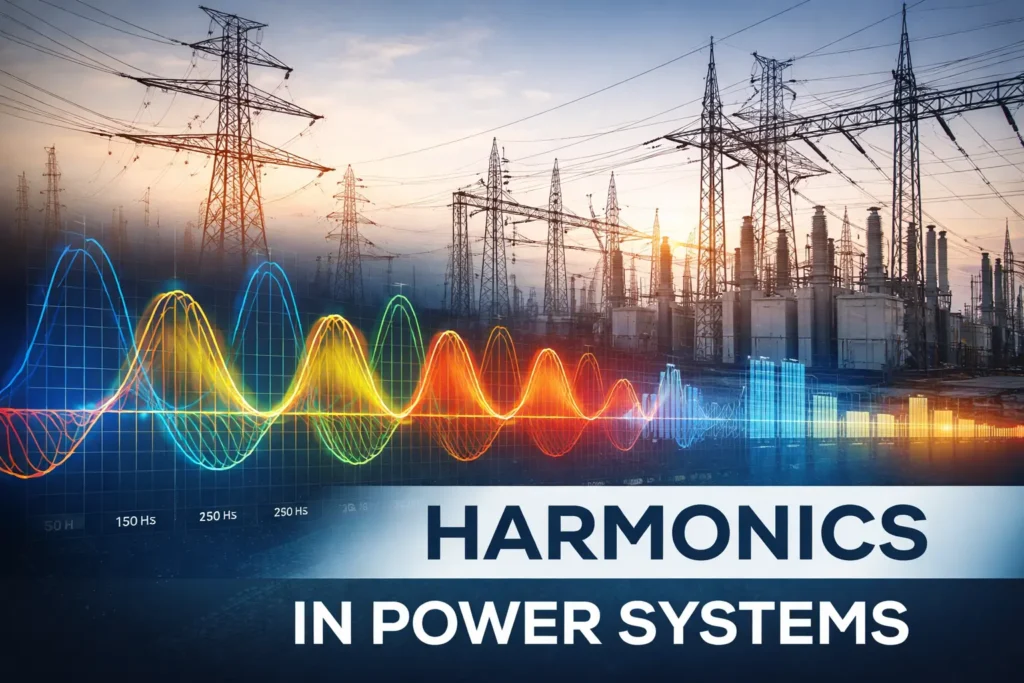
Harmonics are unwanted components of frequency present in voltage or current that are integer multiple of the fundamental frequency. In practical power system, voltage and current waveform are not always perfectly sinusoidal as it contains multiple frequency components in addition to the fundamental. These additional frequency components are integer multiple of the fundamental frequency (50 to 60 Hz), known as harmonics. This component arises in the system because of increase in the presence of non-linear loads such as power electronic converters, rectifiers, variable frequency drives, UPS and FACTS devices.
It inherently distorts the voltage or current waveform which causes undesirable effects to the power system equipment and hampers the operational efficiency. Harmonic components increase the losses in transformer and cables and conductors, causes overheating, produces torque pulsation in machines and can lead to resonance in the capacitor bank. Excessive harmonic distortion can result in protection malfunction and cause interference with the communication system.
Table of Contents
Mathematical Basis and Harmonic order
The periodic power system voltage or current waveform can be expressed as a sum of sinusoidal frequency component using Fourier analysis. The fundamental frequency f1 represents the normal operating frequency of the system (50 or 60 Hz), while the harmonic frequency occurs at a integer multiple of the fundamental.
fh = h x f1, where h = 2,3,4….
Based on the wave form symmetry, harmonics are classified as odd, even and inter-harmonics. Odd harmonics (5th, 7th,11th etc) are the most common in the power system and are typically produced by nonlinear electronic loads. A non linear electrical load is a type of load which draws current unproportionately to the applied voltage even when the supply voltage is perfectly sinusoidal.
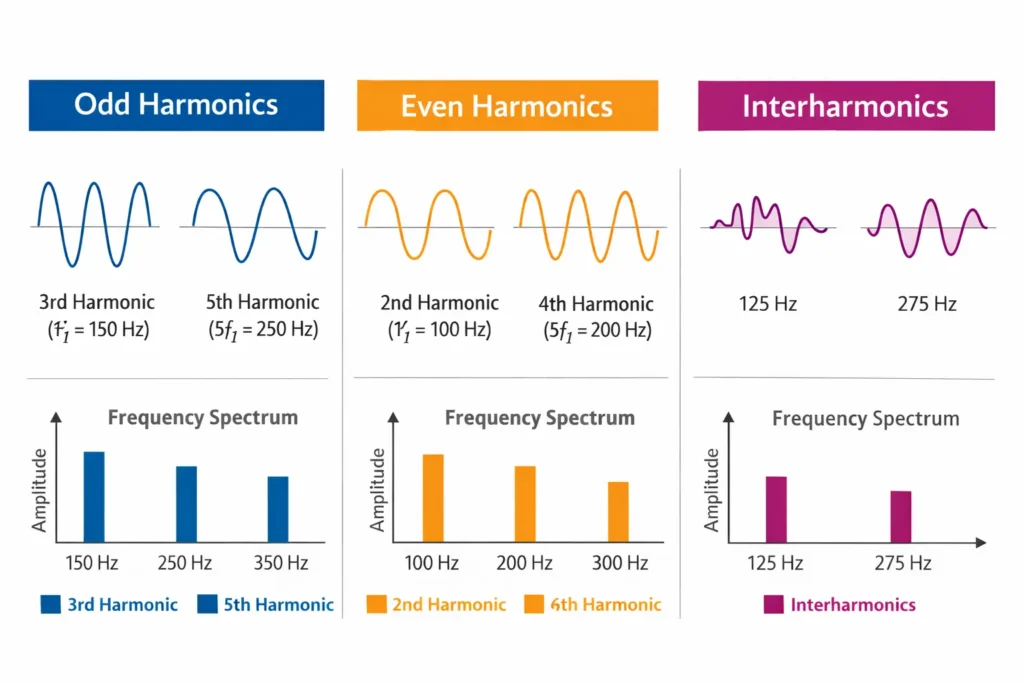
Even harmonics are associated with the waveform asymmetry. Waveform asymmetry is a condition where voltage or current waveform does not have equal positive and negative half cycle often caused because of DC offset, unequal switching or saturation or control imbalance. In a perfectly symmetric AC waveform, the positive and negative half cycles are equal and opposite. This symmetry causes all even harmonics to cancel out when the waveform is decomposed using Fourier analysis and only odd harmonics remain. But, during waveform asymmetry this cancellation mechanism does not works and even harmonics appear in the voltage or current spectrum.
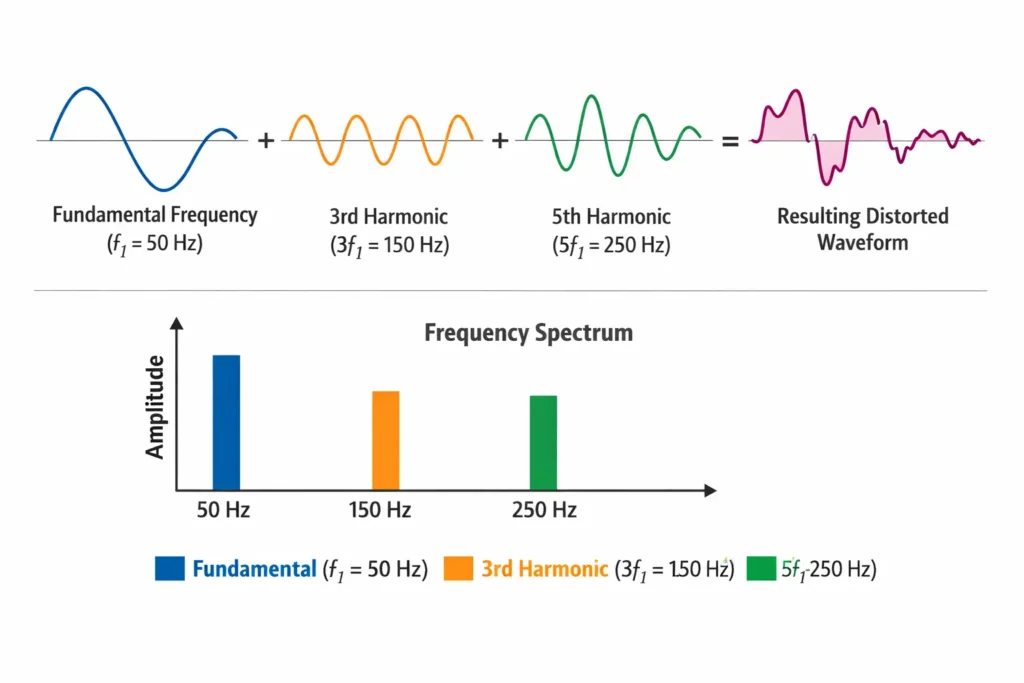
Triplen harmonics are the component which are integer multiples of 3 of the fundamental frequency. These harmonics are zero sequence components in the three phase system as in all three phases these harmonics are in phase, meaning no angular displacement of harmonics between phases. Hence, they do not cancel in the neutral conductor rather adds up arithmetically causing the neutral to overheat and potentially lead to insulation failure.
Major sources of harmonics
Harmonics in power system originates from a wide range of equipment operating across transmission, substation, distribution and consumer level. The popular use of power electronics has made harmonic management a critical design and operational concern.
Transmission level sources
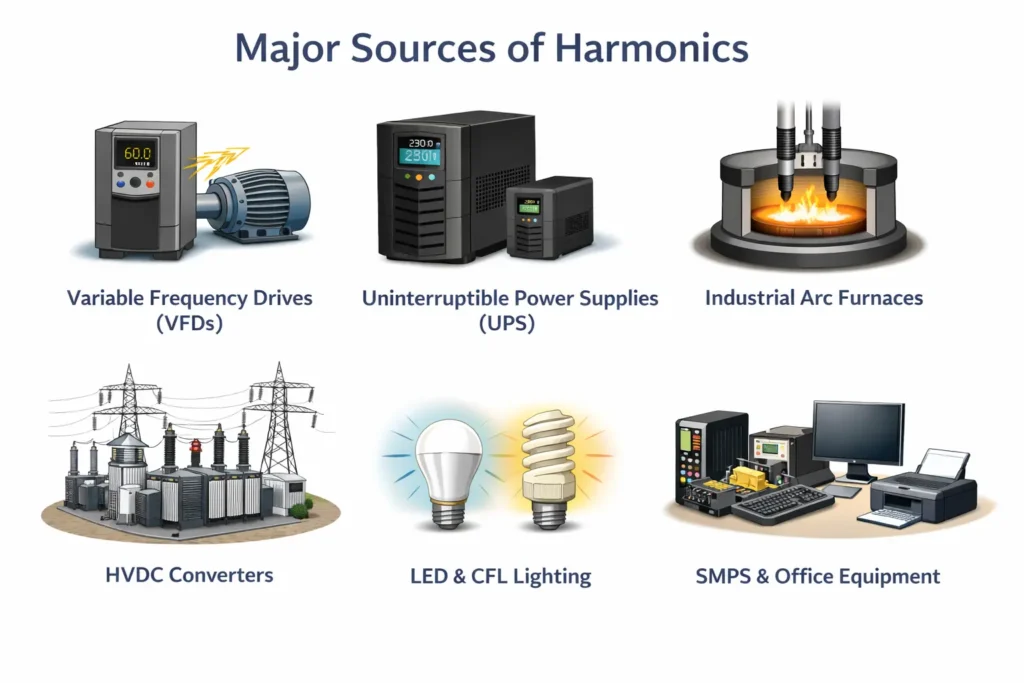
At power transmission level, the HVDC converters generates significant harmonics because of their rectification and inversion processes, which relies on nonlinear switching (at discrete intervals) of power electronics valves. FACTS devices like the static var compensator and STATCOM introduce the harmonics through thyristor switching and converter operation specially during the dynamic control action. The series compensation systems and power electronic controllers used for the power flow control creates both harmonic and inter-harmonics, influencing the system resonance and voltage distortion over wide networks.
Substation and Distribution level sources
The power transformer generates harmonics because of their non-linear magnetizing characteristics of its iron core when it is operating near saturation or under abnormal conditions. The core follows a nonlinear B-H curve, therefore the magnetizing current is non-sinusoidal even with sinusoidal voltage. Odd harmonics, specially the 3rd is dominant and even harmonics also appears when the core has a DC bias.
Harmonics is higher at low loading or no loads because the magnetization current distortion is the highest. During overvoltage conditions, the flux increases beyond the linear region and the core enters the magnetic saturation zone, this saturation causes the magnetizing current become highly peaked and distorted containing strong 3rd and 5th harmonics.
Also, during re-energization of a de-energized transformer, residual flux remains at the core. When energized at an unfavourable point on the voltage waveform, residual flux adds up to the new flux and it can exceed the steady state peak by 2-3 times, this drives the core in deep saturation and results in inrush current rich in 2nd and 3rd harmonics.
Capacitor banks although do not generate harmonics but can form resonant circuits as it supplies capacitive reactance and the transmission line and transformers provide the inductive reactance together; they behave as an L-C circuit. Resonance occurs at the frequency where Xc=XL. The system impedance becomes very high at harmonic frequency, even the small harmonic current can cause a large voltage distortion.
The use of numerical relays and solid state relays induces harmonics in the auxiliary AC supply of the station as these relays are powered by the DC battery banks which are charged by thyristor or IGBT based rectifiers, these draw distorted current from the station service transformers and thus induce the harmonics.
Consumer and industrial load
At consumer and industrial level the variable frequency drives are the most dominant harmonics sources because of the rectifier front ends. The UPS systems, EV chargers, battery energy storage draws high non sinusoidal currents. Data centers and IT loads with extensive use of electronics injects significant harmonic current into the distribution networks often requiring dedicated harmonic filtering.
Effects of harmonics on power system components
Transformers
The harmonic current increases both copper and core losses in transformers. Higher frequency components cause additional I2R losses in the winding and increases eddy current losses in the conductors and structural parts because of skin and proximity effects. The core losses increase because of the hysteresis and eddy current rise at harmonic frequency and flux distortion. Transformers supplying non linear loads are specified using a k-factor or must be derated to avoid overheating. Harmonics also increases audible noise and thermal aging.
Cables and Busbar
Harmonic current intensifies the skin effect and proximity effect, thereby forcing the current to concentrate near conductor surfaces. This raises effective resistance and leads to excessive heating in cables and busbar. Neutral conductor in three phase system can become overloaded because of triplen harmonics. Elevated temperatures increase insulation stress and accelerate aging risking failure. At high current installation with harmonic induced heating, the conductors must be oversized with improved ventilation as a basic safety measure.
Capacitors and Filters
Capacitors are vulnerable to harmonics as their impedance decreases with increase in frequency. Harmonic current can potentially cause overcurrent, overheating the insulation and result in dielectric breakdown leading to premature capacitor failure. Capacitors can also form parallel or series resonance with the system inductance amplifying the harmonic orders to dangerous levels. To prevent this, capacitors are equipped with detuning reactors, essentially introducing a series reactor, thus the inductance seen by the capacitor decreases with increases in frequency, which shifts the resonant frequency away from dominant harmonics typically below 5th.
Electrical machines
Harmonic voltage and current creates pulsating electromagnetic torque . These oscillations lead to mechanical vibration, noise and reduced smoothness. Negative sequence harmonic leads to reverse magnetic field, increasing rotor losses and heating. Overtime, it reduces the machine efficiency, insulation degradation and bearing damage because of circulating current.
System protection control and metering
Protective relays are usually designed to function at fundamental frequency. Excessive harmonic distortion can lead to mis-operation of the relay, inducing false tripping, failure to trip specially in overcurrent and differential protection schemes as harmonic rich waveform can distort the input signals, affecting the magnitude, phase and timing calculations.
Current transformers are very vulnerable to harmonics. High harmonic content increases core flux, potentially driving the CT into premature saturation at normal load currents. This results in distorted secondary currents and thus compromising relay accuracy and coordination, increasing the risk of protection failure during faults.
Digital meters and smart meters rely on digital sampling and signal processing algorithms which are based on assumptions of near sinusoidal waveforms. Harmonic can introduce measurement error leading to inaccurate billing, incorrect power factor calculation, misrepresenting demand and energy consumption.
This article is a part of the Energy storage and reactive power compensation page, where other articles related to the topic are discussed in details.