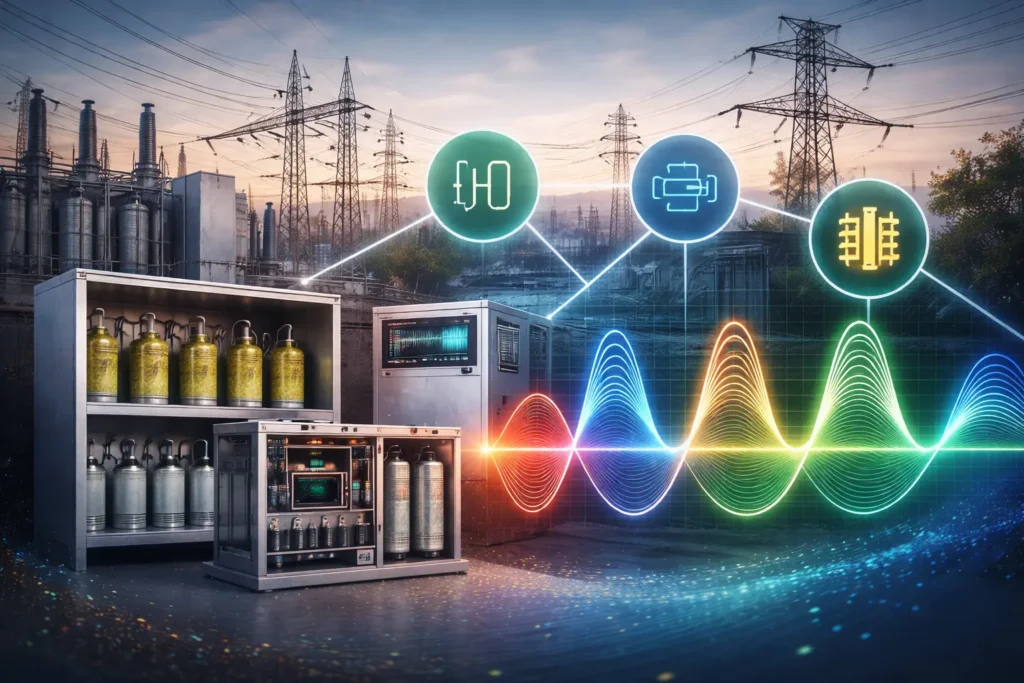
Harmonic mitigation is a critical requirement in modern power system because of rapid penetration of power electronics, nonlinear loads and converter-based systems. Harmonic mitigation focuses on limiting the generation of harmonics, controlling the propagation, and protecting the system assets from the adverse effects of harmonics. This is achieved by a combination of proper system design, equipment selection, active and passive filtering, detuned capacitor banks, phase shifting transformers and advance strategy for converter’s control. Effective harmonic mitigation ensures long term reliability, thermal margin preservation and stable operation of substation and power networks.
Table of Contents
Harmonics Assessment strategy
A structured harmonic assessment is essential for accurate identification of the distortion sources, predict the system behavior and identify resonance risks, and ensure reliable operation of substation equipment by adopting harmonic mitigation measures. The process at substation begins with a top-down approach rather than detailed modelling of every connected load. The study begins with identifying the dominant harmonics sources like STATCOM, Static Var compensator, HVDC converters, renewable energy inverters, arc furnaces and large variable frequency drives.
These sources are then modeled using the manufacturer provided harmonic current spectra or contractual emission envelope. The contractual emission envelope defines maximum allowable harmonic current injection at the point of common coupling, irrespective of internal design. Smaller downstream loads are not modeled individually as their harmonic contribution partially cancels out statistically because of different loading levels, different firing angles and independent switching making the harmonic currents out of phase with each other.
The upstream network is represented using a frequency dependent Thevenin equivalent with attention to minimum short circuit conditions, which produces the highest voltage distortion because of low system impedance. Frequency scan is then performed which plots system impedance vs frequency and helps to detect parallel (high impedance leading to voltage amplification) or series resonance (low impedance leading to current amplification) created by transformers, reactors, and shunt capacitor banks.
Worst case operating conditions are then identified which includes light loading, maximum harmonic injection and all reactive compensation in service. The voltage total harmonic distortion and individual harmonic levels are accessed at the point of common coupling and compared against IEEE 519 or applicable grid codes limits. Where ever the risks are identified, harmonic mitigation measures are then applied.
Harmonic mitigation techniques
Source side harmonic mitigation
Source side harmonic mitigation refers to the technique which reduces or eliminates the harmonics at the point where they are generated, before propagating into the power system. The source side harmonic mitigation is achieved by
Multi pulse converter configuration
Multi pulse converter configuration mitigates the harmonic at the source by phase shifting and cancelling dominant harmonic orders before they enter the network. A 6 pulse rectifier produces strong 5th and 7th harmonics, whereas 12 pulse rectifiers using a +/- 30° phase shifted transformer significantly supresses these harmonic components. 18 pulse system further reduces the lower order harmonics by introducing additional phase shifts and parallel bridges.
Improved converter and inverter design
Harmonic mitigation in modern converters is achieved by advanced pulse width modulation strategies. Higher switching frequencies and optimized control algorithm shapes the current waveform closer to sinusoidal. Space vector pulse width modulation reduces the lower order harmonics while pushing the distortion to higher frequencies enabling easier filtration. Adoption of wider bandgap semiconductor materials like Silicon Carbide and Gallium Nitride enables faster switching lowering losses and improving harmonic performance compared to silicon IGBTs.
System impedance control and network design
The impedance of the system plays a critical role in harmonic performance. Low short circuit strength increases the network impedance, causing harmonic currents to produce higher voltage distortion specially in weak or radial substations. Shunt capacitor banks interact with the system inductance and creates parallel resonance at characteristic harmonic frequency which leads to amplification of current and increases equipment stress. To prevent this, capacitor banks are detuned using series reactors or replaced with tuned filter branch. The reactance tuning and system detuning focuses on shifting resonance frequency away from the dominant frequency rather than exact cancellation.
Passive harmonic mitigation
Tuned harmonic filters
Single tuned harmonic filters are designed to provide low impedance path at specific harmonic orders such as 5th, 7th, 11th and 13th, which diverts the harmonic current away from the network. Quality factor Q which is the ratio of the stored reactive energy in a circuit to the energy dissipated per cycle at resonant frequency. It is a critical selection factor as high Q filter offers sharp tuning but are more sensitive to component tolerance and system changes, while the low Q designs improve the damping and stability. It may also be noted that over time, capacitor aging and temperature effects causes tuning drift which reduces the effectiveness, increasing loss related to heating.
High pass and C-Type filters
High pass and C-type filters provide broadband harmonic attenuation and are commonly applied in EHV substations and HVDC terminals, where multiple harmonics order must be controlled. A high pass filter is basically a capacitor in series with a reactor and damping resistor connected in shunt to the system. At fundamental frequency the reactor offers low impedance but the resistor dominates creating high impedance but at higher harmonic frequency, capacitive reactance decreases and inductive reactance increases, the overall impedance of the LC branch becomes low and the harmonic current is diverted towards the filter and is dissipated in the resistor.
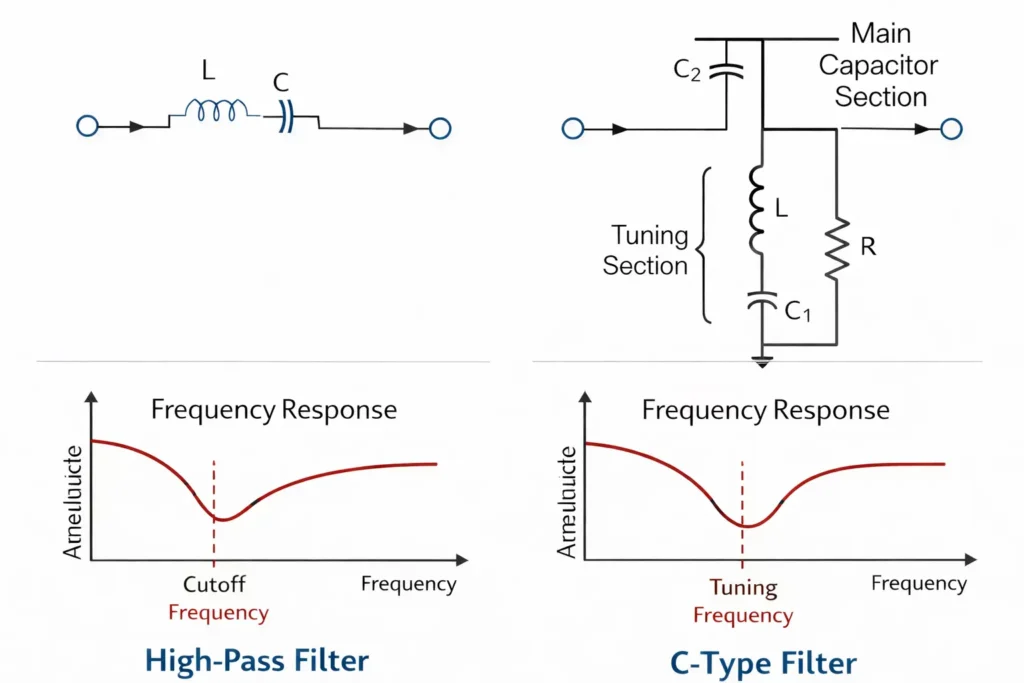
The C-type filter is more advance form of high pass filter which is designed to minimize fundamental frequency losses. It consists of main capacitor and an auxiliary capacitor tuned with a reactor and a damping resistor. At fundamental frequency, the tuned reactor and auxiliary capacitor resonates and the resistor is short circuited resulting in very low losses. However, at fundamental frequency the resonance disappears and the resistor is reintroduced as harmonic current flows into the filter and gets dissipated.
Detuned capacitor banks
Detuned capacitor banks uses series reactor to shift capacitor-reactor resonance below lowest dominant harmonic frequency order with a typical detuning factor of 5.67% to 7% which reduces the effective fundamental frequency reactive power (Mvar) available from the capacitor bank. This reduction in the Mvar output is a trade-off for improved harmonic immunity and system stability.
Active harmonic mitigation
Active harmonic filter
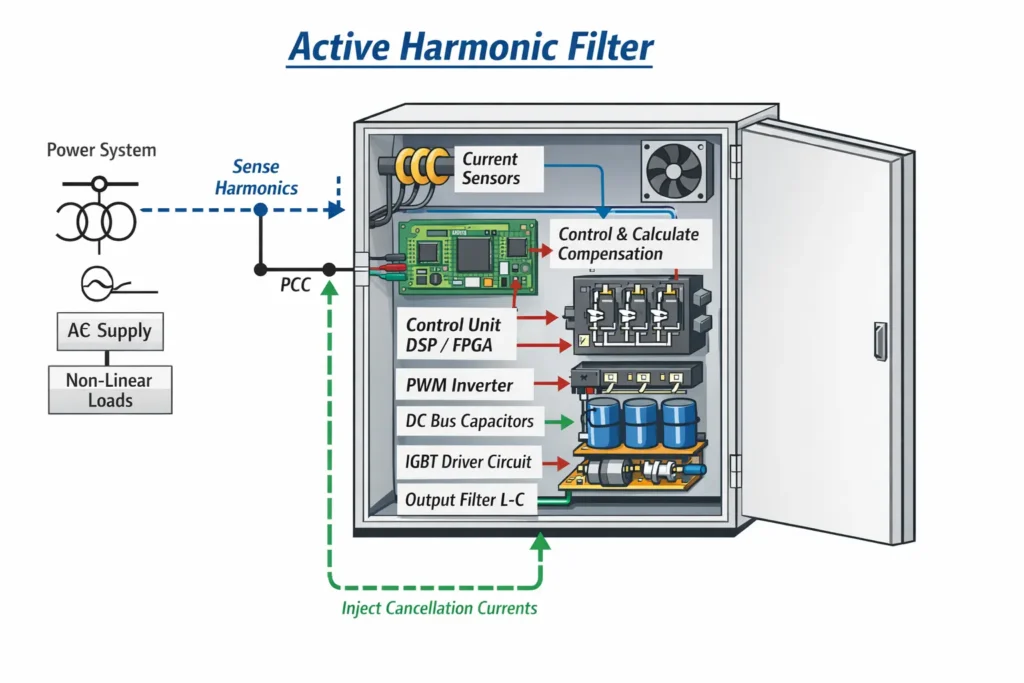
These filters mitigate the harmonic by continuously measuring load current and injecting equal magnitude, opposite phase harmonic currents, there by cancelling distortion at the point of connection. Most active harmonic filters operates in current control mode and directly targets the harmonic currents and is preferred for industrial applications. Voltage controlled active harmonic filters are used where voltage distortion dominates but these are more sensitive to system impedance.
In weak grids with low short circuit strength, the system impedance is high, small injected current causes large voltage drops. The control loop of the active harmonic filter interact with the grid impedance and creates additional phase lag, reduced stability margin and risk of control oscillation, thus facing limitation because of both the control stability and harmonic compensation effectiveness.
Hybrid filter system
This system combines passive filters for bulk harmonic absorption with smaller rated active filters for dynamic compensation and fine tuning. This system significantly reduces active filter rating, losses and cost as passive filter provides the low impedance path to dominant harmonic frequency and absorb large steady state harmonic currents. The active filter is thus reduced to much smaller rating and only targets the higher order harmonics, inter harmonics and load dependent and time varying components, operating at lower current levels and narrower bandwidth, improving control stability.
The passive filter reduces the system impedance at harmonic frequencies, providing inherent damping and it mitigates the converter grid impedance interaction and improves phase margin in the active filter control loop, which improves the stability.
This article is a part of the Energy storage and reactive power compensation page, where other articles related to the topic are discussed in details.
Reference