
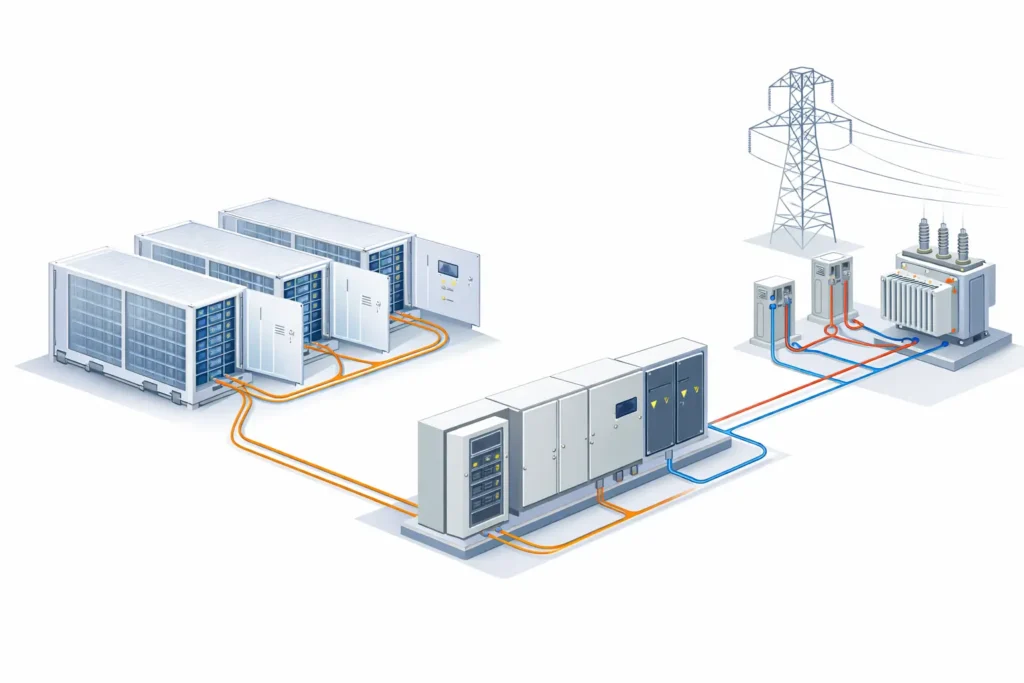
Battery energy storage system is a critical asset to modern power system because it addresses the growing need for flexibility, reliability and efficient energy management. In electrical grids with high intermittent renewable energy integration like solar or wind makes the conventional generation no longer sufficient to maintain voltage stability, frequency control, and supply demand balance. Battery energy storage system provides fast bidirectional power support by storing the electrical energy during low demand or surplus generation and delivering it back as and when required.
The battery energy storage system has a minimum response time in milliseconds making it highly effective for frequency control, ramp rate control, peak shaving and contingency support. The battery energy storage system achieves this because the power flow is controlled by power electronics converters and not via mechanical process. At substation and grid level, the battery energy storage system stabilizes voltage and frequency through fast active and reactive power control, mitigating the power quality issues, smoothing the load fluctuations. By supplying the peak and contingency power locally, it reduces load on transformer, deferring the network reinforcement.
Table of Contents
Working principle of Battery Energy Storage System
The Battery energy storage system fundamentally operates on the principle of storing electrical energy in electrochemical form and releasing it back to the grid when it is required. The operation of the storage system is divided into charging and discharging cycles. During charging, the electrical energy from the grid or a renewable source is converted into chemical energy and is stored within the battery cell. While during discharging the stored chemical energy is reconverted back to electrical energy and supplied back to the grid.
The battery energy storage system inherently stores the energy in direct current form and to interface with the AC grid, a bidirectional power conversion system is used. The power conversion system acts as a rectifier during charging (AC to DC) and as inverter during the discharge cycle (DC to AC). The power conversion system uses high speed bidirectional voltage source converters controlled by digital control algorithms. It independently regulates the inverter’s output magnitude, phase angle and frequency and thus precisely controls the active and reactive power flow.
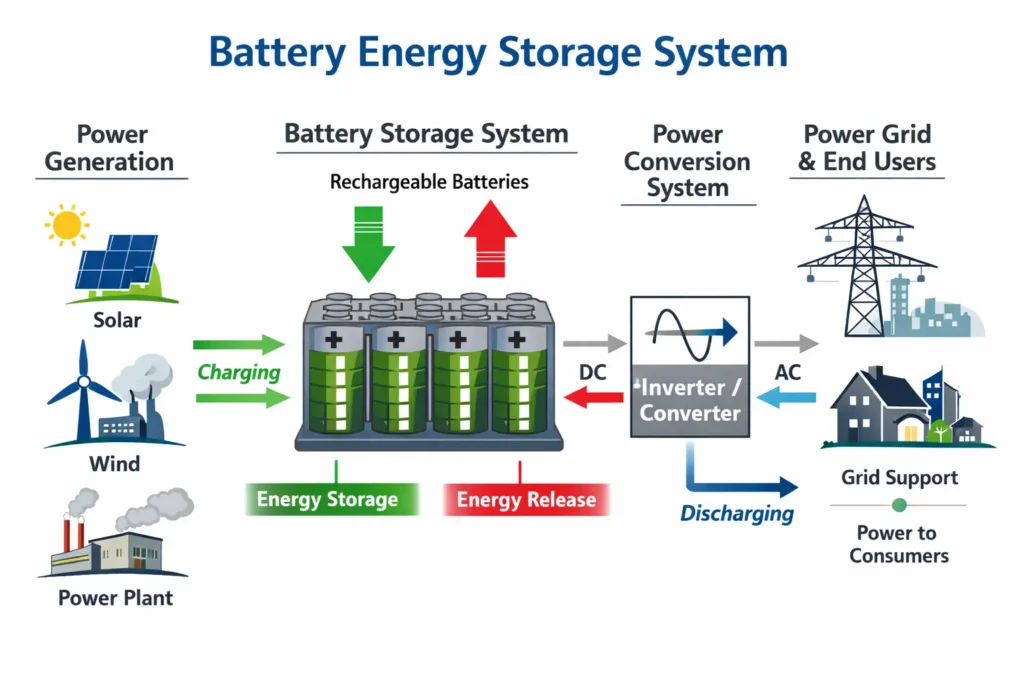
The round trip efficiency of the battery energy storage system typically ranges from 85-95% with modern lithium-ion batteries which is the ratio between energy delivered during discharge to the energy absorbed during charging. The losses mainly occurs in battery chemistry, power electronics and auxiliary system.
Battery technologies used in Battery energy storage system
Lithium-ion battery
Lithium-ion batteries are the most widely deployed battery energy storage systems because it provides high energy density, fast response and modular scalability. The lithium iron phosphate (LFP) cathode offers excellent thermal stability and long cycle life, making it suitable for substations while Nickel Manganese Cobalt (NMC) cathode provides higher energy density for sites with space constraints.
Sodium sulphur battery
Sodium-sulphur battery is capable to operate at high temperatures and are well suited for long duration rated power delivery and are utility grade energy storage with molten sodium anode and molten sulphur cathode. It provides high energy capacity and deep discharge capability with a long service life but requires stricter thermal management and safety controls because of molten sodium operation.
Flow battery
The flow battery (redox flow battery) stores energy in the liquid electrolyte held in external tanks, circulated through an electrochemical cell where reaction creates the electricity. These batteries are ideal for long duration storage applications where energy and power ratings are independently scalable. Flow batteries offer long cycle life, minimal degradation and inherent fire safety but with low energy density.
Emerging chemistries
Emerging battery chemistries aim to reduce the cost, improve safety and address the material constraints. Sodium ion batteries use abundant materials and suit stationary storage, while the solid-state batteries promise higher energy density and improved safety although their commercial viability is still developing.
Major components of the battery energy storage system
Battery modules and containers
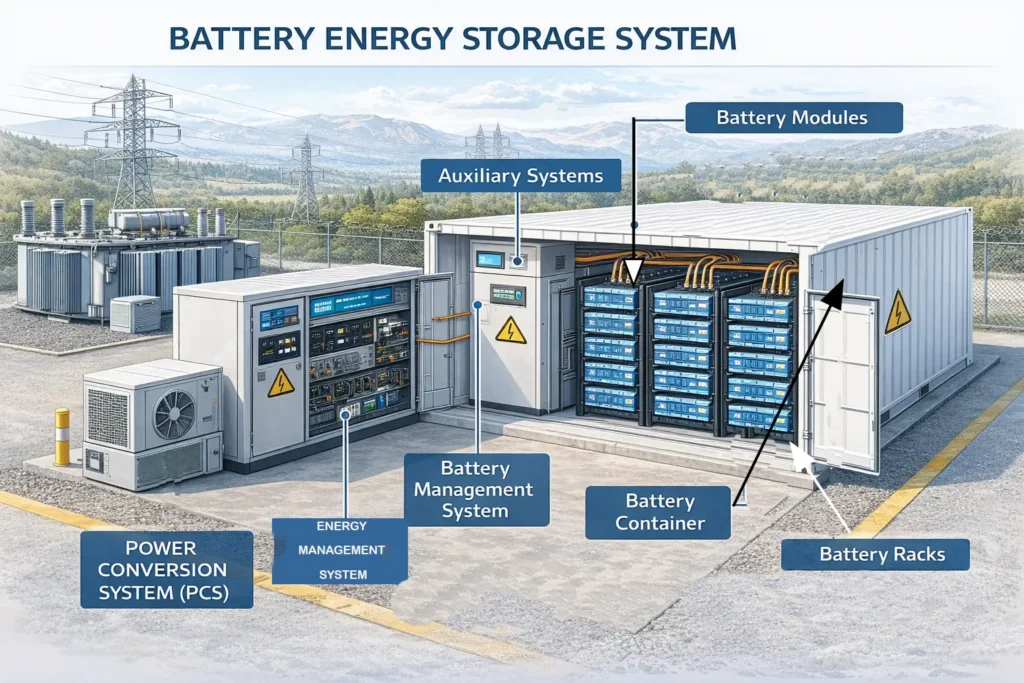
The battery modules are the fundamental blocks of the battery energy storage system which consists of multiple electrochemical cells connected in series and parallel to achieve the required voltage and capacity. The battery modules are assembled in racks to structurally support the cells and facilitate electrical connection and basic protection system. Multiple racks are housed in a container or dedicated building for outdoor substations. This enclosure provides mechanical integrity, environmental protection, electrical isolation and safe maintenance access. Containers simplifies transportation, installation and scalability, while ensuring the necessary layout for thermal management, fire protection, and cable layout.
Battery management system
The battery management system is responsible for safe and reliable operation of the battery. It continuously monitors the cell voltage, temperature, current and state of charge to prevent cells from overcharging, deep discharging and risks of thermal runaway. The battery management system performs cell balancing to maintain uniform performance across modules, thus extending battery life and also provide alarms and interlocks.
Power conversion system
The power conversion system forms the electrical interface between the DC battery system and the AC grid. It performs bidirectional conversion AC to DC and DC to AC during charging and discharging cycles. The power conversion system controls the active and reactive power, voltage regulation and frequency response meeting various grid code requirements. It also provides protection function, harmonic control and synchronization with the grid.
Energy management system
The energy management system is the supervisory control layer which optimizes the battery energy storage system based on the grid condition and asset health. It is responsible to schedule charging and discharging cycles, coordinating with the renewable energy generation and ensuring operational constraints as defined by the battery management system and power conversion system. The energy management system schedules the discharge during peak load period to reduce the demand peak and thus achieving peak shaving. It enables fast automatic power response based on frequency deviation, regulating the frequency and also maintains reserve state of charge, coordinating seamless islanding and load prioritization during grid outages.
Auxiliary system
The auxiliary system supports the safe and reliable operation of the battery energy storage system by maintaining controlled environmental condition. The HVAC system regulates the temperature and humidity for keeping the batteries within the specified operating limits, which directly impacts the performance and lifespan. Fire detection and suppression systems are designed to counter the battery hazards using gas or aerosol agents to mitigate thermal runaway risk. Additionally, the DC power supply for control, lighting and monitoring are essential auxiliary for the system.
Key characteristics
Rated power capacity: It is usually expressed in megawatts (MW), is the maximum continuous electrical power the storage system can deliver under specified operating condition. It defines the system’s instantaneous power capability independent of time.
Rated Energy Storage: It is the total amount of electrical energy that can be stored in megawatt-hours (MWh) also expressed as ampere hour in some cases.
Storage Duration: It is the time duration that a discharging cycle takes before exhausting the battery capacity. Or in other words, it is the length of time, the energy storage system can deliver its rated power continuously from full charge. It is expressed in hours and is the ratio of rated energy storage to rated power capacity.
Depth of discharge: It is the percentage of the battery’s total capacity that has been discharged during a discharging cycle, indicating how deeply the battery us discharged before recharging.
Cycle life: It is the number of complete charge discharge cycles that a battery can perform before its usable capacity falls to a specified limit, typically 70-80% of the original rated capacity. It essentially reflects the durability, aging characteristics and suitability for frequent cycling application.
Self-discharge: It is the gradual loss of the stored energy in the battery energy storage system, when it is not connected to the grid or load. It occurs because of internal chemical reactions or leakage current and reduces the available capacity during idle or standby period.
Discharge rate: It describes how quickly a battery releases its stored energy, typically expressed as C-rate. Higher discharge rate causes increased losses and reduces effective capacity.
C-rate = discharge current (A) / rated battery capacity (Ah)
State of charge: It represents the percentage of a battery energy storage system’s available capacity to its fully charged condition. It indicates how much energy remains in the battery at a given time.
Ramp rate: It is the rate at which the power output of the battery energy storage system changes over time. It is expressed in MW/min or rated power per second. It indicates how quickly the system can increase or decrease power in response to system demand or disturbances.
This article is a part of the Energy storage and reactive power compensation page, where other articles related to the topic are discussed in details.