
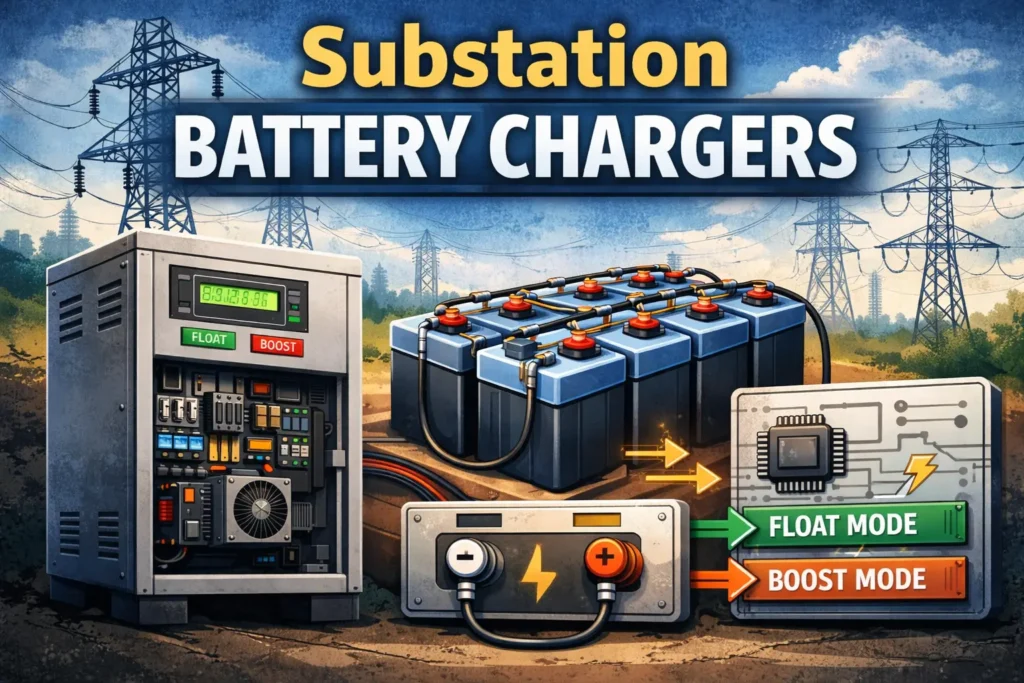
Substation battery chargers are vital component of the substation DC system. The substation battery charger is responsible for providing continuous and reliable DC power for the protection system, the control system and communication equipment available at the substation. Unlike the AC system, which is grid dependent, the DC system in substation must remain operational during grid disturbances, faults and even complete blackouts. The substation battery charger converts the AC power into regulated DC power and supplies the DC loads during normal condition while maintaining the battery bank in fully charged state.
Table of Contents
Types of Substation Battery chargers
Various substation uses various battery chargers and based on operation the types of battery charger can be classified as
Float Charger
A Float charger is a battery charger which is designed for continuous operation in substation DC system. The float charger supplies the entire DC load under normal conditions while also maintaining the battery bank at a constant float voltage. The float voltage is slightly higher than the battery’s open circuit voltage, 2.25V per cell approx for lead acid battery, which ensures that the battery bank remains fully charged without overcharging.
The charger continuously monitors the terminal voltage of the battery and compares it to the float set point which is slightly above the nominal voltage or resting voltage of the battery, when the battery voltage rises to the set value, the charger reduces the output current to very minimum level close to zero which is used to offset the self-discharge rate of the battery and internal losses, thus negating the overcharging phenomenon of the battery. The float charger minimizes sulfation in the lead acid battery and prevents it’s growth and also minimizes its self-discharge. During normal operation, the battery bank remains in standby position and automatically takes over in case of AC input to the charger fails.
Boost charger
A boost charger is a type of battery charger which is used to rapidly restore the battery capacity after a partial or deep discharge. It is used to equalize individual cell voltage of a battery bank and operates at a higher output voltage compared to float charger. Boost charger is normally applied for a limited duration under controlled condition.
The higher voltage forces a controlled charging current into the battery bank, reversing the discharge chemical reaction and rebuilding active material on the battery plates. Boost charging of battery is normally done after outages or during commissioning or as a part of periodic battery maintenance. Boost charging ensures that all cells of the battery reach full charged state and corrects the cell imbalance, improving overall battery performance.
Float cum Boost charger
A float cum boost charger essentially integrates both float and boost battery chargers or charging functions into single charging unit. Under normal operating condition, the charger remains in float mode, supplying the DC load and maintaining the battery at the float voltage. When it is required, this substation battery charger can automatically or manually transit into the boost charging mode for rapidly charging the battery or to perform battery equalization.
After completion of the boost cycle, the charger returns to the float charging mode automatically. The dual mode of this type of substation battery charger offers both long term battery health management and fast recovery after deep or partial discharge events. Float cum boost chargers are the standard configuration in modern substations because of its operational flexibility and reliability.
Construction of float cum boost charger
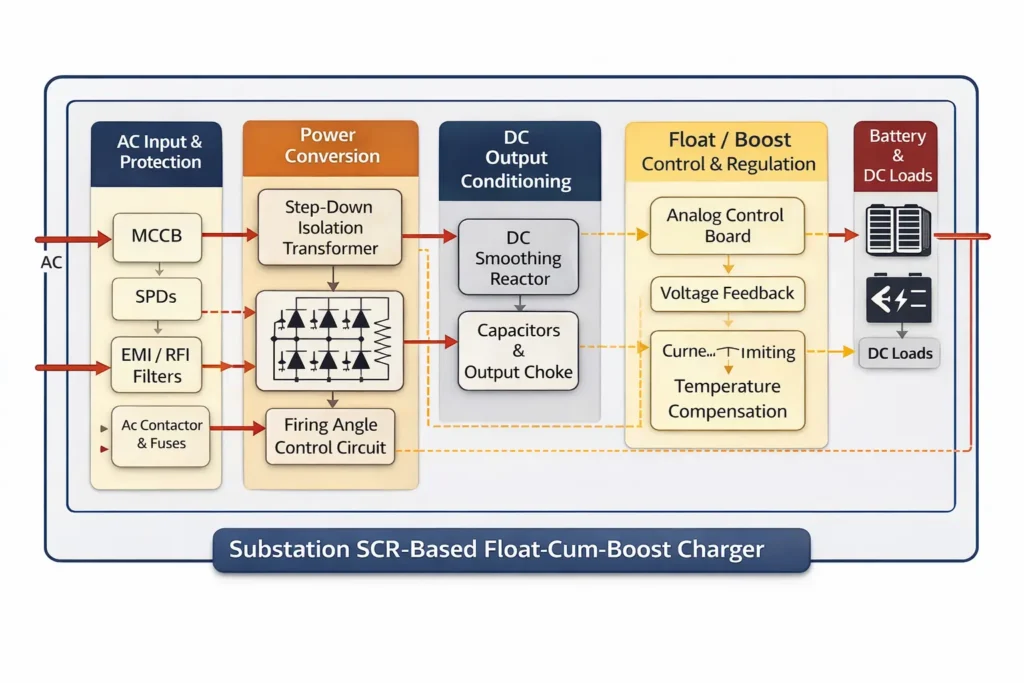
AC Input and protection
The AC incoming MCCB or MCB provides the initial protection against overcurrent and disconnects the AC supply if short circuit or overload occurs, thus preventing the downstream components of the battery charger. The battery charger also houses surge protection device which protects against voltage spikes caused by lightning or switching surges. The EMI/RFI filters limits the noise in the AC mains and prevents the high frequency interference enter the control system. The AC contactors allows for remote or manual switching of the AC supply and the fuse provides the backup protection in case the MCCB fails.
Power conversion
This is the stage where AC is converted to DC for battery charging and DC load supplying. Components of this section are
Silicon controlled rectifiers: The SCRs acts as a switch to control and regulate the DC output voltage. By adjusting the firing angle of the SCRs, the charger can smoothly control the charging voltage and current for both float and float cum boost mode.
Transformer: The transformer adjusts the AC voltage to appropriate level before it is rectified. It provides the isolation between the AC mains and the DC output.
Filter reactor/ choke: It reduces the ripples in the DC output by smoothing the rectified voltage and limiting the current spikes to the battery and connected DC loads.
Control trigger circuit: It provides precise pulses to the SCRs based on feedback from the voltage and current sensors ensuring regulated charging under varying load condition.
DC output conditioning
This section filters and stabilizes the DC output to ensure smooth power delivery to the battery and load. The components of this section are:
DC smoothing reactors: It reduces the DC current ripple and transient spikes, which protects the battery and sensitive relay.
Electrolytic and film capacitors: These provides energy storage and soothes out the voltage fluctuation and helps in maintaining steady voltage for both float and boost mode.
Output chokes and ripple filter: These further reduces the ripples available from SCR rectification providing a stable DC supply for substation protection and control system.
Float or boost control and regulation
This section is the intelligent control unit of the battery charger, co-ordinating float and boost modes automatically. The components in this section are
Microprocessor: It monitors the DC output voltage, current and battery status for implementation of control algorithm to regulate charging voltage and current.
Voltage feedback circuit: It continuously sense the DC output and regulates SCR firing angles, while maintaining accurate float voltage during normal operation and boost voltage during boost charging.
Current limiting circuit: It protects the batteries from excessive current during boost charging by limiting the maximum charging current to safe level.
Temperature compensation interface: It adjusts the charging voltage according to the battery temperature to prevent overcharging in hot conditions or undercharging in cold environments.
The function of this section is to maintain float voltage during normal operation and keep batteries fully charged, switch to boost voltage mode automatically for rapid recharge after partial or deep discharge and limit the current to ensure protection against overcurrent and abnormal conditions.
Besides these sections and functions, the battery charger also has a monitoring and alarm function which monitors the DC output voltage, current and triggers alarm for low DC voltage, charger failure, AC supply failure.
This article is a part of the Energy storage and reactive power compensation page, where other articles related to the topic are discussed in details.