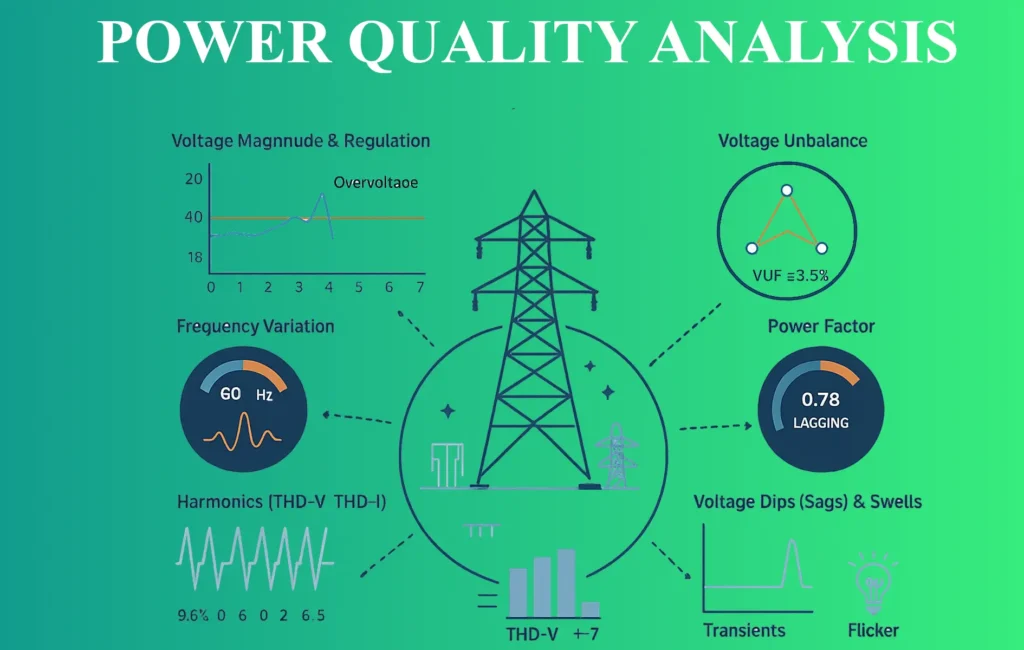
Power quality analysis fundamentally means the measurement and evaluation of disturbance in the power system in order to implement changes for having a stable and consistent power flow allowing all connected equipment operate reliably and efficiently. Power quality analysis is essential because low quality power with interruptions, fluctuations and distortions on the electrical parameters can cause equipment malfunction, reduce the operating efficiency and can even damage the electrical substation components.
Table of Contents
Purpose of power quality analysis
Power quality analysis serves the following functions
Troubleshooting: Power quality analysis data helps in identifying the root cause of equipment malfunction, shutdown, overheating and unwanted tripping often tracing to subnormal electrical parameters rather than mechanical or control failures. By identifying exact nature and timing of the disturbances, corrective actions can be accurately targeted, fixing the issue.
Preventive assessment: Power quality analysis is a great preventive tool. Regular power quality checks and survey helps to establish a baseline of normal system behaviour, which makes gradual deterioration and emerging issues easier to detect. This assessment also complies to international standards like IEEE519 and IEC 61000. By accessing any deviations outside the acceptable limits, utility engineers can address the problem before it escalates to larger issues like equipment damage.
Enhancing efficiency: Poor power quality such as low power factor, high reactive power flow or high harmonic distortion increases the magnitude of the current and adds to system losses as heat. Through detailed power quality analysis, deficiencies can be pin pointed and corrective measures such as power factor corrective devices, harmonic filters can be installed.
Power Quality Analysis of key parameters
Voltage Magnitude and Regulation: Voltage magnitude refers to the close proximity of the supply voltage to the nominal value, while voltage regulation is the variation in the voltage caused by the change in load. If overvoltage is sustained in the network, it will lead to insulation aging and increase dielectric stress on transformers, motors and capacitors. On the other hand, if undervoltage is sustained, it will cause the motor to draw more current to maintain torque and lead to overheating and reduced frequency. Poor voltage regulation across feeders will result in uneven performance and increase technical loss in the power network.
Frequency Variation: Frequency of the system is an indicator of the balance between the generation of power and consumption. Deviation from the nominal frequency affects the synchronous machines, timing circuits and protection systems. Prolonged low frequency can increase current in the motor and transformers leading to overheating, while high frequency can affect the control system and metering accuracy. Too much excursion of frequency affects the overall grid stability.
Voltage unbalance: It occurs when the magnitudes or the phase angle of the three phase voltages are unequal. A small percentage of unbalance can significantly increase the negative sequence current in motors, resulting in excessive heating, vibration and torque pulsation, reducing the motor’s life. In transformers and cable, unbalance increases the losses and loads up the neutral conductor. The unbalance actually indicates uneven phase loading and poor load distribution.
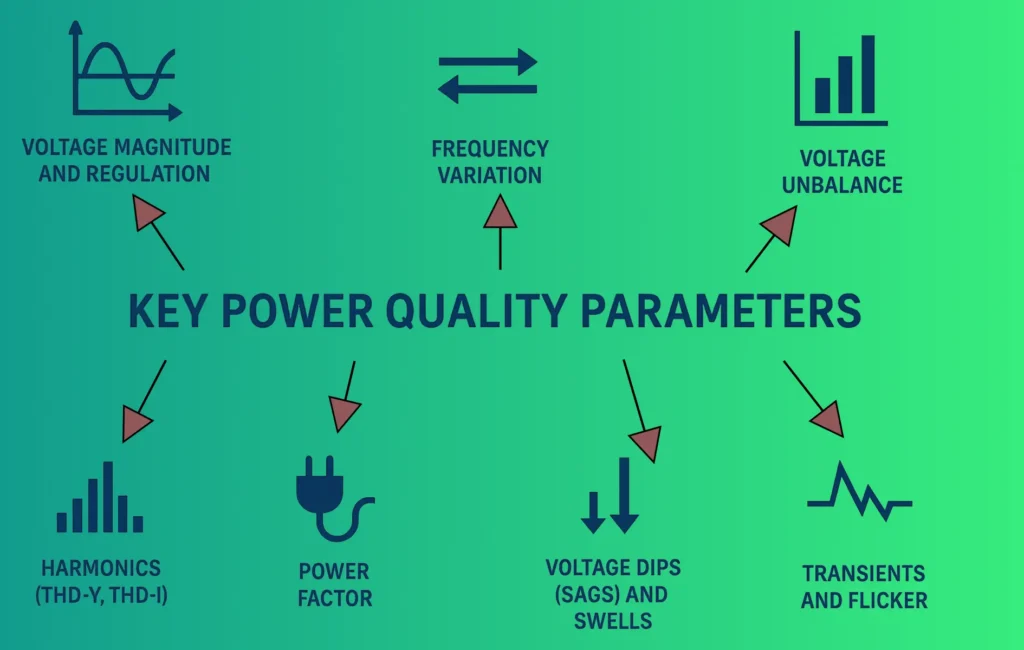
Power factor: Power factor indicates how accurately and effectively the electrical power can be converted to useful work. A low power factor indicates high reactive power flow, which increases line current without delivering useful energy. This leads to I2R loss and voltage drop along the feeders. Poor power factor essentially reduces the capacity of transformer and cable.
Harmonics: Harmonics are voltage and current component at frequencies that are integer multiple of fundamental frequency. Higher the current harmonic distortion, higher is the copper loss, overheating of transformers and motors, the triplen harmonics overloads the neutral conductor. While voltage harmonic distortion affects the control system and electronics as waveform distortion leads to timing error, data corruption. It increases the toque pulsation in motors increasing the mechanical stress.
Voltage Dips/Sags and Swells: Voltage sags are short duration decrease in voltage level, caused by electrical faults or large load change. Brief dips in voltage can cause the contractor to drop, electronics to malfunction. Voltage swells are the temporary increase of voltage when large loads are disconnected or because of control issue in the power network. Both these condition stresses the insulation, equipment failure and disrupt normal operation. These issues are especially sensitive to industrial processes.
Transient and Flicker: Transients are very short duration, high magnitude voltage spikes caused by lightning, switching or even during energization of capacitors. These can damage the insulation, disrupt the electronics and lead to equipment failure. Flickers are the rapid repetitive voltage fluctuation that causes visible light intensify variation. Flickers do not damage the equipment always, however it causes discomfort to the consumers indicating fluctuating load condition.
Power Quality Analysis Techniques
The process of power quality analysis is a comprehensive diagnostic methodology. It is used for transforming raw captured data into actionable insights.
Trend analysis of voltage and frequency: This technique essentially involves plotting the RMS values of voltage, current and frequency over a period of time days or weeks. The voltage current RMS trend shows the daily operational cycle of the facility. Its purpose is to detect the sustained overvoltage (110% of nominal) or under voltage (90% of nominal) which indicates potential issue with the supply side or with the loading side. In substation such evaluation helps to access the effectiveness of voltage regulation equipment like OLTC and capacitor banks.
The frequency trend is essential for evaluating the stability of the grid or local generation. Its purpose is to ensure that the system frequency stays with in the narrow limit prescribed by the national standard as too much deviation affects the downstream loads.
Harmonic spectrum analysis: This power quality analysis breaks down the distorted current and voltage waveforms into individual harmonic components. Instead of looking at the total harmonic distortion, this process identifies the dominant harmonic orders 3rd 5th or 7th with magnitude and source. This is essential for the diagnosis of overheating of transformers, repetitive tripping of protective relays and resonance with capacitor banks.
Phase imbalance Analysis: This power quality analysis measures the symmetry of the three phase voltages and current. By comparing the phase wise magnitudes and phase angles, engineers or substation technicians can pinpoint uneven loadings, faulty connections or asymmetrical feeder configurations within the substation or distribution network.
Event based Analysis: This power quality analysis focuses on the short duration disturbance rather than the steady state. Power quality meters record the voltage sag, swells, interruptions with precise timestamps. Analysing these events help to correlate with the system faults, switching operations, lightning activity helping engineers to differentiate between internal network issue and upstream grid disturbance.
Time of Day and seasonal power quality pattern: This technique lays importance on the varying power quality parameters with time of day and season due to changes in demand, generation mix and environment conditions. Peak hour loading can result in a sustained under voltage and low power factor, while light load period can cause a sustained over voltage. Seasonal factors like heating loads or renewable generation penetration and irrigation loads also influences the power quality behaviour. Power quality analysis hence, helps to plan a better reactive power compensation and network reinforcement.
This article is a part of the Metering page, where other articles related to the topic are discussed in details.