A metering error is basically the difference between measured value and the true value or actual value of the quantity being measured. It represents the failure of the meter or associated system to accurately detect or record the electrical parameters. In mathematical terms, a simple metering error is expressed as
Metering Error = Measured Value – True Value.
Table of Contents
Types of metering errors
The metering error can be classified as Positive error and negative error
Positive error
A positive error in the meter is when it records more energy than is actually consumed. The positive error can be caused because of the following:
CT ratio error (positive bias): It is when the CT ratio is lower than the programmed value, the meter will then receive higher secondary current which will lead to over registration of energy. It is often caused by incorrect tap selection of the current transformer.
PT ratio error (positive bias): If the PT delivers a secondary voltage higher than the rated value, the meter will register this higher voltage magnitude and inflate the energy both active and apparent.
Phase angle error (leading): The phase displacement error in the CT or PT can shift the angle between the voltage and current, which increases the calculated active power. The effect of this error is more pronounced under low power factor operating condition.
As leading means the CT or PT secondary signal leads its primary signal by (δ), therefore this subtracts from the actual voltage current phase angle (ϕ)
Φ measured= ϕ – δ , Since, cos (ϕ−δ) > cos ϕ, this means measured power VI cos (ϕ−δ) will always be greater than actual, causing positive error.
Temperature drift: Elevated temperature can increase the gain of electronic component, subtly amplifying the measured signals and causing over registration of energy.
Harmonic over response: Non true RMS meters can incorrectly register the harmonic components as the fundamental energy which will lead to positive error during nonlinear load distortions.
Incorrect wiring: If the polarity or the phase sequence is incorrect, it can lead to additive vector error, producing high energy reading in normal operating range of current and voltage leading to positive metering error.
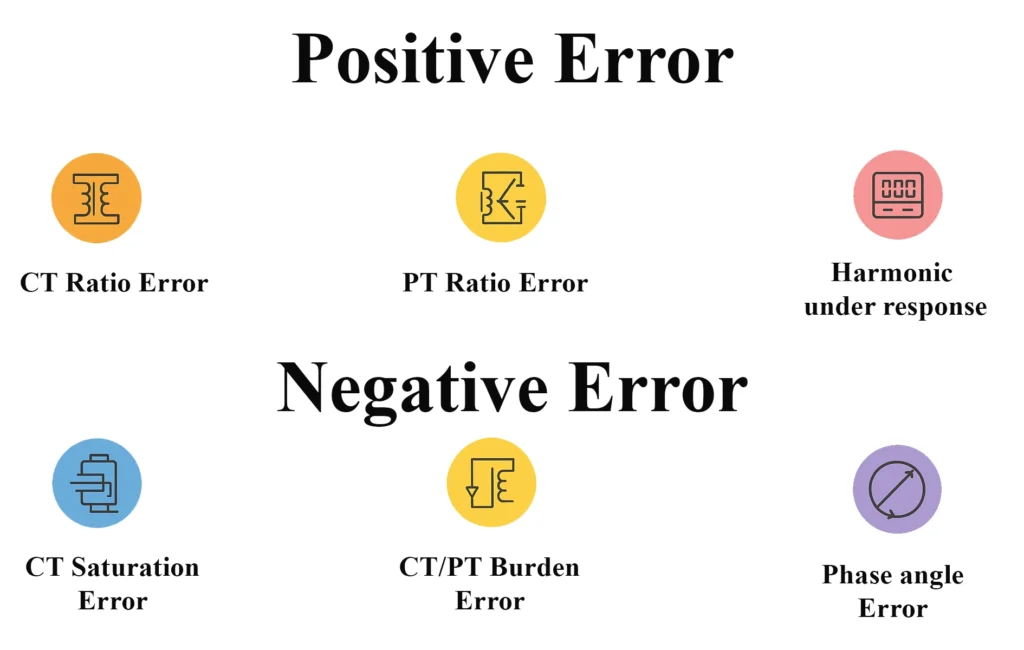
Negative error
Negative error in the meter occurs when the meter registers less energy than is actually consumed. The negative error is caused because of the following:
CT saturation error: At high primary current, the core of the CT saturates which limits the secondary current output. Therefore, low current flows into the meter causing under registry of energy which causes negative meter error specially during the peak load condition.
Excess CT/PT burden: Long runs of secondary cable or poor terminal joints or high burden devices at the secondary reduces the voltage and current levels resulting in lower measured values and under registering of energy leading to negative metering error.
Phase angle (lagging): Lagging phase displacement in the CT or PT increases the angle between current and voltage which reduces the calculated power. This error becomes severely high during low power factor condition.
It means the CT/PT secondary signal lags the primary. It adds positive phase displacement to the actual phase angle. Φ measured = ϕ + δ. Since, cos (ϕ+δ)< cos ϕ, the measured power VI cos (ϕ+δ) is always less then the actual power consumption.
Meter starting current error: When the load current is lower than the starting current of the meter, energy goes unregistered which leads to negative error. It is prominent during night time or during very light loads.
Harmonic under response: During highly distorted waveforms, energy meter fails to register the harmonic components because of sampling and filtering limitation. This leads to under measurement in the system with nonlinear loads.
Aging and component drift: With time the reference voltage of ADC drifts also the component aging reduces the measurement gain which causes gradual under registration of energy even in the normal operating conditions leading to negative error.
Impact of metering errors
Metering error causing over measurement (positive error) or under measurement (negative error) has specific and detrimental effect on billing, loss analysis and grid planning.
Impact on billing: The most direct and immediate effect of metering error is on the financial transaction between the utility and the customer. If the metering error is positive, the consumer is over charged, meaning the customer is paying more than the actual consumption, leading to financial loss of the consumer and dissatisfaction. This can be seen as a short-term gain for the utility but in the long term leads to dispute and loss of consumer trust and can even result in legal action.
For the negative errors, the consumer is charged less than the actual consumption which means a direct revenue loss for the utility. Regardless of the direction, the meter error leads to expensive and time-consuming manual investigation and bill adjustments which increases the operational cost for the utility.
Impact on loss analysis: Utilities compares the total purchased energy to the total billed energy for calculating the system losses. The metering losses are often masked as the non-technical losses which includes energy theft and poor data handling. If the most metering error are negative then the system losses will become much higher and it will be very difficult to distinguish between the technical losses and unbilled consumption. Inaccurate data from meters means higher chances of utility to misallocate the resources in fixing technical loss where as the actual issue lies in the faulty meters.
When the meters at the HT substations are faulty, it leads to high technical losses and can potentially result in inaccurate network planning decisions, distorted load flow and loss studies.
Impact on grid planning and operations: The metering data of energy meter is the primary input to all operational decisions. Metering error compromises the decision making or the ability to manage the grid effectively. It leads to load forecasting errors. Positive meter error results in more power generation or purchase while negative metering error leads to shortage of power or blackouts compromising the grid reliability.
Long term grid planning like building new substations, transmission lines, distribution capacity relies majorly on accurate consumption trends. Metering error can lead to over investment meaning investing in unnecessary capacity building in areas where the consumption was artificially inflated by metering errors. Metering error can also lead to under investment which means failing to reinforce the power infrastructure in areas where the actual consumption is high but meters were under reading leading to over stressing of substation components and transmission lines.
This article is a part of the Metering page, where other articles related to the topic are discussed in details.