
Head end system is the central server platform within the advanced metering infrastructure which controls the central communication and interfaces directly with filed devices and data concentrator units.
The HES in the AMI is responsible for establishing communication session with smart meters, collecting the raw meter data, sending commands and configuration to the meters, and managing the connectivity and security of the meter.
The head end system is the centralized system above the field layer which acts as a gateway between the physical meter and the IT system of the utility ensuring secure and reliable data acquisition.
Table of Contents
Head End System Architecture
The head end system is basically a multi layered communication and device management system that finds its place between the field device and utility IT systems. It essentially includes the protocol and device layers which implements DLMS/COSEM functionality. The Head end system manages the authentication, encryption, and also the communication profile such as RF mesh, PLC, cellular and ethernet.
Besides this, the HES includes communication management and data acquisition functions responsible for scheduling meter reading data and collecting the raw meter data into a buffer before forwarding it to MDMS.
The Head end system can be centralized or distributed.
In centralized HES, all the meters communicate with a single logical system, which simplifies the administration and integration. But scalability and failure at single point is a big issue for very large deployment of centralized HES.
The distributed HES deploys multiple regional, logical head end systems which shares the communication and processing load. This improves the scalability and reduces latency. It resolves the issue of failure at a single point or localized failure making it more suitable for nation wide roll out.
The deployment of the head end system can either be on premise or cloud based.
On premise head end system is installed within the premise of the utility with owned data centers which offers greater control over the data and infrastructure. It involves higher capital expenditure and restricted elasticity.
The cloud-based head end systems leverages the public and private cloud platforms and can scale faster. It supports high availability and faster upgrades while also raises cyber security concerns and dependance on third party network services.
In order to ensure high reliability Head end system is engineered with mechanisms offering redundancy, failover and scalability.
Redundancy is achieved by the active-active server configuration or with active-standby configuration, databases which are replicated and communication interfaces which are duplicated.
Failover mechanism is a system which allows automatic switchover in cases when server or network fails ensuring minimal data loss and restoration of the meter.
Scalability is typically handled by horizontal scaling meaning adding a same server which is identical to the first, using a load balancer which will split the traffic evenly across available server and using asynchronous data processing. In synchronous processing, if one step is slow all the other steps are stopped but in asynchronous processing, if one step is slow, it is moved to a message queue and the other steps are performed immediately. It can make the head end system to support millions of meters without performance degradation.
Core function of the Head end system
Meter discovery and registration: It is the process by which the head end system identifies new meters on network, verifies their identity, assigning logical addresses and gets them boarded the AMI system. The process ensures secure communication with proper device tracking.
Scheduled on demand meter reading: It performs the scheduled meter readings based on predefined interval as opted by the utility as per the billing requirement, load profiling and metering analytics. It also supports reading on demand for troubleshooting and verification. This capability of the head end system enables the timely data acquisition without manual intervention.
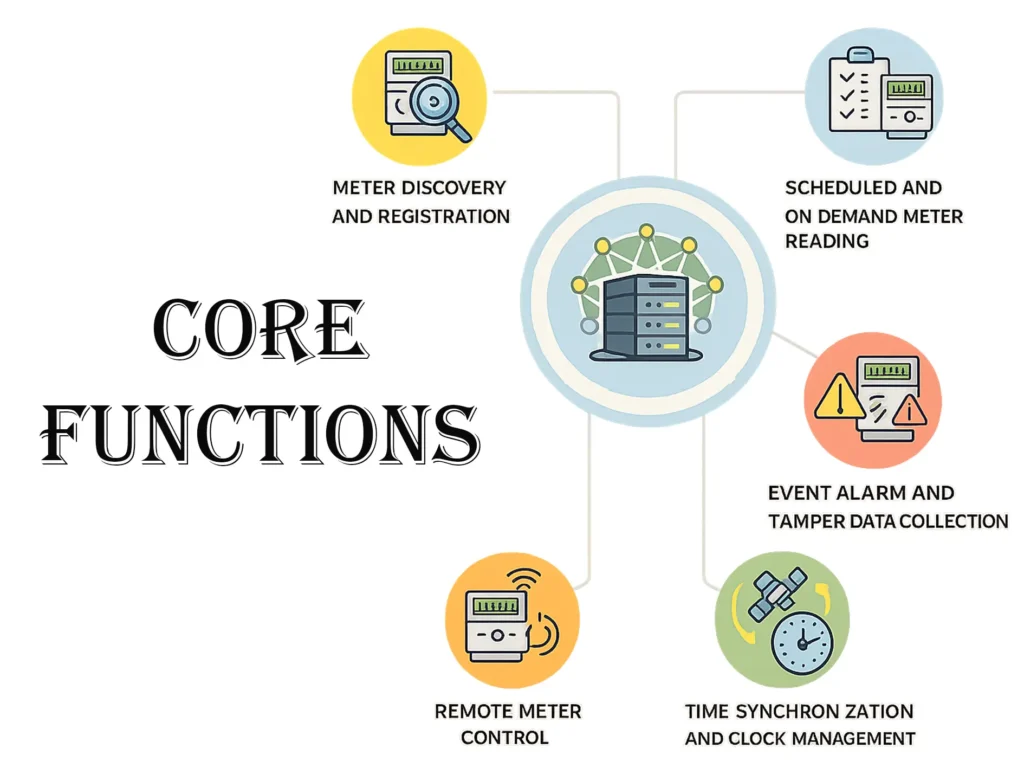
Event Alarm and Tamper data collection: It can collect the non-billing data from the meters like the power failure events, voltage anomalies and tamper alarm from meters as these data provides critical insight to the system health, revenue issues, outage management and supports faster fault identification and restoration.
Time synchronization and clock management: Accurate time synchronization ensures all meter maintain a consistent clock. For achieving this HES periodically updates the meter’s clock to prevent the time drift, which rectifies the TOD billing, alignment of the load profile, and event sequencing.
Remote meter control: Through the secured channel of communication, HES is capable to remotely configure the meter parameters such as demand interval, communication settings. It is also capable to enable control action like remote connect or disconnect, firmware upgrades and feature activation which reduces the field visit of personnel, improving operational efficiency.
This article is a part of the Metering page, where other articles related to the topic are discussed in details.