
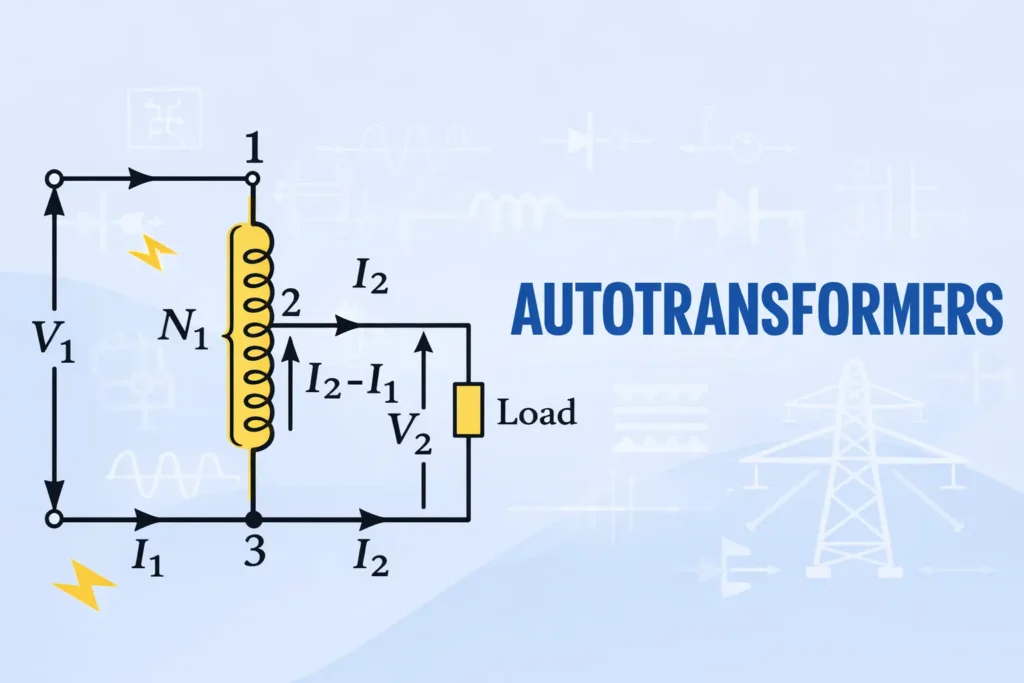
An autotransformer is a special type of transformer, which has a single continuous winding which performs the function of both the primary and secondary windings. A conventional transformer uses two electrically isolated windings for input and output but an autotransformer uses common turns for both input and output. The voltage transformation is achieved by tapping the winding at different points. The transfer of power in autotransformer occurs partly because of electromagnetic induction and partly by direct electrical conduction. This design significantly reduces the copper usage, magnetic core material, size, and cost while improving the efficiency and voltage regulation.
Table of Contents
Principle of operation
Single continuous winding
An autotransformer has one primary winding per phase placed on a magnetic core with a start terminal, an end terminal and tap points in between. The entire winding corresponds to the input voltage and a portion of the same winding is used to obtain output voltage.
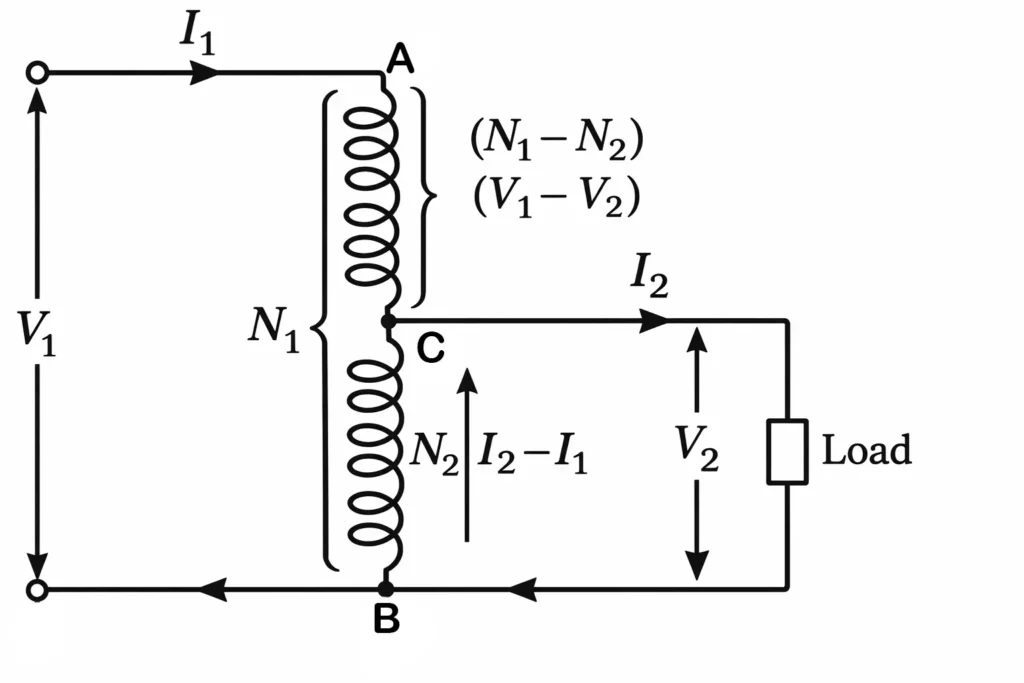
From the above drawing, A-B is connected to the primary supply with voltage V1 and a tap is taken out from point C which corresponds to output voltage V2. When the primary source voltage is applied across the winding, an alternating magnetic field is generated in the magnetic core. This changing flux induces a voltage across every turn of the winding.
Therefore,Voltage per turn = V1/N1
Voltage between A and any tap C becomes, V2 = (N2 x V1)/N1
Since at the load terminal, A-C, there is no supply voltage to oppose the induced voltage V2, it appears across the load.
Tap voltage selection
The output voltage of the auto transformer is determined by the number of turns between the selected tap points. If the full winding has N1 turns corresponding to the input voltage V1 and the tap is taken at N2 turns then the output voltage V2 corresponds to
V2/V1 = N2/N1
Hence, by shifting the tap location along the winding, the autotransformer can provide multiple output voltage levels which makes it suitable for voltage regulation and grid interconnection where voltage adjustment is prioritised.
Power transfer mechanism
The total power transferred through the autotransformer is divided into two components
Inductive power transfer
The inductive component of power flows through the magnetic circuit following the electromagnetic principle same as in the conventional transformers. When the input V1 is applied across the winding A-B, it establishes alternating magnetic flux in the core. This flux links all turns of the winding and induces voltage proportional to the number of turns according to Faraday’s law. The induced voltage across section A-C appears without any direct electrical connection and purely by electromagnetic induction. The part of the load power is transferred via induction as part of the load current flows via the magnetic circuit.
Conductive power Transfer
In addition to induction, the autotransformer allows part of the load current to flow directly from the source via the common section of the winding since the input and output circuit shares the common winding. This part of the load current flowing via the winding makes the part of the load power delivered to the load via ohmic conduction escaping magnetic coupling.
Mathematically Interpretation
V1 = input voltage across winding
V2 = Output voltage across tapped portion
I1 = Input current
I2 = load current
Transformation ratio V2/V1 = I1/I2 = N2/N1 = k
Power input, P in = V1I1 and power output, P out = V2I2
Power output = power transferred inductively + Power transferred conductively.
The apparent power output is = V2 I2, where V2 is the induced voltage across output terminal and I2 is the load current.
Since the magnetic coupling is only up to the tapped position therefore the apparent power inductively transferred is
P inductive = V2 (I2 – I1) = V2 (I2 – k I2)
P inductive = V2 I2 (1-K) = P out (1-k)
Therefore power transferred conductively, P Conductive = P out – P inductive
Substituting the value of PInductive, we get,
P Conductive = P out – P out (1-k) = P out ((1-(1-k)) = P out (1-1+k)
P Conductive = k P out
And P inductive = (1-k) P out
This essentially means that when the voltage ratio k = V2/V1 is very very small as in case of 11/0.4 KV, where k = 0.04/11 = 0.036, the conductive power transfer which is
k P out = 0.036 P out becomes minimum and hence auto transformer is not needed in this case as most power transfer is via the magnetic coupling as it is in the case of conventional transformer.
In cases for 400/220 KV, the voltage ratio becomes, k = 220/400 = 0.55
In this case the conductive power transfer = 0.55 time the output power and inductive power transfer is (1-0.55) which is 0.45 times the power output. Nearly half of the power transfer escapes the magnetic coupling which results in strong advantage.
Autotransformer power transfer vs voltage ratio
| Voltage ratio | Conductive power | Inductive power | Engineering Interpretation | Design Implication |
|---|---|---|---|---|
| 0.10 | 10% | 90% | Almost all power flows magnetically. | Autotransformer offers no advantage |
| 0.30 | 30% | 70% | Magnetic section still dominant. | Rarely economical |
| 0.50 | 50% | 50% | Power split equally. | Strong benefit region |
| 0.60 | 60% | 40% | Majority power bypasses core. | Highly efficient region |
| 0.70 | 70% | 30% | Core handles small fraction of power. | Excellent material savings |
| 0.80 | 80% | 20% | Core & copper dramatically reduced. | Ideal EHV application |
| 0.90 | 90% | 10% | Transformer section very small. | Maximum economic advantage |
| 0.95 | 95% | 5% | Transformer behaves almost like direct connection. | Used only for very close voltage levels |
| 1.00 | 100% | 0% | No magnetic power transfer required. | Becomes a conductor, not a transformer |
Copper saving in Autotransformer
For same output and voltage transformation ratio k = N2/N1, an autotransformer requires less copper than two winding conventional transformers. The volume and weight of copper is proportional to the length and area of the cross-section of the conductor. While the length of the conductor is proportional to the number of turns and the cross-section depends on the current. Therefore, the weight of the copper is proportional to the product of number of turns and current to be carried.
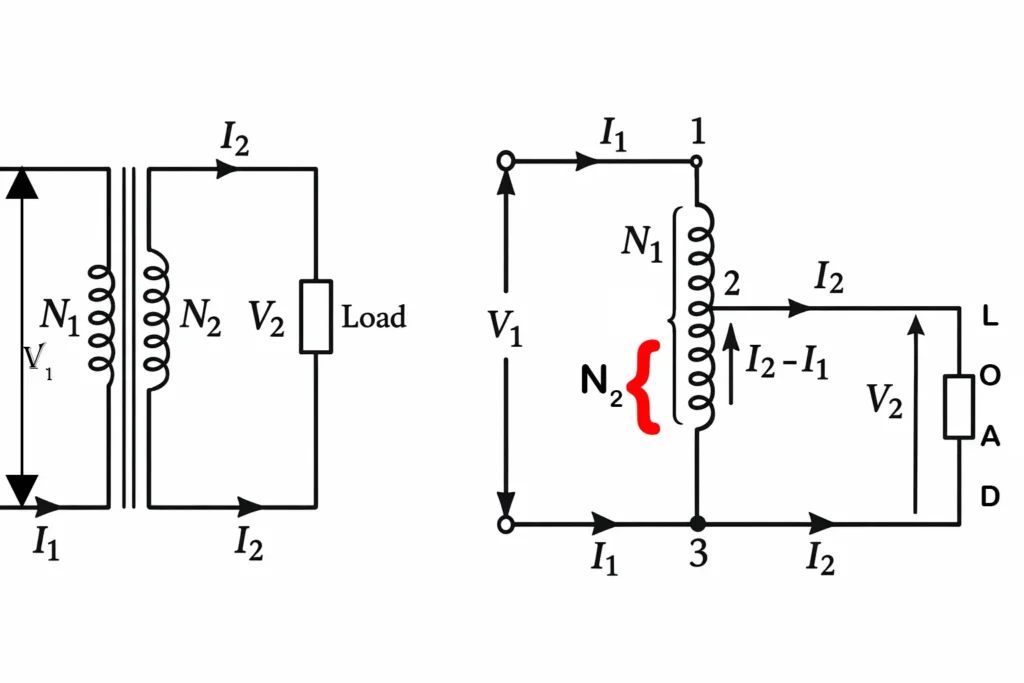
For 2-winding power transformer, weight is proportional to (I1N1 +I2N2)
While for autotransformer, weight is proportional to I1 (N1-N2) in the first section
And weight of copper is proportional to (I2-I1) N2 in the second section
Total weight of copper in autotransformer is proportional to I1 (N1-N2) + (I2-I1) N2
Dividing the weight copper in autotransformer by weight of copper in conventional transformer
= (I1 (N1-N2) + (I2-I1) N2) / (I1N1 +I2N2)
= (N1I1 – N2I2+N2I2-N2I1) / (I1N1 +I2N2)
= (N1I1 +N2I2– 2 N2I1) / (I1N1 +I2N2)
= 1 – (2 N2I1) / (I1N1 +I2N2)
=1 – 2 N2I1 / 2I1N1 [ Since N2/N1 = I1/I2]
=1- N2/N1 = 1 – k
Hence, W Autotransformer = (1-k) W Conventional
Therefore, saving of copper = W Conventional – W Autotransformer
= W Conventional – (1-k) W Conventional [Substituting from above]
= (1-1+k) W Conventional = k W Conventional
Thus, the saving of copper in autotransformer is k times the weight of copper in conventional transformer. This essentially means that for higher voltage ratio, the copper saving is higher.
Advantages
Reduced materials
In most autotransformers only the portion of power is transferred via the magnetic circuit. Hence the magnetic circuit can be designed for much smaller MVA rating compared to the total output. This reduces the core volume and copper cross-section resulting in lower manufacturing cost, smaller size, and reduced weight.
Higher efficiency
Because the power transfer occurs in dual mode, partly via conduction and partly via induction, the copper losses are substantially reduced. Also because of smaller core section compared to two winding transformers, the core losses are also lower. The combined effect makes the operating efficiency 0.5-1 % more than the conventional transformers.
Improved voltage regulation
The autotransformer has inherently low leakage reactance because the primary and the secondary shares a common winding and magnetic path. This results in low voltage drop under load with superior voltage regulation under heavy loading.
This article is a part of the Transformer page, where other articles related to the topic are discussed in details.