
ABT meter is a specialized electronic energy meter that works on Availability Based Tariff system. Other than precisely monitoring and recording the energy consumption, it measures the energy consumption in the four power quadrants and thus is a bidirectional meter.
Table of Contents
What is Availability based tariff mechanism?
The availability based tariff is basically a payment structure or a pricing mechanism which is used for bulk power transactions. It’s main goal is to penalise the participants of grid, that is generator and distribution companies for any diversion from the scheduled commitments, which encourages a stable frequency.
The three components of the availability based tariff in context to ABT meters are
Capacity Charge: This is basically the fixed charge or payment made to the power generation company based on declared availability in MW, regardless of whether the power is drawn. It compensates the fixed costs of the generating plant while incentivizing them to keep the plant available and ready to run.
Energy charge: It is the payment made based on the actual energy generated in MWh which essentially covers the variable cost of power generation. For example fuel costs etc.
Deviation charge: This is the penalty charge levied for the difference between the scheduled power injection and actual power injection. This charge is crucial for grid discipline mechanism which is linked to grid frequency in real time.
The role of frequency here is during low frequency, the power demand is more than the power supply. During this condition, consuming or over drawal of power compared to the scheduled is penalized at high rates while under drawing power or over generating is rewarded at high rates.
During high frequency system conditions, when the demand is lower than the supply, over generating is penalized and over drawing of power or under generating is rewarded.
Core Parameters of ABT meters
15 minute block wise active energy: The ABT meter measures the net energy flow in KWh or MWh in a time block of 15 minutes which tracks the import and export of energy separately. This is the energy which is used to calculate the deviation from the scheduled energy for the time block.
Frequency linked to settlement parameter: The ABT meter records the average frequency of the system during the same 15 minutes time block. It is used as the price signal. The average frequency of the time block determines the deviation charge rates.
Four quadrant reactive energy: The ABT meter measures the reactive energy in both import and export, segregated into registers. It is used to incentivize the grid participants to maintain good power factor and reduce the grid losses and maintain voltage stability.
Instantaneous parameters: The ABT meter also measures the true RMS value of voltage, current, power factor, frequency which helps the grid operators to monitor under or overvoltage conditions, monitor the current imbalances, reactive power drawal and real-time system efficiency for operational awareness. The ABT meter also records the maximum active and apparent demand for 15 minutes time block.
Tamper and Event logs: The ABT meter detects and records specific events with date and time stamps. The events related to voltage missing or unbalance, events related to current reversal, current imbalance or bypass, physical events like meter cover open, terminal open or presence of high magnetic field and guarantees data security and prevents unauthorized manipulation of readings.
Time synchronization: The ABT meter maintains highly accurate real time clock which is synchronized with the external sources like GPS or NTP. It ensures all meters across the grid starts and end their 15 minute measurement block at exact same instant which is essential for fair settlement.
Working of ABT meter
CT/PT input processing and vector calculation: The ABT meter’s operation begins with the acquisition of instantaneous voltage and current signals which are 63.5 V phase to neutral and 1 or 5 A as current transformer input. This analogue voltage and current is sampled continuously at a very high rate (1-4 KHz RMS computation) and converted to digital signals by the ABT meter’s analogue to digital converter.
The microcontroller or a digital signal processor, DSP takes the digital signal and computes the vector calculations to determine the instantaneous active and reactive power for each three phases.
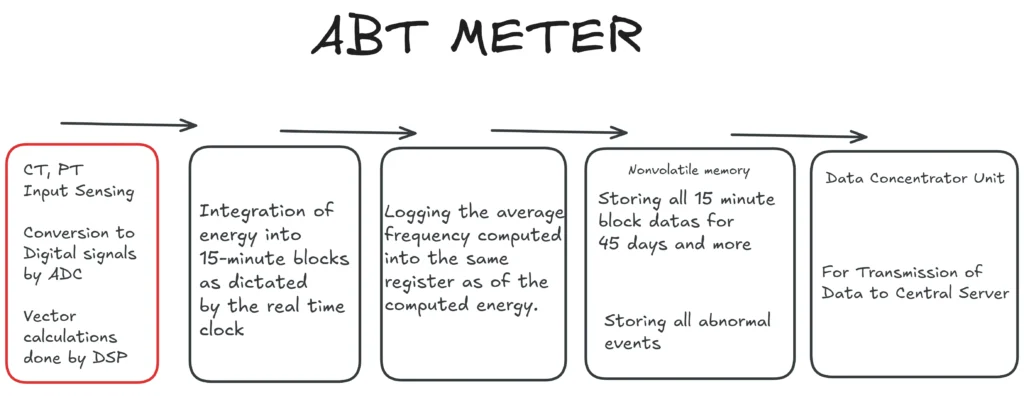
Integration of energy in 15 minute blocks: It is the most critical function of the ABT meter. The DSP continuously integrates the instantaneous power over time to calculate the total energy in all four quadrants. The ABT meter’s real time clock dictates the precise start and end of the 15 minute blocks and at the end of the block, the DSP registers the cumulative import and export of active and reactive energies for the specific block into segregated registers in the memory. The process resets and restarts again for the next time block.
Frequency band for each block: The ABT meter continuously measures the instantaneous frequency of the grid and also calculates the average frequency during the 15 minute time period. This single average coded frequency is logged along with the energy values into the registers in the memory.
Data storage: The ABT meter’s memory is basically a commercial register where the 15 minute block data are stored in a non volatile (flash) memory which can store data up to 45 days or more for backup and audit purpose.
Along with this memory the ABT meter also has a separate tamper proof log record register which is logically separated and often physically separated. This records all the abnormal events with date and time stamps ensuring integrity.
Data transfer: The recorded data is then transferred to the State Load Despatch Center and is integrated with the Automated meter reading (AMR) infrastructure.
The ABT meters at the interface points are connected to the Data Concentrator Unit, DCU via local communication ports like RS-485 or ethernet. The DCU polls the meter’s 15 minute block data and transmits it to the central server located at State Load Despatch Center. The data is often transmitted via fiber optics links or internet. The received data at the central server is then validated and processed via settlement software like SAMAST (Scheduling, Accounting, Metering and settlement system) popular in India for generating weekly and monthly settlement accounts.
This article is a part of the Metering page, where other articles related to the topic are discussed in details.