
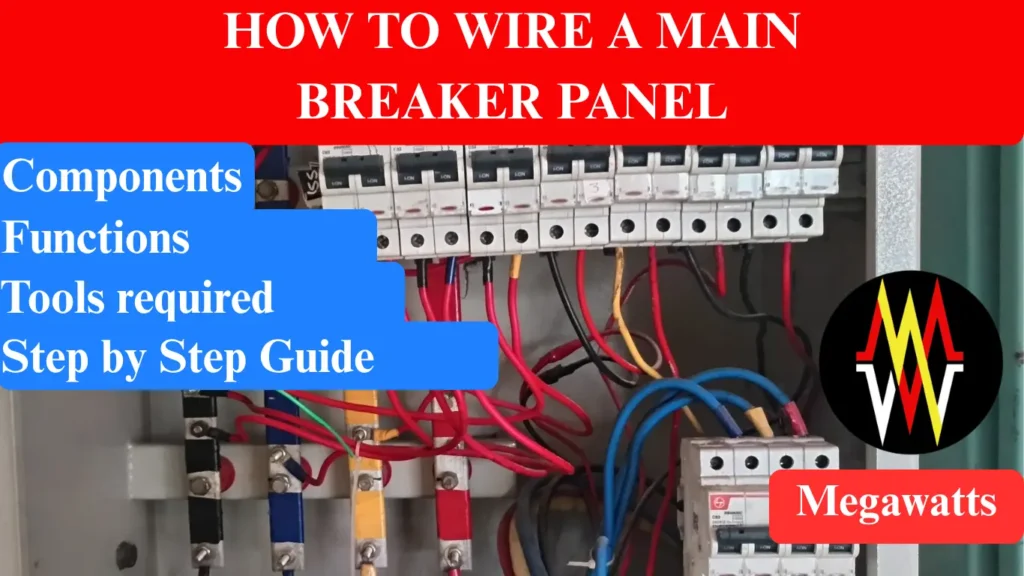
In order to learn how to wire a main breaker panel, it is essential to understand what a main breaker panel is? A main breaker panel or service panel or distribution panel is a junction through which the utility power enters a facility and is distributed to different circuits as present in the panel. The main breaker panel houses the main circuit breaker and various other branch circuit breakers for the branch distribution circuits.
The main circuit breaker controls the power supply of the entire facility, turning it off disconnects all other branch circuits. Where as, the branch circuit breakers are intended for powering individual circuit like lighting, HVAC, etc.
Table of Contents
Components of main breaker panel
The components of the main circuit breaker panel are:
Main circuit breaker: It is the largest circuit breaker in the panel rated the highest typically 100-650A depending upon the load. It provides a single disconnection point for all utility power entering a facility.
Bus bar: The busbar is the junction through which the power gets distributed to various branch circuits. The bus bar connects the main breaker to various branch circuit breakers. The bus bar consists of all the three phases separated by rated air gap along with the neutral bus for the current returning to the source and ground bus which connects to the earthing system for safety purpose.
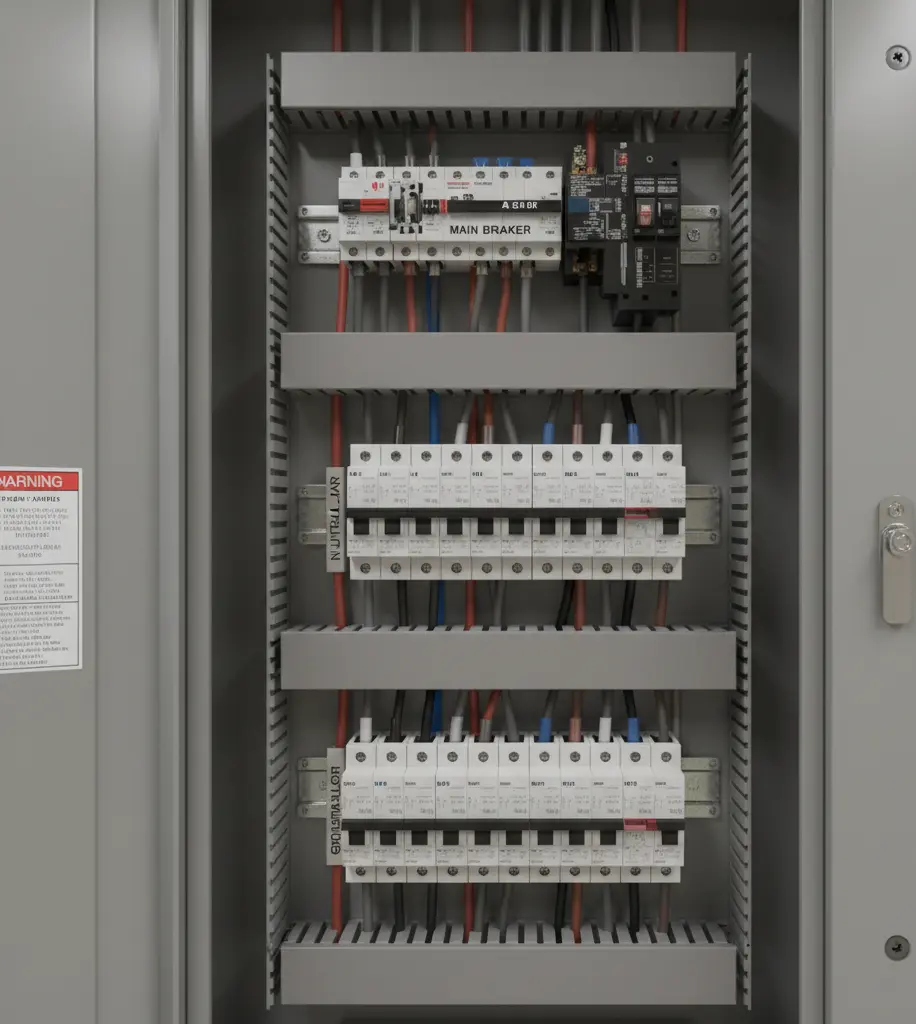
Branch circuit breakers: These are used for the protection of the branched distribution circuit from overload and short circuit, usually rated much below the main circuit breaker. If the branch circuit breakers are not placed in a branch circuit, any fault in that circuit will result in the tripping of the main circuit breaker.
Panel Box: It is basically a metal cabinet that houses all the component inside and provides mechanical protection.
Function of the main breaker panel
The main three functions of the main breaker panel are:
- It distributes the incoming electrical power safely
- It provides protection to all the circuits from overload and short circuit.
- It allows isolation of electricity during maintenance or any emergency.
Learning how to wire a main breaker panel ensures safe power distribution by preventing electrical hazards, and equipment damage.
Tools and Equipment needed
Main breaker panel: While learning how to wire a main breaker panel, careful selection of right panel rating is very essential. The rating of the panel determines the amount of current, the panel can safely handle. Typically rated between 100-650A, the panel provides enclosure to all the circuits, breakers, with safe and organized power distribution in the facility.
Service cable: The service cable connects the utility meter and the main breaker panel, it delivers the utility power to the breaker panel. While learning how to wire a main breaker panel, knowledge on the correct sizing of the service cable be it aluminum or copper for total serviceable amperage is essential. Also proper termination and tightening restricts high temperature at the terminals, reduces voltage drops and ensures safe electrical connection inside the panel.
Branch circuit wires: The branch circuit wires connect the main panel’s branch breakers to the individual electrical loads such as lights, fans, and other appliances. While learning how to wire a main breaker panel, selection of wire gauge based on current rating like 14 AWG for 15 A or for 20 A, 12AWG aluminum wire must be selected for efficient operation.
| Size (AWG or kcmil) | Copper (75°C Rating) | Aluminium/Copper-Clad Aluminium (75°C Rating) |
| 14 AWG | 20 Amps | 15 Amps |
| 12 AWG | 25 Amps | 20 Amps |
| 10 AWG | 35 Amps | 30 Amps |
| 8 AWG | 50 Amps | 40 Amps |
| 6 AWG | 65 Amps | 50 Amps |
| 4 AWG | 85 Amps | 65 Amps |
| 3 AWG | 100 Amps | 75 Amps |
| 2 AWG | 115 Amps | 90 Amps |
| 1 AWG | 130 Amps | 100 Amps |
| 1/0 AWG | 150 Amps | 120 Amps |
| 2/0 AWG | 175 Amps | 135 Amps |
| 3/0 AWG | 200 Amps | 155 Amps |
| 4/0 AWG | 230 Amps | 180 Amps |
| 250 kcmil | 255 Amps | 205 Amps |
| 300 kcmil | 285 Amps | 230 Amps |
| 350 kcmil | 310 Amps | 250 Amps |
| 400 kcmil | 335 Amps | 270 Amps |
Grounding rod and wires: These are used for safely diverting the fault current into earth. While learning how to wire a main breaker panel, connection of ground wire from ground bus bar to the grounding rod must be thoroughly checked. Proper grounding must be ensured for proper safety and ground fault detection and voltage stabilization.
Wire stripper, Screwdriver, Torque wrench, voltage tester: These are the most essential tools and proper usage of these tools will aid in how to wire a main breaker panel. The wire stripper is used to clean the insulation of the wires properly, screwdrivers for tightening the terminals, torque wrench is used for securing lugs in exact specifications and voltage tester is used to confirm the circuits are deenergized before starting any wiring works.
Cable connector, conduit and labels: The cable connector and conduits protect the wires entering the main breaker panel. Proper fittings must be ensured for strain free connection. Wile learning how to wire a main breaker panel. Labelling of circuits must be done as it helps in future troubleshooting, maintenance and also ensures compliance with the electrical standards.
Safety precaution for how to wire a main breaker panel
- Utility power must be turned off first.
- Using a voltage tester, make sure that the lines are not live (no voltage).
- Wear insulated gloves and PPE rated for the voltage level work.
- Follow the local electrical code.
- Try to never work on a live panel.
Step by Step process for how to wire the main breaker panel
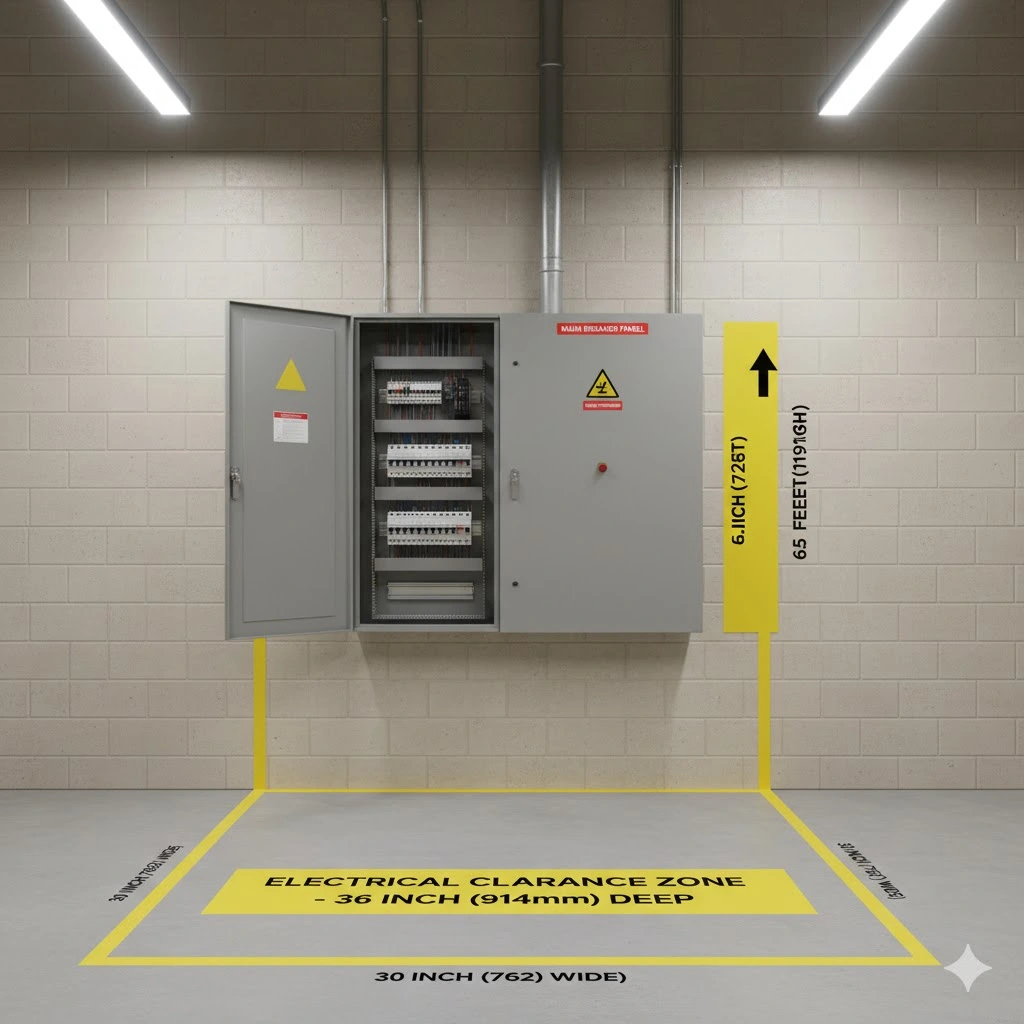
Step 1: Mount the panel securely on a wall near the service entrance of the facility maintaining a good clearance for easy access which is 36 inch (914mm) deep. 30 inch (762mm) wide and 6.5 feet (1981mm) high in front of main breaker panel. The panel door must open at least 90 degrees.
Step 2: For installation of the service cable, run the service cable from the meter box to the main panel via the conduit and connect the phases and neutral line to the main breaker. Bonding the ground wire to the ground bar of the panel. Bonding of the neutral and the ground must be done at the main panel only by strapping the links or installing the bonding screws. It may be noted that in the subpanels the neutral and the ground must remain separate.
Step 4: Connect the Main breaker to the busbar of the panel. Then connect all the branch circuits by running individual circuit cables into the panel. Connect the phase wire to the branch circuit breaker’s terminal and neutral wire to the neutral bar of the panel. Connect the ground wire to the ground bar.
Step 5: Label each circuit breaker like Lighting, AC, etc.
Step 6: Installation of the grounding electrode must be done by driving the grounding rod into the earth near the service entrance and connect the copper grounding wire to the ground bar of the panel.
Step 7: Recheck all the connection thoroughly, ensure that neutral and the phase wiring is proper and not reversed or swapped, ensure the tightness of all terminal connections and then restore the power.
Common mistake to avoid while practicing how to wire a main breaker panel
Mixing neutral and ground connections: Confusing between neutral and ground connection can cause severe hazard while learning how to wire a main breaker panel. It can cause shock, tripping of breaker. Hence special care should be taken in these connections.
Overcrowding wires in one conduit: Forcing multiple wires via one knockout stresses the insulation, increases fire risk and hence must be avoided.
Loose terminal and over torqued screws: Loose terminal connection can cause overheating, arcing. Ensuring proper connection increases the reliability and safety of the panel.
Unlabelled breakers: Unlabelled breakers can cause difficulty in future trouble shooting.
Undersized conductors: Using undersized conductors can cause overheating of the service wires and branched wires leading to insulation failure. Hence selection of wires must be done carefully with respect to the ampere rating of the load.
This article is a part of the Switchgear, where other articles related to switchgear are discussed in details.